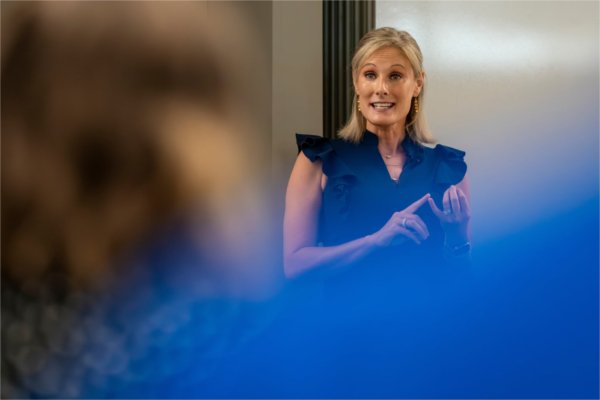
Her keynote focused not on lofty technological
concepts, but on a personal story of how small data points made a
profound impact on a GVSU student’s well-being, reinforcing the
everyday ways that data, when paired with personal insights, can
form meaningful change through action.
Luttenton-Knoll explained that through Blackboard, the
program students use to access course content, faculty can see data
on students’ platform use: how many times they’ve clicked into
course content, assignments they’ve missed, overall time on the
platform and more.
She recalled a time she saw a sudden drop in engagement
from one student in particular on Blackboard’s activity scatter
plot, representing a strong deviation from the student’s normal
behavior. “It was my insight that said, there's got to be something
deeper going on here,” she recalled.
She reached out once via email, as per her typical
process, with no response. So, she reached out again. “My second
message was to the effect of, ‘This is the trend I've seen in you,
and I'm worried. I don't see anything that would be hindering you
from doing the good work you had been doing. Do you need help? Are
you OK?’ And I left it at that.”
Luttenton-Knoll did end up receiving a response from
the student, indicating that the student was experiencing a severe
mental health crisis and had not been going to any classes. “I had
never received an email like this from a student,” she recalled.
“What I can tell you is that that email carried the weight of a
student who was in an immediate crisis and needed help.”
Luttenton-Knoll took action, filing a
CARE
(Campus Assessment, Response, and Evaluation) report
and connecting with the
Counseling Center
. “In less than an hour, we had a network for this
student,” she said. “They had the team they needed to handle this
crisis. The data, analytics, insight and actions had created a
lifeline for this student who may not have had one otherwise.”