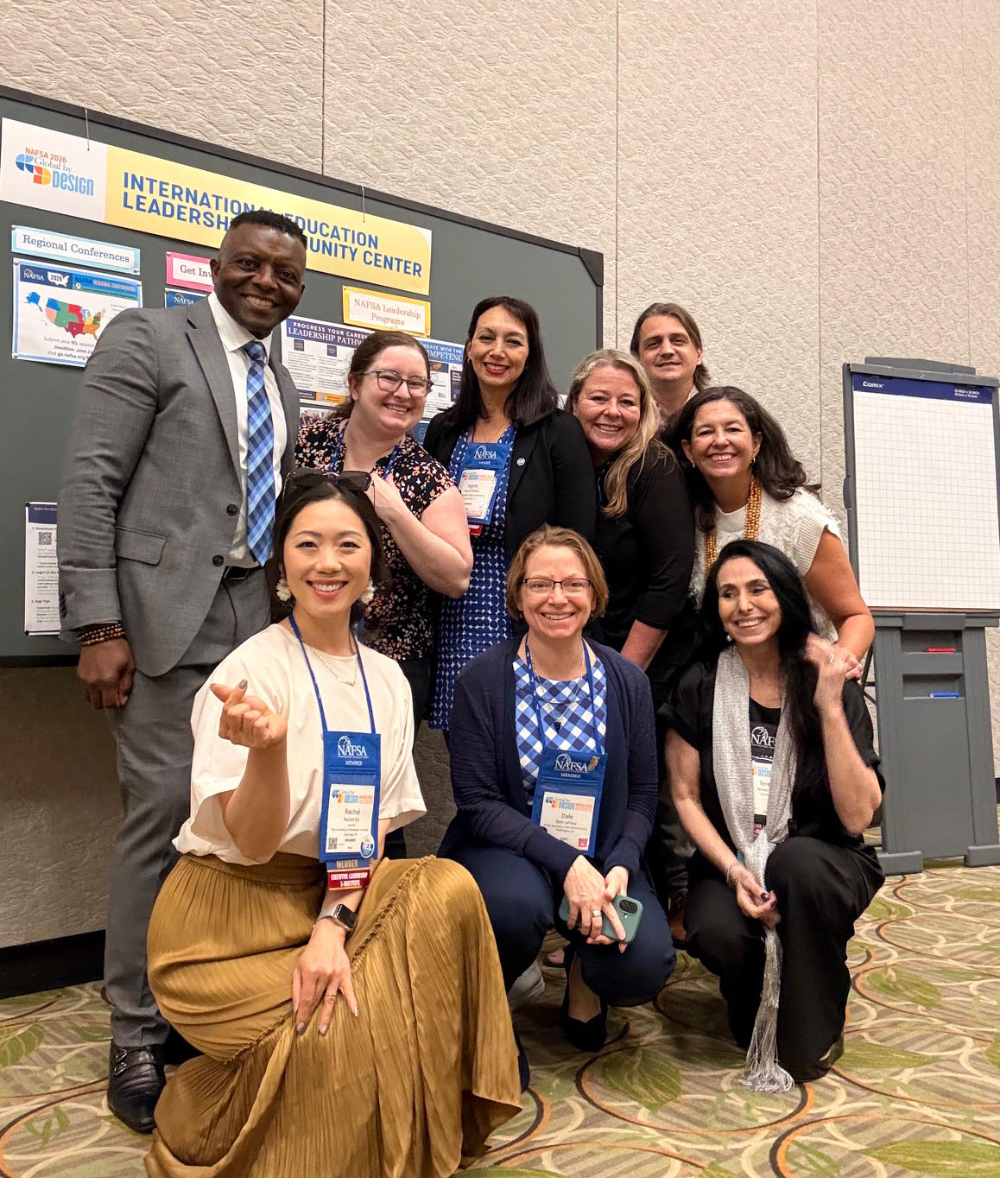
Felix Ngassa, back row at left, stands with colleagues from
the NAFSA Executive Internationalization Leadership e-Institute.
It's been a busy few months for Felix Ngassa. After two years in the
Office of the Provost, Ngassa transitioned to a role as assistant vice
president in the Division of Enrollment Development and College Futures.
Below, the former chair of University Academic Senate and professor
of chemistry discusses how his background and year-long participation
in a NAFSA Executive Internationalization Leadership e-Institute
bridge the fields of academic affairs and enrollment to enhance Grand
Valley's internationalization efforts.
You recently transitioned to work within the Division of
Enrollment Development and College Futures. What are your responsibilities? My role as assistant vice president for International Enrollment
and Academic Partnerships is new and I am in the early stages of
learning the full scope of the work already underway across this
division and the university. At its core, the position sits at the
intersection of international enrollment strategy and academic
affairs, and that intersection is exactly what it was designed to
strengthen and coordinate. I will work to advance Grand Valley's
international enrollment by supporting the global pipelines, pathway
partnerships and institutional agreements that bring students from
around the world to our campus.
Equally important, I will serve as a connector between the Division
of Enrollment Development and College Futures and Academic Affairs:
deepening and extending the collaborative relationships that faculty,
department chairs and academic units have long cultivated as partners
in this work. Grand Valley has talented, experienced colleagues
leading international recruitment and enrollment across Admissions and
Recruitment, the Padnos International Center, the colleges and
Academic Affairs. My job is to help coordinate those efforts, amplify
what is working and bring additional capacity to a strategy that is
already well underway.
International enrollment at U.S. universities has dropped
dramatically. What strategies does Grand Valley have for
international recruitment? The national decline in international enrollment is real, and it
would be a mistake to underestimate the pressure that federal policy
uncertainty around visas and immigration is placing on institutions.
What gives me confidence about Grand Valley's position is that we have
not been standing still. Through this division, in partnership with
Academic Affairs, the colleges and faculty, the university has been
developing a comprehensive international recruitment strategy. It
diversifies our geographic markets, builds new pathway agreements with
institutions around the world, supports faculty engagement in
recruitment and strengthens our capacity to serve international
students from arrival through degree completion. We have multiple
pathway partnerships in active development, reflecting years of
investment by our teams.
One thing that energizes me about this work is the full picture of
what international students bring to Grand Valley, not only as
contributors to enrollment sustainability, but as innovators and
entrepreneurs who enrich our academic community and our regional
economy. We have seen students who came to Grand Valley through
College of Computing partnerships launch startups and secure customers
here in West Michigan — that kind of contribution is what we want to
grow. Our academic strength, our location, our workforce outcomes and
our commitment to student success make a compelling case. The
opportunity ahead is to ensure that story reaches the right global audiences.
You were once an international student. How does that
experience impact your work today? I came to the United States for the first time almost 30 years
ago to pursue graduate studies. That transition shaped everything
about how I understand this work. I know what it feels like to
navigate a new country, an academic culture and a language of
institutional norms, all at the same time and without a roadmap. I
know international students arrive with extraordinary preparation and
ambition. What they need most isn't sympathy. They need a system that
meets them where they are and invests in their success.
That's why one of the central arguments of the comprehensive
internationalization plan that I am developing for Grand Valley, as
part of the NAFSA internationalization cohort, is that equity cannot
be an aspiration — it has to be a design principle. When I think about
the students who will come through our partnerships across Africa,
Asia and beyond, I'm not thinking about enrollment numbers in the
abstract. I'm thinking about individuals who made courageous decisions
to pursue their futures far from home. Grand Valley has the
opportunity to be exactly the institution they hoped they were coming
to. I don't take that responsibility lightly.
How do internationalization efforts benefit Grand Valley? Study abroad, virtual exchanges, faculty partnerships and
international student pipelines only create real institutional value
when they're coordinated toward a shared purpose, not when they're
pursued in isolation as individual programs. Grand Valley has a rich
array of internationalization activities: our Immersive Virtual
Exchange collaborations across Canada, Germany, Hungary and beyond;
our faculty engagement with global institutions; our growing
international student community. What I'm focused on building is the
connective tissue that makes all those efforts reinforce each other.
Our computing partnerships are a good example of what comprehensive
design looks like: a student pipeline, an academic collaboration and a
faculty engagement opportunity all at once. When we bring
international students into the College of Computing, faculty become
invested in their success in ways that enrich the classroom for all
students. And when we engage our own students in virtual exchanges
with peers around the world, they're gaining global competencies
without ever leaving Grand Valley. Every student at Grand Valley,
regardless of their financial means, background or major, deserves to
graduate prepared to engage in an interconnected world. That's the
standard I'm holding this work to.
Participants spent 10 weeks in an accelerator program offered by the DeVos Center for Entrepreneurship & Innovation, in partnership with GVSU's Northern Michigan Region.
Featured
July 14, 2026 (Volume 49, Number 19)
Article by
Shannon Owen