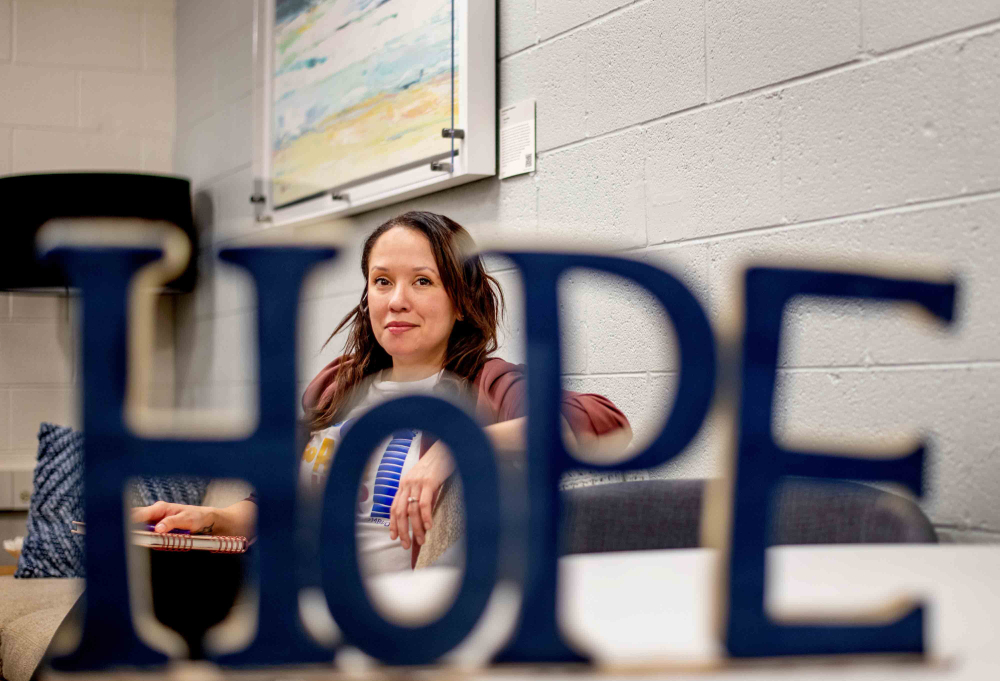
Elisa Ortega-Schultz is Grand Valley’s employee ombuds officer.
Photo Credit:
Kendra Stanley-Mills
GVSU’s employee
ombuds celebrates its fifth anniversary this year. Elisa
Ortega-Schultz, ombuds officer, discusses her role, how it impacts
GVSU and what comes next.
What is an Ombuds? What does the name mean? Ombuds, or the Swedish word “ombudsman,” means representative.
Through ombuds, we get to help faculty and staff navigate conflict in
the workplace.
I usually talk about ombuds as a lighthouse. The lighthouse is
grounded on the standards of practice. All ombuds who are part of the
International Ombuds Association (IOA) have to adhere to four things:
confidentiality, neutrality, independence and informality. I'm a safe
space to help faculty and staff navigate any concerns. So, I sit
outside of others, outside of HR and I'm not a part of any other
formal offices. I get to shine a light on both directions. On one side
of the house, I'm shining the light on resources for you. I can
explain policies and procedures, and make inquiries. And on the other
side, I'm also responsible for shining a light on any systemic issues
at GVSU and can elevate concerns to the president.
How did you get interested in doing this work? My background is a licensed social worker with a master's degree.
I graduated from GVSU in 2010. At the start of my career, I worked as
a therapist in mental health and substance abuse, specializing in
trauma and women's concerns. I was the work life consultant in Human
Resources, where I did preventative and emotional well-being work. My
background fits nicely in this current role, because employees have
life happen to them, too.
I earned another master's degree here in communications in 2020, and
I'm currently working on my Ph.D., specializing in conflict in the workplace.
How does the work of your office align with GVSU’s values? We have GVSU core competencies through Human Resources and the
Reach Higher Together goals, and faculty and staff wellness is central
to the university's mission. Ultimately, we serve students, but to
give students our best, faculty and staff also need to be well and
supported. One part of my role is to help them be well and help them
navigate issues in order to keep the amazing people here at GVSU.
How has your office impacted GVSU? I can't force accountability, but I can shine a light on these
issues. The hope is that folks use our ombuds
reports in different groups — faculty governance or the AP
committee — and advocate for more resources or policy changes, for example.
Currently, I have four working groups where we address issues and
trends. I've worked on some policies with key stakeholders. Working
with these groups across campus as a collective is making change.
What do the next five years of being an ombuds look like? Last year, I was published in the IOA. I wrote a chapter about
how ombuds remain viable and relevant in the future. I interviewed
ombuds from all over the world and had three takeaways: One is that we
need to continuously look in the mirror at ourselves and our practice
and ask what people need from us. We need to be at the table with
leaders and have conversations. And the last one was binocular. We
should be thinking 100 years from now, not just five or 10 years, but
taking a long view of what it looks like to remain relevant and viable
as ombuds officers.
— Cass Wainwright, a student writer for University Communications,
graduated in early May with a bachelor's degree in writing.
Participants spent 10 weeks in an accelerator program offered by the DeVos Center for Entrepreneurship & Innovation, in partnership with GVSU's Northern Michigan Region.
Featured
July 14, 2026 (Volume 49, Number 19)
Article by
Shannon Owen