

Promoting Meaningful Interactions and Multimodal Communication
Ways Students Communicate in the Classroom
Communication in the classroom takes many forms. While spoken words are one way students share ideas, communication can also happen through movement, expressions, writing, and technology. Recognizing different communication methods helps create a more inclusive and accessible learning environment where all students can participate.
Think about the classroom environment. How might students communicate their thoughts, ideas, or needs? You may have thought of the following examples:
- Spoken language
- Writing or drawing
- Gestures or body language
- Sign language
- Facial expressions
- Technology or communication devices
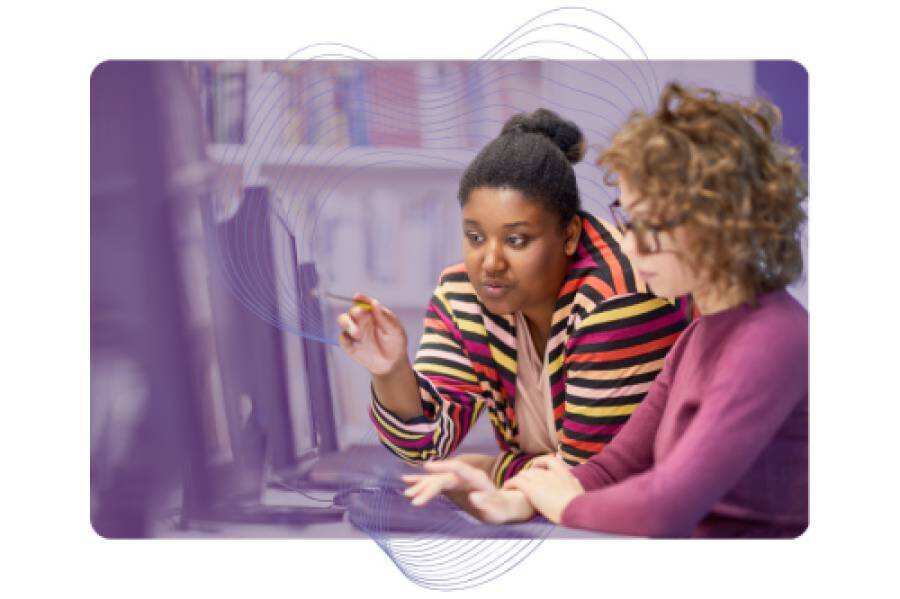
“Paraprofessionals often provide support in inclusive settings, which offer numerous opportunities for students to learn alongside and interact with their peers without disabilities. This places paraprofessionals in a unique and impactful position to facilitate inclusion, advance learning, foster relationships, and promote a sense of belonging for students.”
(Chung, 2022)
Inclusive Communication Matters
There is no “right” way to communicate. Students have different strengths, needs, and preferences when sharing their ideas. Supporting multiple communication methods helps ensure that:
- All students have ways to participate and express themselves
- Instruction is accessible to diverse learners
- Classroom environments are inclusive and supportive
Being prepared to recognize and support different forms of communication is an important part of effective teaching.
The Role of Paraeducator in Promoting Multimodal Communication
Promoting Communication as a Paraeducator
- Always provide communication access
- Encourage inclusive social interactions
- Model AAC usage
- Support group work and collaborative learning
- Provide additional visuals needed to support activity
- Encourage communication attempts
Modeling Communication Partnerships as a Paraeducator
- Be an active listener
- Give response time
- Be patient and respectful
- Ask open-ended questions
- Validate communication attempts
Students communicate in many ways within the instructional setting. Students may express themselves through gestures, facial expressions, movement, sign language, writing, voice or technology. Recognizing these different forms of communication helps create classroom environments that truly honor and celebrate each student's unique cultural identity. By supporting multiple ways of communicating, paraeducators help ensure that all students have opportunities to participate, share ideas, and engage in learning.
Promoting Peer Interactions
Paraeducators often support students in inclusive classrooms where there are many opportunities for students to learn alongside and interact with their peers. During instruction, the curriculum can become a shared experience that naturally brings students together. One important role of the paraeducator is to promote peer participation during learning activities. This means encouraging students to work and communicate with their classmates, rather than relying primarily on adult support.
Participation vs Helping
When supporting interactions, it is helpful to think about the difference between the Participation vs Helping Model.
- Participation Model: Students with and without disabilities come together to engage in shared activities where all students learn together in a reciprocal manner.
- Helping Model: Students without disabilities, often referred to as "mentors", are assigned to peers with disabilities for the purpose of helping students with disabilities.
The Role of Paraeducators in Facilitative Strategies
Paraeducators can use simple strategies to encourage peer interactions during instructional time:
- Ensure students are physically near one another and have access to shared materials
- Encourage academic and social conversations between classmates
- Monitor interactions and provide positive feedback when students engage with peers
Modeling respectful communication and helping students understand different communication styles can also make it easier for students to initiate and maintain interactions with their peers.
Tools and Resources
- National Joint Committee for the Communication Needs of Persons with Severe Disabilities (NJC): Communication Bill of Rights
- The AAC Coach: Multimodal Communication
- Alt+Shift: AAC Fundamentals
- TIES Center:
References
AltShift Education. (n.d.). AAC fundamentals: Quick wins. https://www.altshift.education/index.php/professional-learning/quick-wins/aac-fundamentals
American Speech-Language-Hearing Association. (n.d.). Augmentative and alternative communication (AAC). https://www.asha.org/public/speech/disorders/aac/
Chung, Y.-C. (2022). A guide to implementing paraprofessional facilitation. In E. E. Biggs & E. Carter (Eds.), The power of peers. TIES Center. https://publications.ici.umn.edu/ties/peer-engagement/practice-guides/paraprofessional-facilitation
Kearns, J., & Kleinert, J. (2020). Successfully using communication practices in the inclusive class (TIPS Series: Tip #4). University of Minnesota, TIES Center. https://publications.ici.umn.edu/ties/communicative-competence-tips/successfully-using-communication-practices-in-the-inclusive-class
National Joint Committee for the Communication Needs of Persons with Severe Disabilities. (2024). NJC communication bill of rights (3rd ed.). https://www.asha.org/njc
Texas Education Agency. (n.d.). Honoring communication attempts of students with complex access needs. https://spedsupport.tea.texas.gov/resource-library/excerpts-experts/honoring-communication-attempts-students-complex-access-needs
Therrien, M. C. S. (2022). A guide to supporting peer interaction for students who use AAC. In E. E. Biggs & E. Carter (Eds.), The Power of Peers. TIES Center. https://publications.ici.umn.edu/ties/peer-engagement/practice-guides/peer-interaction-aac
START presents these resources for informational purposes only; no endorsement or recommendation is expressed or implied. Any use of these materials must be premised on the user's own professional judgment as to the appropriateness for their district, community, and student(s), and be undertaken in accordance with all applicable district policy.