

Print and Drawing Cabinet: Calligraphy
Calligraphy is the art of handwriting, where letters are carefully crafted with deliberate strokes, rhythm, and style to create visually expressive text. It has deep historical roots, appearing in ancient civilizations such as Ancient China, where brush writing became a highly respected art, and in the Islamic world, where intricate scripts developed alongside religious texts. In medieval Europe, calligraphy flourished in hand-copied manuscripts before the invention of the printing press, preserving knowledge and culture through skilled, decorative writing.
The Grand Valley State University Art Museum has a wide range of both historic and contemporary calligraphy. Much of the contemporary calligraphy is from Grand Valley State University professor, calligraphist, philosopher, and author Peimin Ni. Ni has published several books on various philosophers and has produced a television program on the art of Chinese calligraphy.
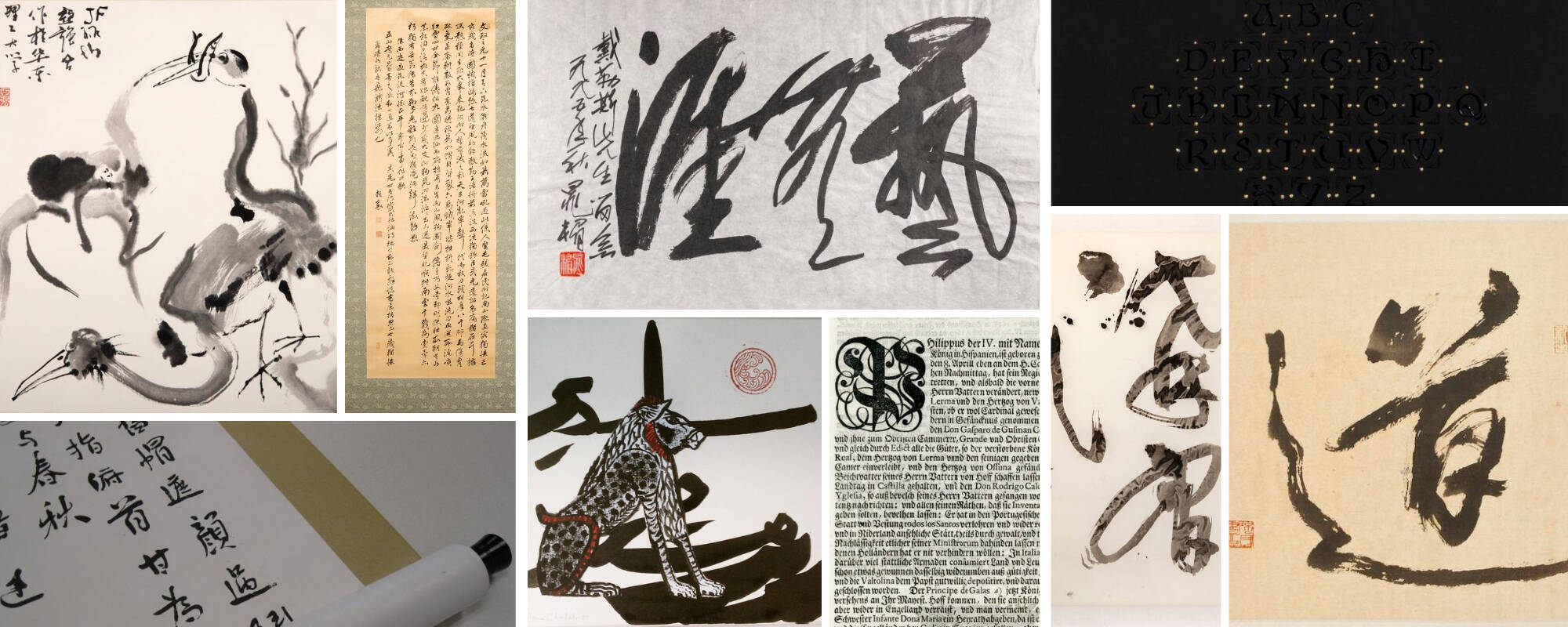
Header Images
Left
Yaqiang, Cranes and Birds, ink on paper, 1996, 2000.343.1.
Otsuka Kogeisha, Bunsei No Gan (Based on Original Painting by Sanyo Rai), ink on silk, 2022.23.2.
Lu Xun, Self Mockery, reproduction ink on paper, 2011.11.1.
Center
Chao Mai, Art Has No Limitation, ink on paper, 2022.19.2.
Rana Chalabi, Egyptian Phantasies: Monkey, ink on board with collage, 2009, 2012.43.1.
Artist Unknown, Persian Calligraphy with Illustration, print, ca 1600, 2020.1.387.
Right
Janet K. Kasper, Noir Nouveau, ink on paper, 2012, 2012.107.1.
Peimin Ni, Speaking and Learning, ink on rice paper, 2005, 2005.319.1b.
Peimin Ni, Tao (The Way), ink on paper, 1996, 2000.073.1.