

Medium: Photogravure
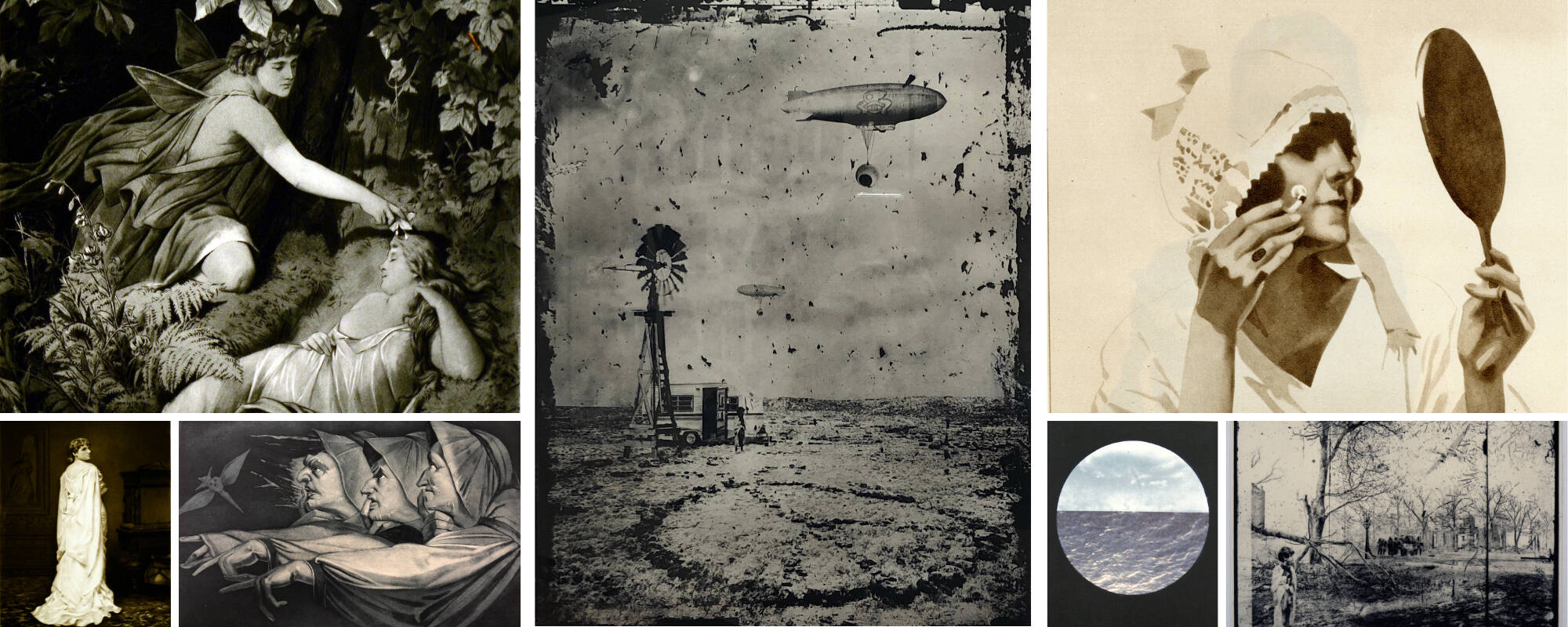
Photogravure is a process for printing photographs in the form of intaglio printmaking. The process follows that of the aquatint closely, starting by covering a chemically prepared copper plate with resin and heating it to create an ink-resistant surface. The plate is then coated with a light-sensitive gelatin tissue which has been exposed to a film positive before being etched in multiple acid baths. These plates can reproduce the detailed continuous tones of the photograph, but with ink on paper. Two pioneers within photography history, Nicéphore Niépce from France and Henry Fox Talbot of England, developed this process in the 1820s while looking for a way to create photographic images that could be etched with a traditional printing press. Photogravure was often used for creating fine art prints of original artwork since it could create high-quality and rich images.
Explore photogravure in the collection
Resources in the Collection
Header Images
Left
Artist Unknown, A Midsummer Night's Dream (Act IV, Scene I), photogravure, 1888, 2007.487.12a.
Artist Unknown, Miss Neilson as Juliet, "Romeo and Juliet," (Act II, Scene II), photogravure, 1888, 2007.487.38a.
Artist Unknown, The Witches of Macbeth, "Macbeth," (Act I, Scene I), photogravure, 1887, 2007.487.31a.
Center
A.W. Thompson, Surveillance, photogravure with chine-collé, 2018, 2019.23.1.
Right
Ludwig Hohlwein, Miro, photogravure, 1926, 2020.1.427.
Stephen Koller, Hydrologic IV, photogravure, laser-print transfer, and monotype, 2011, 2012.5.5.
A.W. Thompson, Drone Over Savannah, photogravure with chine-collé, 2016, 2017.72.2.