

Learning Module: Rethinking Street Signs ArtPrize 2022
ArtPrize 2022 Learning Activity
Rethinking Street Signs
Inspired by Scott Froschauer’s The Word on the Street Series
Created for Grades 6-12 (can be adapted to other ages)
In 2022, the GVSU Art Museum hosted work by California-based artist Scott Froshauer from his series, The Word on the Street. Froschauer’s work is familiar yet surprising, taking the form of street signs but communicating messages of hope and positivity. Of his work, Froschauer states, “By using the materials and visual language of street signs, but replacing the traditional negative wording (Stop, Do Not Enter, Wrong Way…) with positive affirmations, The Word on the Street seeks to provide something that is missing from our daily visual diet.”
In this activity, students will look closely at and think critically about the visual language of municipal street signs and other ‘official’ signs in their environments. They’ll question the impact of these signs in their day-to-day lives. They’ll re-imagine and create their own signs with alternative messages. If possible, students may post their re-imagined signs in their schools or neighborhoods to see the direct impact of their work.
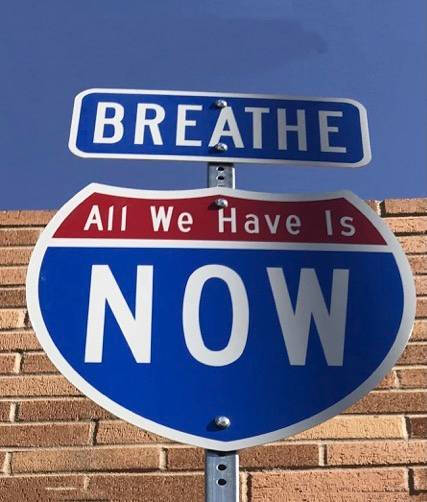
Scott Froschauer, Breathe/Innerstate Now, steel and vinyl, Courtesy of the Artist.
Key Terms and Concepts
- Visual language – a system of communication, like spoken, written or gestured language, that communicates ideas and messages through visual elements like color, shape, line, texture, and sometimes words.
(Teachers, want to include more info about the history of the visual language of street signs? This explainer video from Cheddar is helpful. Additionally, here’s a great primer video from the Toledo Museum of Art about visual literacy and its importance in creating visually media-savvy students.)
- Street art – artwork created in public places for public viewing. Street art is sometimes created by ‘gorilla’ style artists who don’t necessarily have permission to do what they do. Examples include graffiti, murals, sculpture, and more.
- Public art - artwork created in public places for public viewing. Public art is most often created by artists working collaboratively with a city or state government organization or a private business. In other words, they typically have permission to do what they do.
- Font or Type Face – the style of printable letters, referring to letters’ thickness (sometimes called weight), height, serifs (the extra lines at the ends of letters, for example, this is a serif font, this is a sans serif font), curves, and other features.
(Teachers, here’s a short article about the personality of fonts from the Purdue University Online Writing Lab.)
Meet the Artist
Scott Froschauer is an experimental artist who lives and works in Los Angeles. He has studied engineering, science, art, computer programming, and business. He also has hands-on experience with fabrication (or building objects with different materials and processes, often industrial or mechanical in nature), design, experiential narrative, venture capital, counterfeiting, and breathing.
Scott’s artwork is designed to be experienced in-person. He creates pieces that are not easily captured through photography or video. Some of his works are an exploration in emotional connectedness, some work is about revolution, particularly because our culture considers being connected to oneself as a revolutionary act, but his primary focus is on exploring new spaces and techniques for communication.

Close Looking Discussion
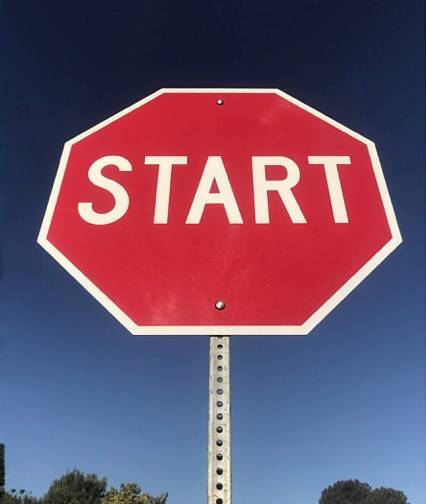
Scott Froschauser, Start, steel and vinyl, Courtesy of the Artist.
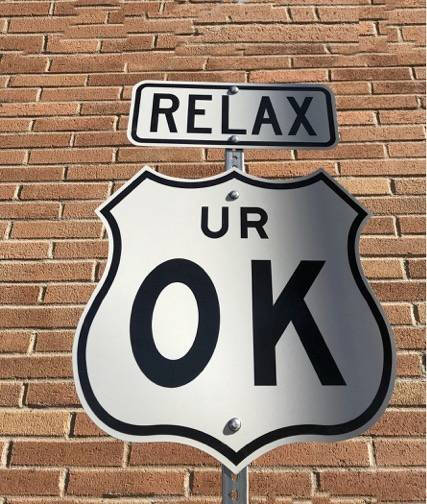
Scott Froschauer, Relax/UROK, steel and vinyl, Courtesy of the Artist.
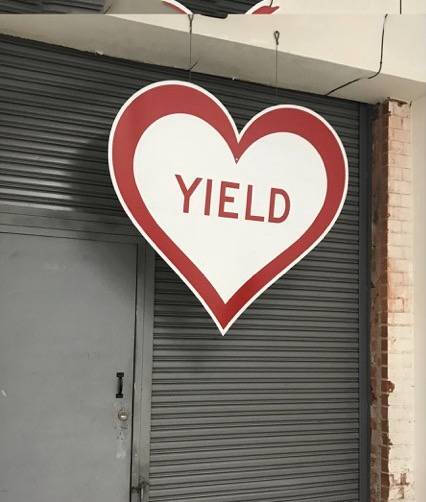
Scott Froschauer, Yield Heart, steel and vinyl, Courtesy of the Artist.
- Start by looking closely at Frochasuer’s signs. If you’re not visiting ArtPrize in-person, view the video or photographs included here (linked above).
- Consider these questions and discuss with those around you;
- Describe the shapes, colors, and words you see. Be obvious and direct. For example, “I see a red octagon with a white outline and the word ‘Start’ printed in big, bold white letters.”
- How would you describe this work to someone who hasn’t seen it?
- When you see traditional street signs, what do you think about? Do you spend a long time looking at them? Why or why not?
- What is the purpose of traditional street signs?
- When you see Froschauer’s street signs, what is your first impression? What makes you say that?
- What do you think is the purpose of Froschauer’s street signs?
- Do Froschauer’s street signs make you think differently about traditional street signs?
Rethinking Street Signs Activity
Gather Your Materials
- Worksheet and font examples
- Pencil
- Poster board or construction paper
- Markers or paint, or additional construction paper and glue
- Scissors
Activity Instructions
- Look at signs in your immediate environment (school, neighborhood, etc), use the following questions to think critically about how they impact your perception of that space/area.
- How do these signs tell you to move through this space/area??
- How comfortable (or uncomfortable) do I feel in this space?
- Do these signs help me understand the purpose or use of this space?
- How would this space feel different without these signs?
- Using the worksheet provided, rethink the colors, shapes, language, and style of letters used in traditional street signs, sketch your own ideas for these signs by choosing different colors, words, and fonts.
- Share your ideas with your classmates.
- Choose one of your worksheet designs and sketch a final draft of your sign.
- Using a poster board or construction paper, create your sign in a larger-scale format.
- If possible, connect with your school or neighborhood administrators to post these signs for a limited period of time, observe how people interact with them.
- With your classmates, discuss your observations of people interacting with the new signs.
Helpful Tips
- Don’t get too hung up on sketching the best font on your worksheet; you can always practice different fonts later and refine your choice for your final design.
- Try different combinations of fonts and sign shapes.
- For teachers: make a few sign-shaped stencils using the Sign Shape PDF and old file folders for students to use.
Reflection and Discussion
- How has your understanding of traditional public signage changed? Do you look at street signs the same way you did before this activity?
- Share your sign with another classmate, tell them about your thought process – why did you choose that sign shape and color, why did you choose those words?
- If you hung your sign in your school or neighborhood, how did people interact with it? Did you get any feedback from others about your sign?