

Learning Module: Intuitive Painting Activity- Inspired by the Work of Reb Roberts
Intuitive Painting Activity
Inspired by Reb Roberts
Created for All Ages
Welcome to the GVSU art collection! Thousands of original works of art grace the walls of buildings on all of GVSU's campuses to support learning and inspire students. All of these works can be viewed in our online database. One of the most popular artists on campus is local Grand Rapids self-taught artist Reb Roberts, whose work embodies joy and collaboration with its bright colors and uplifting messages. In this lesson, you’ll take a close look at Roberts' work, learn more about his approach to painting, his preference for collaboration, and hear his thoughts on labels like 'outsider art' and 'raw art'.
Note to educators: This activity includes the use of found materials like discarded cardboard, deconstructed cereal boxes, posters, or any type of solid, paintable surface (super shiny surfaces aren't recommended as they may not hold paint). We recommend doing this lesson over the course of two or more days so that you can have a conversation with students about those types of materials, and then give them time to find them and bring them to class. The final paintings are most interesting when everyone is working with different sizes, shapes, and types of surfaces.
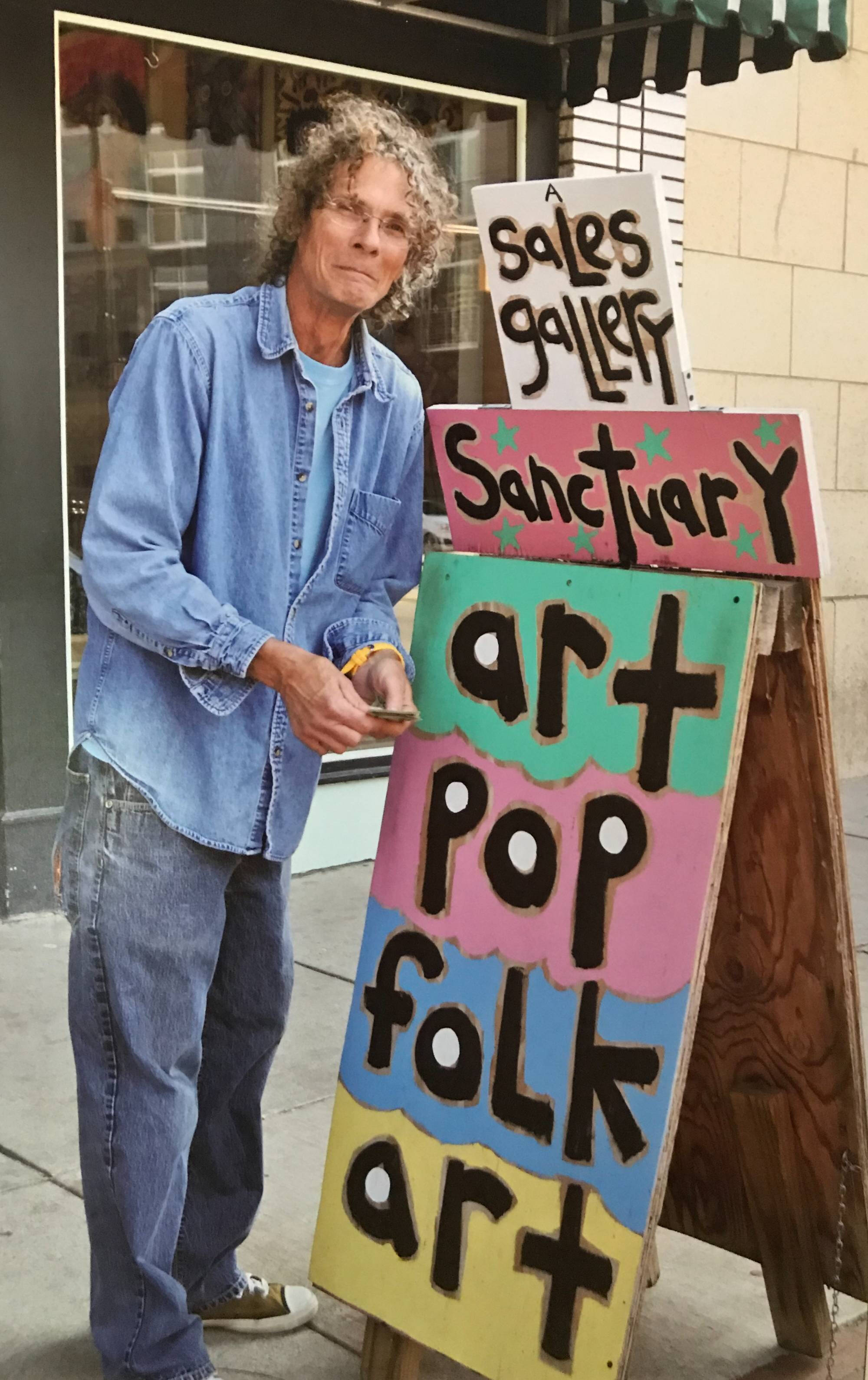
Artist Reb Roberts outside his former gallery, Sanctuary Folk Art located in downtown Grand Rapids.
Meet the Artist & See His Process
Watch and Listen to an Interview with Reb Roberts
Reb Roberts is an artist, educator, and collaborator who remains active and involved in the Grand Rapids community and local art scene. Born and raised in New Orleans, Reb arrived in West Michigan in 1972 and enrolled at Grand Valley’s William James College. He spent over 20 years working in early childhood education, a passion that continues to this day through partnerships and artist residencies. In the mid-1990’s, Reb began to intentionally focus on creating small-scale art and large works in public spaces. Then, in 1999, he and his wife, Carmella Loftis, opened The Sanctuary Folk Art Gallery in the Heartside neighborhood of downtown Grand Rapids. For 18 years, their space was a hub for artists and art that embraced authenticity, inspiration, and collaboration.
In this interview, Roberts talks about how he got started painting, what interested him most about the Heartside neighborhood of Grand Rapids, where his gallery was located, his thoughts on labels often given to his work like 'intuitive,' 'outsider,' or 'raw art,' and his preference for working in collaboration with other artists.

Watch Reb Roberts' Painting Process
Roberts painted a mural in the GVSU Art Gallery for the Fall 2021 exhibition titled Honest and Unrefined: Art Outside the Academy. He guest-curated the exhibition, and it also featured some of his work. Watch this time-lapse video of his painting process and notice how he builds up the surface with colors, textures, patterns, and other small details.
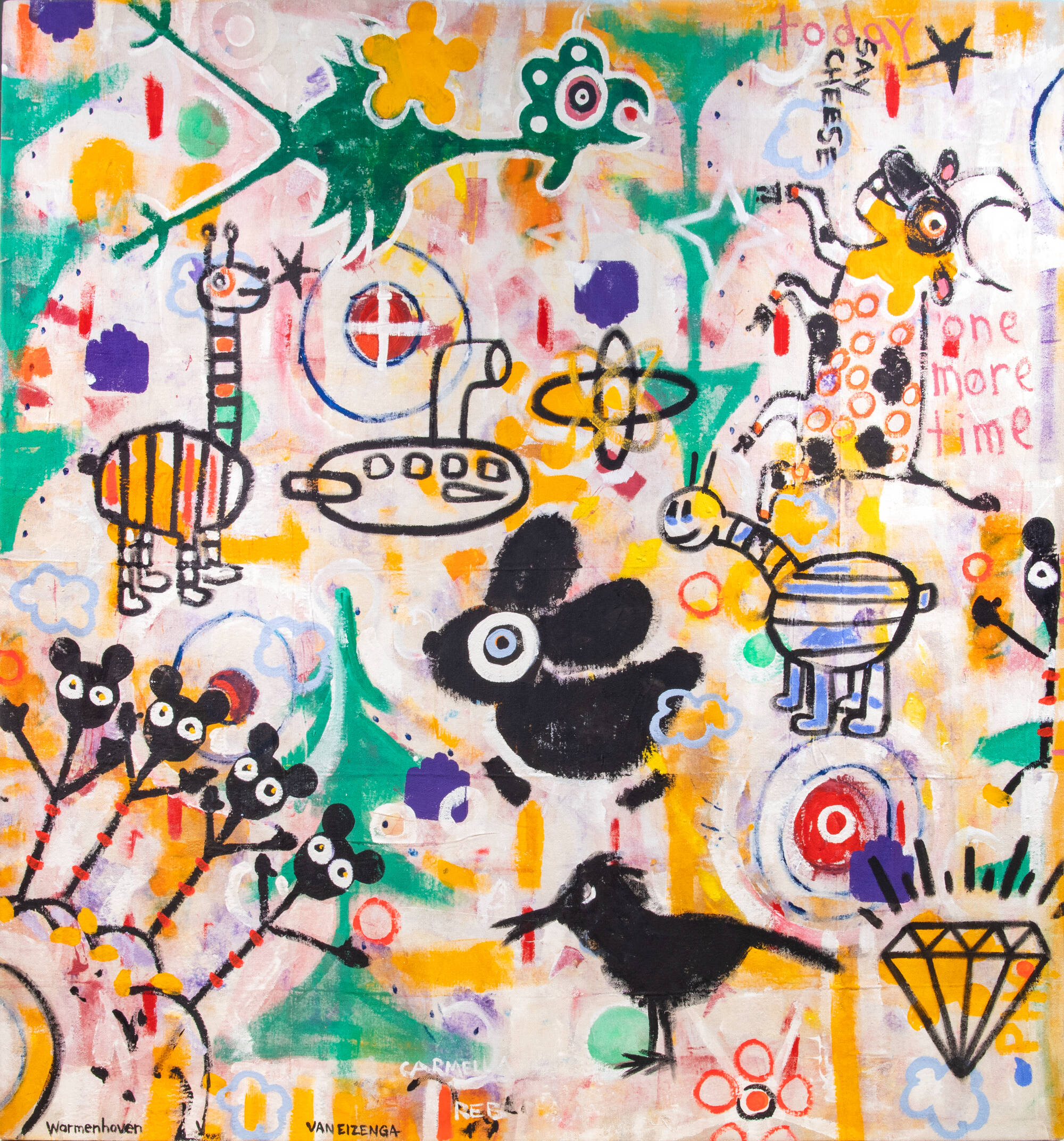
Reb Roberts, David Warmenhoven, Carmella Loftis, James Van Eizenga, Today One More Time, acrylic on canvas, 2020.26.3.
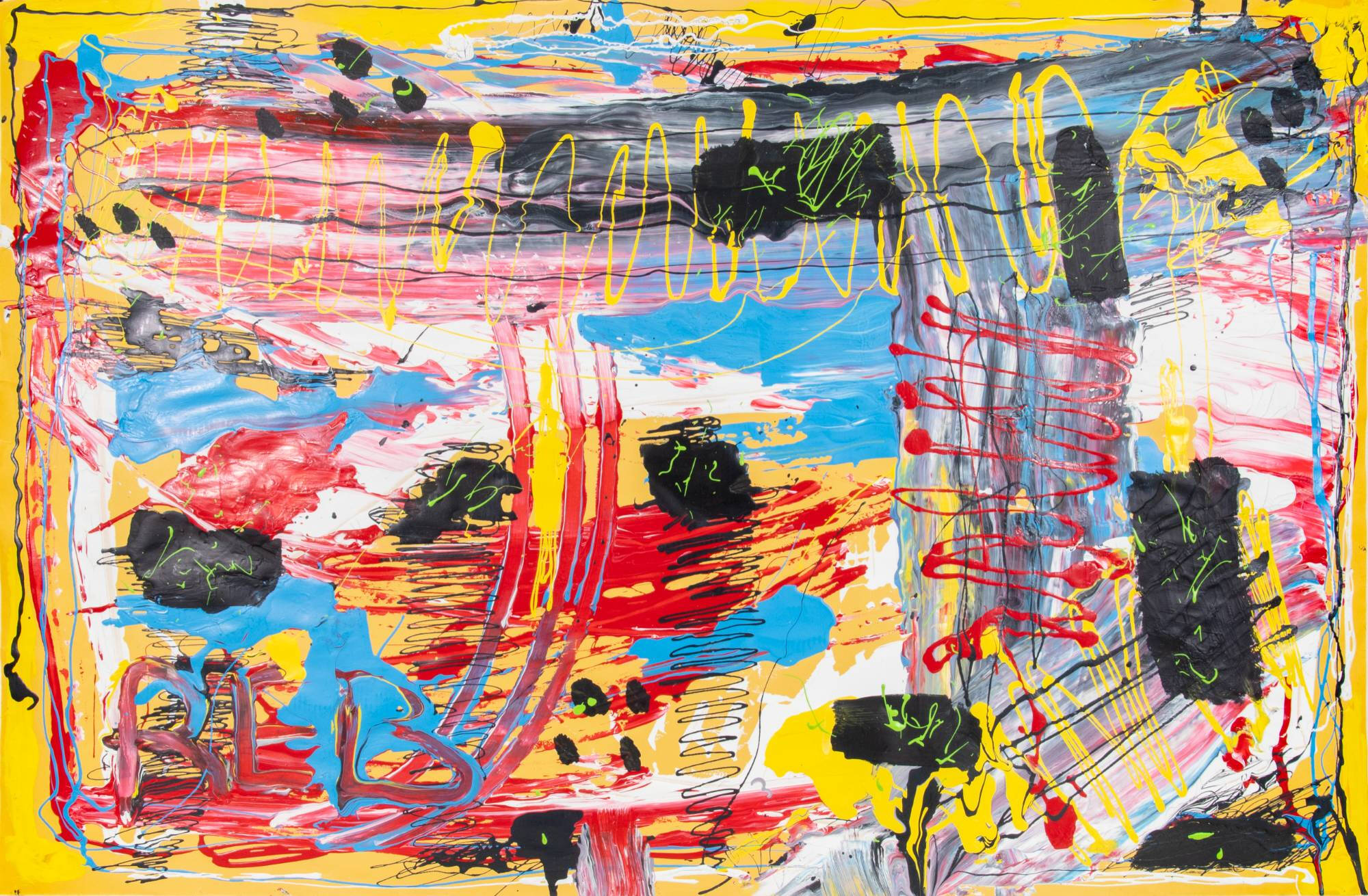
Reb Roberts, Negrita Luna #7, acrylic on paper, 2003, 2012.17.26.
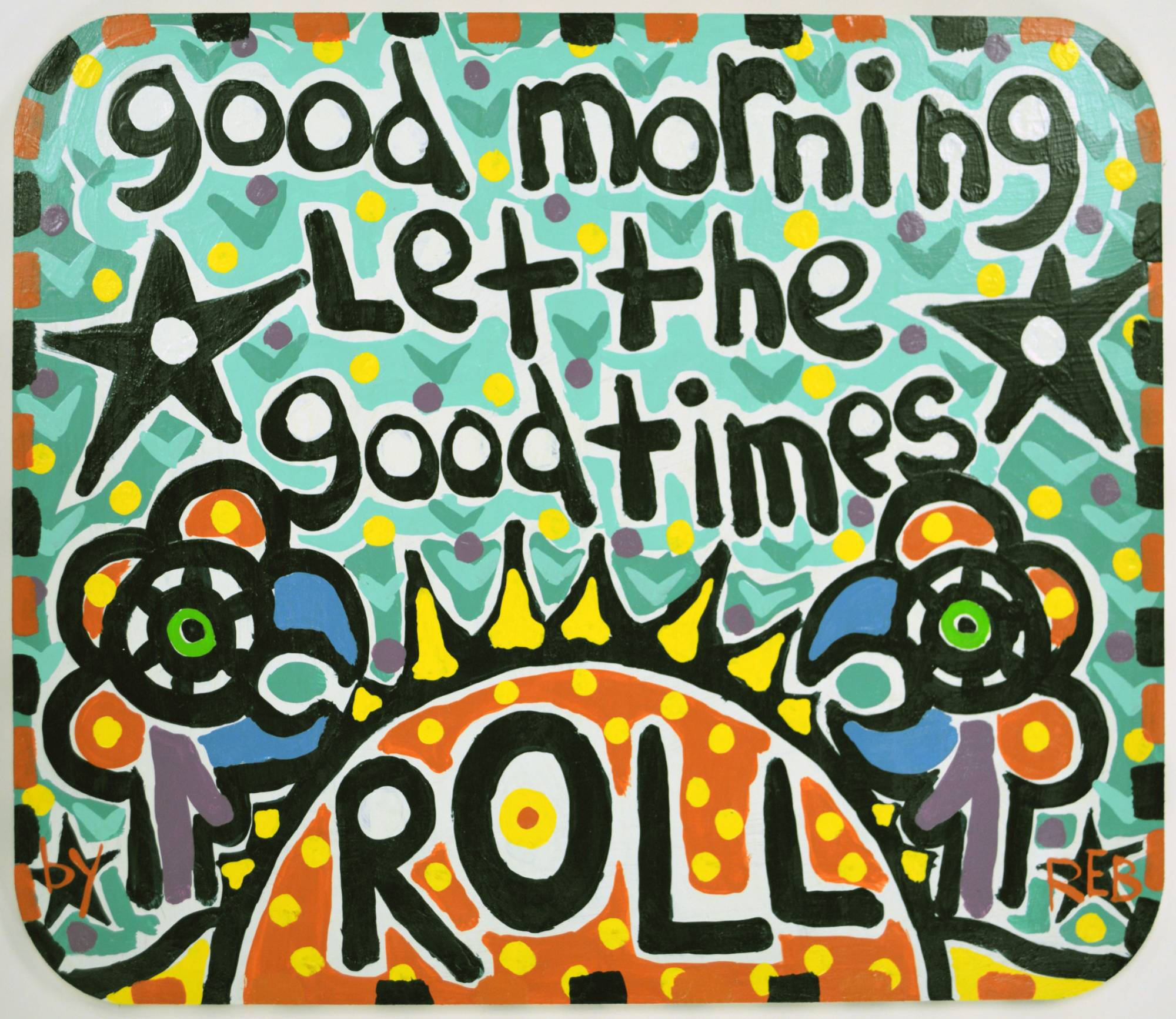
Reb Roberts, Let Em Roll, acrylic on board, 2017.68.14.
Reb Robert Intuitive Painting Activity
Gather Your Materials
- Sketch paper, pencil, crayons, pastels, markers, or other colorful drawing utensils
- Found material to use as a painting surface, for example, discarded cardboard, canvas scraps, old posters, or deconstructed cereal boxes
- Paint (any kind, ideally not washable paint, but instead choose tempera or acrylic, even left-over house paint will work well)
- Brushes or anything that can be used to apply paint to a surface
- Cup and water for rinsing brushes
- Towel or paper towel
- Craft paper or a drop cloth to protect your painting surface (recommended but not required)
Introduction
- (Pre-activity, at least one day in advance) Have a conversation with students about found materials. Reb Roberts is a self-taught artist, meaning he wasn't formally trained in an art school. Because of this, he doesn’t feel obligated to use traditional art materials like oil paint and prepared canvas (materials that are archival); instead, he often uses found materials like leftover house paint and cardboard scraps.
- Today, we’re going to create a painting inspired by Reb Robert’s style and approach to making art.
- Characteristics of Roberts' work include bright, bold colors; simple shapes, patterns, and lines; uplifting words or phrases; and he often collaborates with other artists.
- Reb is a self-taught artist, meaning he wasn't formally trained in an art school. Because of this, he doesn’t feel obligated to use traditional art materials like oil paint and prepared canvas (that are archival); instead, he often uses found materials like leftover house paint and cardboard scraps.
- Archival is a term used to describe materials that stand the test of time; they don’t deteriorate easily and last for a long time. They’re also usually expensive.
- Found materials are just that, materials that are found in the trash, in resale shops, in your closet, or other free sources. These materials are not necessarily intended for art-making, like cardboard, house paint, scraps of packaging, etc.
Activity Instructions
- To start, using a piece of scrap paper and pencil or crayons (etc), sketch a few shapes, lines, images, words, or phrases that spark joy for you. You may want to sketch many variations across multiple pieces of paper. Share your ideas with another classmate and ask for their thoughts.
- Next, reflect on your sketches. Which shapes, images, or words are your favorite? How can they be combined? Think about the time-lapse video of Reb Roberts' mural, think about how you can work similarly to combine colors, textures, images, and phrases into a balanced composition?
- Next, using paint on a found material, begin painting your favorite colors, textures, and shapes. Use the whole surface. Embrace accidents. Go with the flow. And enjoy the experience!
- You may choose to share your painting surface with a friend. Have them add a few items to your painting. Embrace how their addition changes your design. Does it inspire new ideas?
Helpful Tips
- Start by painting bigger shapes and sections of color first
- Create balance by painting a little of each color in different areas
- Go slow and embrace accidents
- Paint smaller shapes and details after larger sections dry
- Paint words or phrases last in a bold color
Reflection
- In this activity, you created a work of art by responding intuitively to your own mark-making, meaning that you painted without a concrete plan, embraced accidents, and made changes to your work as you went along.
- Many artists create work intuitively and don't have a formal fine art education from a major college or university. Sometimes their work is labeled as 'outsider art,' 'raw art,' or even 'visionary art.'
- Labels like these are often used by art gallery and museum professionals to describe the work and differentiate it from other categories of art.
- In the fine art world there are entire museums and art fairs dedicated to 'outsider art,' just like there are museums dedicated to just contemporary art or just sculpture. One example is Intuit: The Center for Intuitive and Outsider Art in Chicago, IL.
Discussion Questions
- Look at these examples of Reb Roberts artwork. What do you see in these works of art? What’s going on these pictures? What makes you think that?
- What did it feel like to paint intuitively?
- What do you prefer; painting with a plan or painting intuitively?
- What do you think about labels like 'outsider,' 'intuitive,' or 'raw art?'
- Can labels be useful? Can labels be limiting?
- What affect do labels have on artwork and our understanding of it?