

Frequently Asked Questions
FAQ
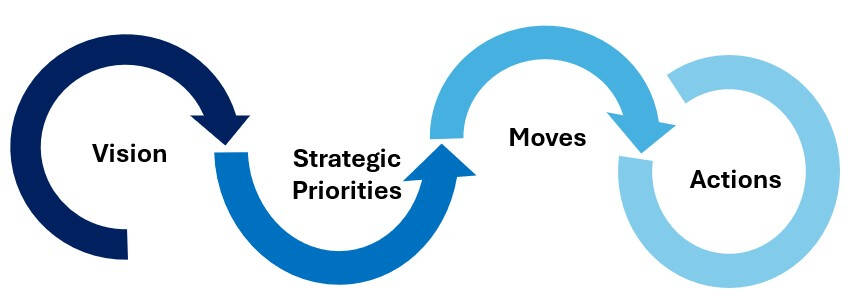
A strategic framework provides high-level direction and is adaptable to changing conditions. Unlike a detailed strategic plan, it outlines goals and priorities without prescribing exact actions or timelines. A strategic framework answers “why” and “what,” while a strategic plan answers the “how” and “when."
The Academic Affairs Strategic Framework was created using extensive input gathered throughout 2025, including forums, consultations, and feedback processes across Academic Affairs and the university. We are grateful for all of the faculty and staff who participated in building the framework. It is our long-term guiding document and will inform our resource decisions.
The Academic Affairs Action Plan builds on the objectives outlined in the framework. The 2026 Action Plan prioritizes actions identified for a single calendar year and translates long-term priorities into concrete work.
The Division of Academic Affairs has not had a defined strategic framework or plan before. The new framework provides shared direction for all faculty and staff in the division. It defines long-term aspirations and values, while aligning with the Reach Higher Together Commitments established by the university. The framework establishes coherence across priorities while allowing flexibility as conditions change and honors the voices of our faculty, staff, and students. The Strategic Framework is a map to help us navigate our path forward, supports cross-college coordination and collaboration, and provides us with a shared vision to allow us to realize our mission. It clarifies our highest values and helps us stay focused.
The Academic Affairs Strategic Framework defines how Academic Affairs advances the commitments of the Reach Higher Together plan. Together, they function as the division’s primary mechanism for translating university-level commitments into academic priorities, actions, and outcomes. The Reach Higher Together plan was deliberately developed after the Academic Affairs Strategic Framework. Both frameworks are about strengthening our foundations to build our future. The 2026 Action Plan further breaks down how these priorities will be achieved in Academic Affairs.
This is the first year of operating under a unified strategic framework and plan, and the division is building shared capacity for this work. A one-year plan allows progress to be tracked by quarter and adjusted in response to changes in the external and internal environment. In the future, we plan to develop multi-year action plans to support greater clarity.
Each “action” or tactic will have a team lead that is appointed by the provost. Teams will be created based on the needs of the action. Any given team may include members of the Provost Cabinet, shared governance representatives, faculty, staff, students, and partners from other divisions. Responsibility is shared across Academic Affairs. There will be many opportunities for faculty and staff to engage and contribute, especially when it cascades into colleges and units.
The Academic Affairs Strategic Framework (www.gvsu.edu/aasf) website serves as the central location for updates and information. Progress reports will be shared on a quarterly basis via Lakers Ready and the website.
There was extensive input gathered throughout 2025, including forums, consultations, and feedback processes across Academic Affairs and the university. The actions were refined through engagement with Provost Cabinet and existing working teams.
For more detailed information on the development of the framework, click here.
We understand that everything cannot be accomplished all at once, so we have adopted a deliberate pacing strategy that prioritizes action on some of the moves, while others are sustaining current efforts or delayed until future years. We heard your feedback on workload, fatigue, and the need for foundational resources. The Strategic Plan is sequenced to build these conditions first, ensuring we can address complex goals effectively in future phases. By concentrating resources on fewer initiatives, we ensure the capacity to execute them with depth and quality.
Some of the work is about strengthening our foundations and setting deeper roots. Other elements are about are about creative and forward-looking change. We are building on our strengths and assets to redesign how we work with longevity in mind. The division will be able to grow and thrive because of the foundations we are setting today. For a full list of 2026 priorities, visit www.gvsu.edu/aasf.
Another way to think of a ‘move’ is as a strategy within the framework to address higher-level strategic priorities. ‘Actions’ are the tactics identified for a given year to advance each move.
Because we are building on our current strengths and assets, the good work that our colleges are already doing directly influenced the development of the framework and will continue to drive divisional decision making. The shared framework calls us together to lead and collaborate with intention and purpose to create a lasting impact for generations to come.
Some individuals will participate directly in action teams. Others will see alignment through college and unit planning, reporting, or existing responsibilities. The plan emphasizes coordination rather than adding additional work.
Additional resources are available at www.gvsu.edu/aasf. Questions may be directed to Sean Lancaster or the identified lead contact for specific actions.