

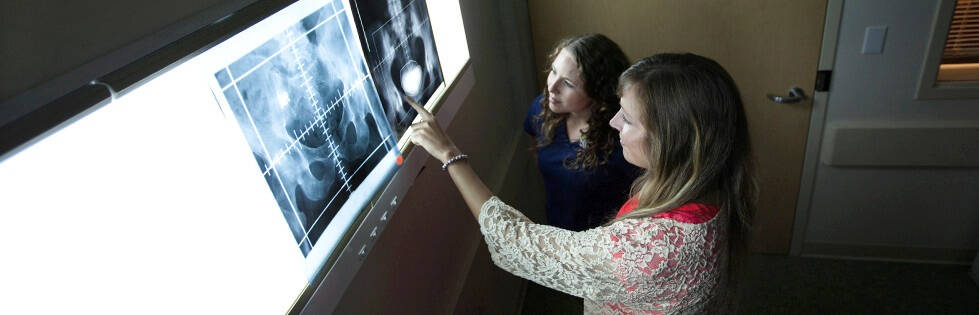
What is Radiation Therapy?
Radiation therapy is a health care discipline that utilizes ionizing radiation for the treatment of mostly malignant diseases. Radiation therapists are health care professionals skilled in the art and science of radiation treatment delivery.
Why Study Radiation Therapy at Grand Valley?
- Quality. Our well-established program provides a strong curriculum and knowledgeable faculty along with clinical site placements to prepare students for the national certification exam.
- Clinical Experience. Grand Valley students enjoy small class sizes, cohort educational experiences, and clinical rotations offered at a wide variety of different clinical affiliates, including large teaching facilities as well as small community hospitals.
- Facilities. The program is located in the state-of-the-art Cook DeVos Center for Health Sciences building in the heart of the medical community of downtown Grand Rapids, Michigan.
- Accreditation. The radiation therapy program is accredited through the Joint Review Committee on Education in Radiologic Technology for a length of 8 years. General program accreditation information and the current accreditation award letter can be found on JRCERT's GVSU page.
Program Overview
The radiation therapy program is designed to prepare students for the technical, theoretical, and psychological aspects of this career. The program provides a unique learning environment which includes state of the art equipment. By recruiting the help of highly qualified Radiation Oncology faculty, students acquire skills necessary to become successful Radiation Therapists.
Students receive didactic, laboratory, and clinical experiences in both existing and emerging radiation therapy practices and procedures. This may include treatment planning, simulation, quality assurance, brachytherapy, external beam therapy, stereotactic radiosurgery, intraoperative radiation therapy, intensity modulated radiation therapy, image guided radiation therapy, and total body irradiation. Students will rotate through a minimum of three clinical facilities to ensure exposure to emerging technologies.
Admissions Process
Application Deadline: February 1
Students spend two years completing the general education and prerequisite courses. After admission to the secondary competitive program, students complete two years of full-time professional coursework.
Mission & Vision
The program’s mission is to provide competent, entry level Radiation Therapists who shape their profession, society, and lives of the communities of which they serve.
The program provides students opportunities to develop technical knowledge and personal skills necessary for a career in the radiation sciences. The curriculum is designed to combine compassion with integrity in order to shape a student into a professional. The program provides a unique learning environment which includes state of the art equipment. By recruiting the help of highly qualified Radiation Oncology faculty, students acquire skills necessary to become successful Radiation Therapists.
Programmatic Goals
Upon completion of the program students will be able to:
- demonstrate clinical competence.
- develop critical thinking and problem solving skills.
- communicate effectively to patients and healthcare professionals.
- demonstrate professional behavior in clinical areas and the profession.
Student Learning Outcomes
While in the program, students will be evaluated by the following learning outcomes;
- Students will appropriately simulate treatment delivery.
- Students will demonstrate correct positioning of patients for treatment.
- Students will illustrate correct simulation of a variety of patients.
- Students will compare current treatment images to treatment plan and determine accuracy of positioning.
- Students will propose treatment plans for the treatment of breast cancer.
- Students will describe procedures to patients.
- Students will communicate effectively with healthcare staff.
- Students will demonstrate effective formal presentation skills.
- Students will demonstrate professional behavior.
- Students will integrate networking into program and profession.