


CPT | Curricular Practical Training
In August 2026, SEVP sent communications to all school sites hosting F-1 international students. These communications provided clarification on the “integral” nature of CPT to the F-1 student’s curriculum. In response to these communications, GVSU has carefully reviewed CPT practices and authorizations. Revised CPT guidance is now available on this page which complies fully with the communications from SEVP.
The ISS Team and GVSU's goal with these changes is to ensure all student's are fully compliant with the regulations. Please direct all questions and concerns to the ISS Team: [email protected]
F-1 Work Authorization before Graduation
CPT (Curricular Practical Training) authorizes F-1 international students to legally work off campus before graduation or above the permitted on-campus hours, only as long as the work experience is a requirement of their degree program and is in no way elective. This benefit of the F-1 visa requires academic departmental approval, registration in the CPT eligible course, and both a job offer letter and cooperative agreement from the employer. While F-1 students are normally limited to 20 hours of work per week on-campus during the semester, CPT authorization can authorize more than 20 hours combining both on and off campus work, but only if the F-1 student is approved for full-time CPT (usually during breaks or when the academic program permits).
Please note, full-time CPT does not exempt the student from the online course limits.
Learn more below:
CPT Eligible Programs & Courses
Only students enrolled in the following degrees, specified courses, and number of credits are eligible for CPT Authorization. All other programs and courses do not require experiential learning in order to fulfill graduation requirements and therefore are not eligible for CPT authorization.
Please note: this list is currently under review and we anticipate there will be additions to the CPT eligible programs list. If you believe your program requires experiential learning, please consult with your academic advisor first then email [email protected] with your request to review your program for CPT eligibility.
|
Degree Program |
CPT Eligible Course |
Maximum CPT Eligible Credits |
|---|---|---|
|
CAP 490 |
One 3-credit course |
|
|
BUS 490 |
One 3-credit internship course |
|
|
One 2-credit internship course |
|
|
Bachelors in Engineering |
EGR 290 |
9 credits total, 3 credits per required co-op course |
|
Bachelors in Engineering |
EGR 292 |
6 credits total, 2 credits per required co-op course |
|
EXS 490 |
One 6-credit course |
|
|
HTM 290 |
6 credits total, 2 credits per required internship course |
|
|
PNH 490 |
One 3-credit internship course |
|
|
SPM 490 |
One 6-credit course |
|
|
EGR 699 -or- EGR 685 |
3 credits total
|
|
|
PNH 690, only if prior experience not met |
One 3-credit course |
|
|
Masters in Public Administration
|
PNH 690, only if prior experience not met |
One 3-credit course |
|
Masters in PSM
|
4 credits total
|
|
|
Masters in PSM
|
3 credits
|
|
|
WAT 691 |
One 6-credit course |
CPT Info Session
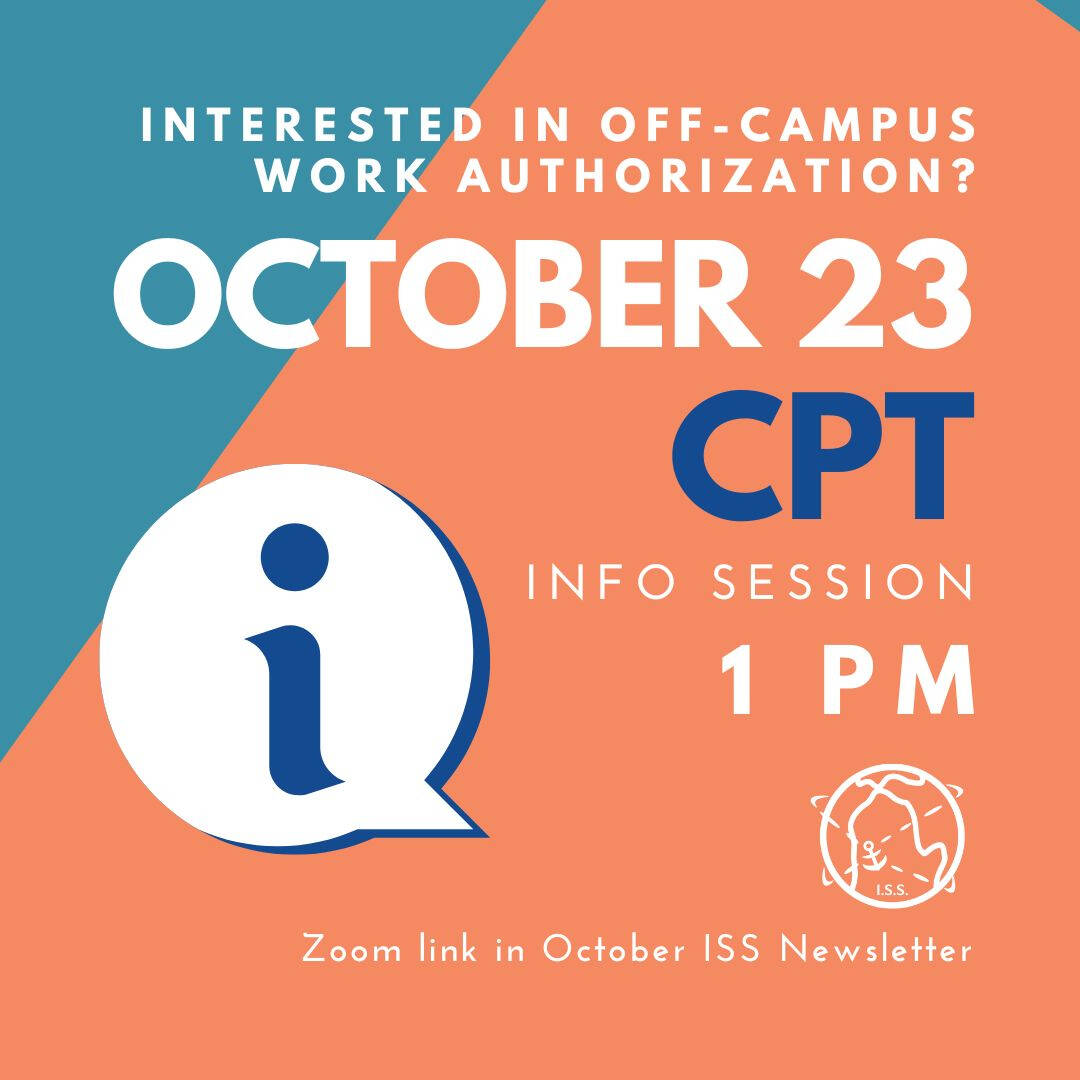
The Padnos Center for Global Experience's International Student Services (ISS) hosts an CPT Information Session twice a year in Fall and Winter semesters.
Upcoming info session is October 23rd 2026.
Invitations to the Zoom sessions are sent out via email. If you're a current student and interested in attending, please check your emails.
If your degree requires work experience off campus, you are required to submit the CPT request form and be issued a new I-20 authorizing the CPT work before you begin the experience. You may NOT work until you have your new I20.
Processing Time: all immigration requests are expected to take about 1 week (5 business days) to process while CPT requests can take up to 2 weeks if requested during a high demand time such as the start of a semester.
In order to be authorized for CPT, you must first make sure you have fulfilled all these requirements:
- The work experience is required for your degree
- You are registered for the CPT eligible course & you do not exceed the minimum required credits for this course
- You have a Job offer letter (see the details below)
- You & your Internship Coordinator complete the Faculty Approval Form
- You and your Employer complete the Cooperative Agreement Form
Once you have all of the above ready, apply using the form linked above.
Job Offer Letter Requirements
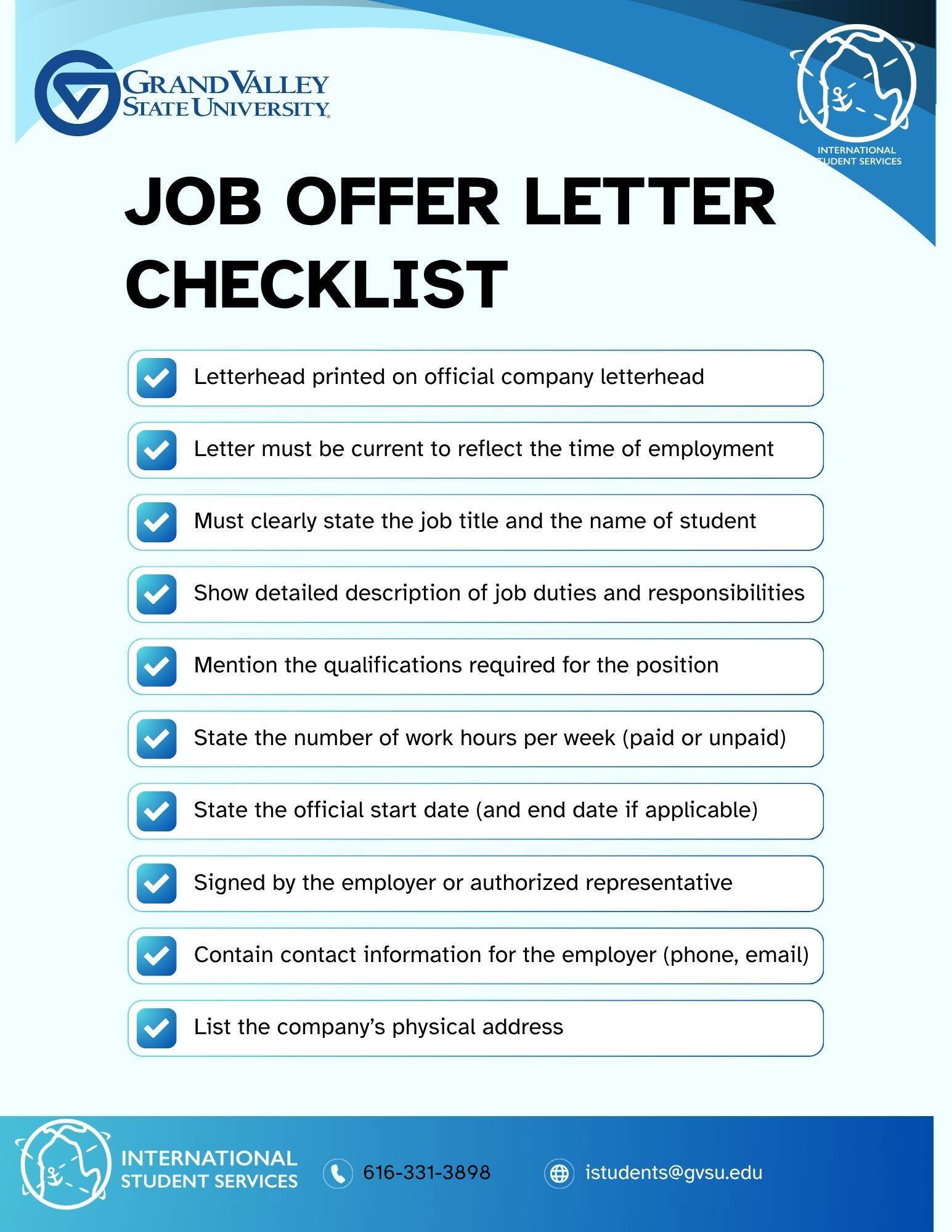
1. Document & Employee Identification
- Must be on official company letterhead
- Include the issue date
- Include the student’s full name
2. Job & Employment Details
- Job title, duties/responsibilities, and required qualifications
- Work hours per week
- Employment start date (and end date if applicable)
- Salary (required for STEM OPT only)
3. Employer Verification & Contact Information
- Signed by employer or authorized representative
- Include representative’s:
- Full name and title
- Email and phone number
- Company website and physical address
Note: Missing any of these elements may make the letter insufficient for verification.
CPT (Curricular Practical Training) authorizes F-1 international students to legally work off campus before graduation or above the permitted on-campus hours, only as long as the work experience is a requirement of their degree program and is in no way elective. This benefit of the F-1 visa requires academic departmental approval, registration in the CPT eligible course, and both a job offer letter and cooperative agreement from the employer. While F-1 students are normally limited to 20 hours of work per week on-campus during the semester, CPT authorization can authorize more than 20 hours combining both on and off campus work, but only if the F-1 student is approved for full-time CPT (usually during breaks or when the academic program permits). Students must be authorized through our office (ISS) for CPT to work off-campus; an international student is never allowed to work off-campus without CPT authorization. International students are allowed to volunteer or accept unpaid internships without CPT authorization, although sometimes iStudents should seek CPT authorization for unpaid work if it is a core component of their program. The ISS Team will be able to help the student determine if this is necessary.
CPT is authorized based on the semester a student is registered for the required experiential learning course. CPT authorization dates are approximately the same as the semester and cannot exceed 4.5 months per authorization. iStudents cannot begin work until they have their new CPT I-20. Work prior to the start date on this I-20 is in violation of their status and will result in a termination of thier F-1 record.
CPT eligible programs allow F-1 students Full-time or Part-time CPT authorization during Fall & Winter semesters based on the total number of hours they work:
- Part-time CPT authorizes a total of 1-20 hours of work per week, including on and off-campus work
- Full-time CPT authorizes a total of 21-40 hours per week, including on and off-campus work
If a student is authorized for more than 365 days total during their degree for FULL TIME CPT, they lose their ability to have OPT. Part-time CPT does not affect a student's ability to have OPT.
- OPT stands for Optional Practical Training and is a benefit of the F-1 student visa
- OPT allows 1 year (up to 3 years for STEM) work authorization anywhere within the US after graduation but only within the student's field of study/major
Are there any exceptions for full-time enrollment while on full-time CPT?
F-1 Students who are authorized for Full-time CPT are considered as Full-time enrollment. If the F-1 student is only taking the CPT eligible course, that course CANNOT be an online class. Additional exceptions to full-time enrollment are listed on the Maintain your Status page.
Will I be authorized for part-time or full-time CPT?
The authorization for CPT is based on the TOTAL number of hours the iStudent works in 1 week. This means on-campus and off-campus work are combined.
- Part-time CPT authorizes a total of 1-20 hours of work per week, including on and off-campus work
- Full-time CPT authorized a total of 21-40 hours per week, including on and off-campus work
For example, if a student has a 20 hour per week GA and works 12 hours per week at an internship site off-campus, the student will be authorized for Full-Time CPT.
What is the 365 day rule?
iStudents who work 365 days or more of Full-Time CPT during their degree, lose their ability to work on OPT after graduation. Part-time CPT does not affect a student's ability to work on OPT after graduation.
Some programs, such as Engineering, require 3 semesters of Full-time CPT to fulfill their Co-Op degree requirements. iStudents in these programs must pay very close attention not to exceed the 365 days of Full-time CPT during their degree. The Engineering department is aware of this limitation and students can successfully complete their Co-Op degree requirement without surpassing 365 days of Full-time CPT.
What if I want to continue working at the same employer for multiple semesters?
CPT is authorized based on the semester that the iStudent is taking the required experiential learning course. If iStudents want to work at the same employer for multiple semester, they must apply for CPT multiple times and the total number of credits cannot exceed the minimum number of credits in the required experiential learning courses needed for graduation.
For example, if a student gets an internship placement at a company that lasts an entire academic year (August - April),
- the experiential learning needs to be required for all students in their degree program in order to meet graduation requirements, and
- the iStudent needs to be registered for the CPT eligible course each semester, without exceeding the minimum credits required for the experiential learning course, and
- the iStudent needs to apply for CPT in August which is tied to the required Fall experiential learning course, and
- the iStudent needs to apply again for CPT in November or December which is tied to the required Winter experiential learning course
Do I have to register for a new course every semester I work on CPT?
Yes. CPT is authorized based on the required experiential learning course taken during that semester. So each semester an iStudent needs CPT authorization, they need to be registered for the CPT eligible course and the iStudent must apply for a separate CPT authorization.
The only exception to registering for a new class each semester is if the Faculty deems that the coursework was not complete and assigns an Incomplete grade (letter "i"). Read more below about Incomplete grades & CPT Authorizations.
I was given an Incomplete grade for my CPT eligible course. Do I have to apply for CPT again?
Yes. CPT is based on the semester that the iStudent is taking the course. Experiential learning courses are only eligible for a continuation of CPT if the core requirements of the courses were not met. If the iStudent needs to continue their CPT authorization into the next semester because the coursework related to the CPT eligible class cannot be fulfilled without additional CPT authorization, the iStudent must apply for CPT again and indicate on the form that the course was from the last semester and they were assigned a letter "i" grade.
Permitted:
- An experiential learning course requires 200 hours but the student was only able to complete 150 hours. In this case, the course would be temporarily graded as incomplete and the student's CPT could only continue until the hour requirement was met.
Not permitted:
- Student would like to continue working on projects with the employer but this additional work is not necessary to fulfill the course requirements.
- If a student's experiential learning course was graded, that means the requirements were fulfilled. The graded course cannot be used for future CPT.
How many hours can I work during the Summer while on CPT?
Since Spring/Summer semester is considered a break, you can work up to 40 hours per week combining CPT and on-campus work, only if experiential learning is a required component of your degree. Check out these scenarios to better understand how this works:
Scenario 1:
20 hours on Part-time CPT + 20 hours on-campus = total 40 hours per week
Yes! This works during Spring/Summer because it is a break semester and 40 hours total are permitted.
Scenario 2:
30 hours on Full-time CPT + 10 hours on-campus = total 40 hours per week
Yes! CPT is always considered full-time if over 20 hours per week.
Scenario 3:
40 hours on Full-time CPT + 40 hours on-campus = 80 hours per week
NO! This is not permitted. Even with full-time CPT authorization, you are permitted to work a total of 40 hours on and off-campus. This would be a violation of your immigration status.
Do I need CPT for an unpaid internship?
If the work experience is required based on the CPT eligible programs above and you are fulfilling the requirements of the CPT eligible course with an off-campus work experience, you will need CPT authorization whether the work experience is compensated or not. Commonly, experiential learning opportunities are referred to as internships. Internships are in the field of study and serve as training for the student's career development.
If you are taking an elective experiential learning course or volunteering off-campus, you can engage in unpaid work experience; however, you CANNOT engage in paid work experience with an elective course.
Do I need CPT to volunteer off-campus?
Volunteering is generally a donation of your time to support a cause in the non-profit sector with no form of compensation received in return, including gifts, gift cards, mileage reimbursement, stipends, etc. Volunteering is often not related to the program of study (ie. helping at a cat shelter). Volunteering does not require work authorization. If uncertain about whether or not your experience is considered volunteering, please consult with the ISS Team.
International students only require CPT authorization when the on campus internship is paid and over 20 hours during fall and Winter Semesters with a maximum of 40 combined hours per week. Unpaid on campus internship do not require CPT authorizations.