News from Grand Valley State University

GVSU Expert: A Q&A about having civil discussions during election season

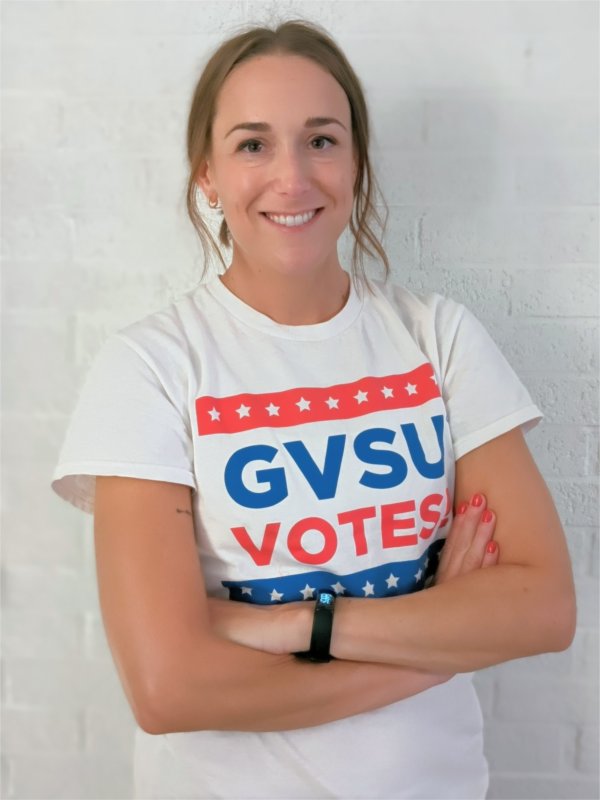
Dan Cope, affiliate faculty of interdisciplinary studies, was named the faculty fellow for the Padnos/Sarosik Center for Civil Discourse. Cope will bring her expertise in civic participation and elections to the two-year position. Before joining Grand Valley's faculty in 2018, Cope served as deputy clerk for Grand Rapids Township and continues to be a precinct chair for the City of Grand Rapids during elections.

Cope is active in GVSU Votes!, a nonpartisan group of campus community members who work to increase student voter engagement. Their efforts include securing a satellite Allendale Township Clerk's Office in the Kirkhof Center during November elections, making it easy for students to register and cast ballots.

Dan Cope in a white GVSU Votes T-shirt
Dan Cope, affiliate faculty of interdisciplinary studies, was named the faculty fellow for the Padnos/Sarosik Center for Civil Discourse.

What led to your passion for civic participation?

When I was a little kid, if you asked me what I wanted to be, I would have said president of the United States. Now, I no longer want that job, but as I worked in local government over the years, I became more and more interested in elections and the process. 

I would say my light bulb moment was during the 2020 election, when I was deputy clerk for Grand Rapids Township. I had been working elections since 2017, but 2020 was different. That was when this ordinary business of record-keeping became a lightning rod, a source of tension. I saw a lot of people who had lost faith in that institution. 

I was an adjunct faculty member at that time. I felt people had a lack of understanding of how elections work and some began to disengage with their public responsibility. I believed at that time, and still do, that more robust education in democratic processes and participation, like civic responsibility, was needed.

Then I started teaching full-time and was able to blend my work experience with teaching and started planning coursework around civic participation.


Why are difficult conversations, like politics, often unproductive, and what tools can the Civil Discourse Center give people to approach those discussions differently?

In many difficult conversations, some people shut down and do not want to engage. Another set of people resort to debating, but it's ineffective because they're thinking, "I want to win this conversation." 

Avoiding people and conversations is not going to get us anywhere. We're not challenging ourselves or others, which is an important part of engaging in civil discourse and thinking critically in a way where the end goal is to improve ourselves and each other.

My role as a civil discourse fellow is to equip students to have tools at the ready for these kinds of challenging conversations.

It's, of course, an interesting time nationally. Two polls came out in 2025: one said that 85% of Americans fear politically motivated violence or think that politically motivated violence is on the rise; the other poll found that 30% of Americans believe that violence is actually necessary to correct this course that we're on.

I didn't grow up thinking that way. When I asked my students about this last fall, they were appropriately upset but did not seem that surprised. Young people tend to have this normalized fear of ideological violence because that's what they're seeing around them as normal. Many of them are even afraid of the word "argument" because they associate it with this sort of escalation of violence.

Part of my job as a faculty member, and I see this as an important part as a faculty fellow, is to demonstrate what collaborative argumentation or critical thinking actually looks like for them.

I want to teach and demonstrate that these conversations can be accomplished when the two parties are coming from a framework of respect and love. It's going back to that idea of improving the self and improving each other.


Campaigns will use ads designed to make voters distrustful of the opposing party. How effective are those tactics at increasing political polarization?

We have to think, "What is the purpose of this ad?" And it's easy for us to retreat into an us-versus-them mentality, a kind of binary opposition. It's what we do naturally when we're confronted with uncertainty and it's something that we have to actively train ourselves not to do.

Fearful people are easy to exploit. It's in the interest of powerful people and powerful systems to strategically divide people so that they're weaker. Political advertising works to invoke these kinds of strong emotional reactions to make us feel a certain way, so that we aren't exercising critical thinking.

With any advertising, stop and ask yourself, who benefits from me feeling this way? The answer is never me. I don't benefit from those feelings. It's always the company, the celebrity, the party or even the system that benefits from me feeling scared, resentful, doubtful, energized or distracted.

Ads like that are very effective. But none of this new, of course. It's an intentional strategy to make people do something.


How can we create more opportunities to have good conversations, to listen and learn from each other?

I heard a podcast recently about Sarah Josepha Hale, who's considered the mother of Thanksgiving. She's the woman who successfully lobbied Abraham Lincoln to declare a national holiday. 

There's a reason Thanksgiving is in the fall, after election season. It was the idea that people needed a time to come together. It was also during the Civil War, the idea being to try to mend some of those relationships that saw families torn apart. I think about that, that we need to seek out and create time to have those conversations, to share our appreciation for each other.

So, we shouldn't shy away from difficult conversations or try to go at them from an argumentative standpoint of "I want to win." Asking questions is always the best route, asking questions of yourself and of others.

Take the approach of "I want to learn something new" or "I want to better understand why my mom or my brother feels this way." It's hard to do. You never want to appear that you don’t know what you're talking about. That's why asking questions is a good place to start.


What's ahead for you at the Civil Discourse Center?

I'll teach a course next semester called Collaborative Dialogue; it's a general education course that will teach the theory and practice of dialogue through personal reflection, integration and action.

I'm helping to host the Civil Discourse Symposium, "Ethics and Responsibility in Online Spaces," in late October and I'll moderate the panel discussion. And I'll host two post-election reflections in the fall, one for Democracy 101 and the other for the Civil Discourse Center. We will have space to share feelings and talk about what they're feeling.

Subscribe

Sign up and receive the latest Grand Valley headlines delivered to your email inbox each morning.