

Grand Rapids Montessori

Project Description:
Stewardship and service learning are integral parts of a Montessori education. Four teachers at this Montessori school in the heart of Grand Rapids provided opportunities for fourth, fifth, and sixth graders to learn about the natural world surrounding their school by testing water quality in local streams and Lake Michigan; installing a native vegetation buffer strip between existing raised garden beds and the sidewalk; and stenciling stormwater drains on their campus. To engage the community, students partnered with a local dancer and choreographer and musicians to create an interpretative dance representing nonpoint source pollution and stormwater.
Fostering Lifelong Stewardship:
Students learned that they can contribute to a healthier world by focusing on nonpoint source pollution concerns around the school campus and local watershed.
Partners:
LGROW, Green Fellow GRPS, MDEQ, WMEAC, Dance in the Annex, Joshua Dunigan
Teachers:
4
Students:
105
Funder:
U.S. Environmental Protection Agency through the Michigan Department of Environmental Quality
Showcase Video:
https://www.youtube.com/watch?v=79pGWHBp_bE
Project Description:
Students continued learning about stormwater runoff, both on campus and in the surrounding neighborhood. They further adapted an existing garden bed to capture stormwater runoff on campus, conducted streamwater tests, and participated in water testing activities aboard a GVSU research vessel.
Fostering Lifelong Stewardship:
Students have been observed acting and speaking about the importance of our local watershed to the overall environment. Our project has brought greater awareness to environmental and watershed issues by focusing on nonpoint source pollution in our school and local community.
Partners:
LGROW, MDEQ, River City Wild Ones, Urban Roots, WMEAC
Teachers:
3
Students:
107
Funder:
U.S. Environmental Protection Agency through the Michigan Department of Environmental Quality
Showcase Video:
https://www.youtube.com/watch?v=bVbKai_KF1Q
Project Description:
Throughout all phases of our project, students worked in classroom teams and compared data among groups and between classrooms. Students identified and specified what problems exist, listed and prioritized the problem areas, and determined mitigation options. Projects or action areas that students had the opportunity to lead included:
- Storm Drains: Relabeling and stenciling signage to inform residents to not dump waste into the storm drain, distributing informational fliers to neighbors and parents, and educating younger students regarding watershed/storm water/pollution issues with partner Grand Valley Metro Council.
- Campus Grounds/ Groundwater, and Gardens: Students worked in teams and with community partner Urban Roots to increase water stewardship practices on school property. Students continued best practices by creating/ maintaining the berm/swale areas for storm water filtration and planting more native vegetation gardens to help increase stormwater infiltration options.
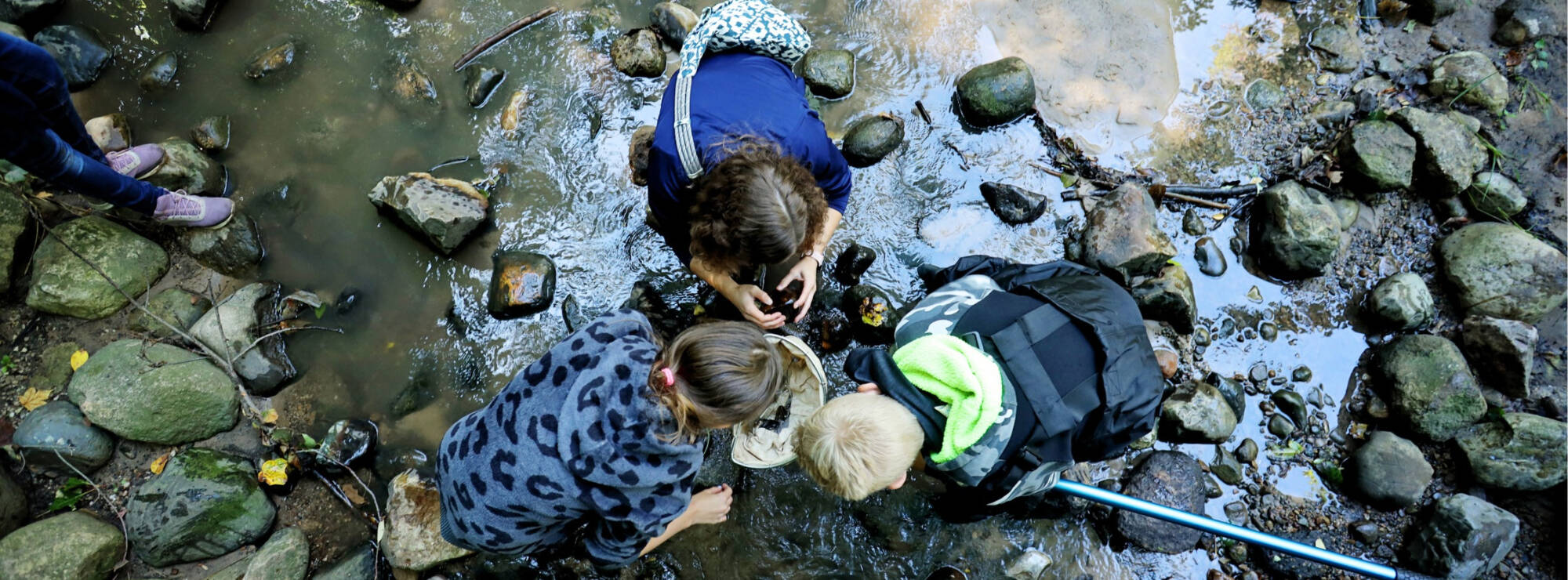
- Stream Sampling/ Enviroscape education: Throughout the school year students researched watershed issues and conducted stream water tests with partners WMEAC, John Ball Zoo, and GVMetro Council. Assessment sites included the John Ball Zoo pond, Highland Park, Grand River, and Lake Michigan.
Students connected these findings to their Salmon in the Classroom project.
Fostering Lifelong Stewardship:
Students have been overheard explaining to others the importance of caring for the environment through removing and preventing invasive species, preventing nonpoint source pollution from getting out of hand, and keeping their school and neighborhoods cleaner and safer.
Partners:
LGROW, MDEQ, Urban Roots, WMEAC, John Ball Zoo
Teachers:
4
Students:
93
Funder:
GVSU College of Education
Showcase Video:
https://www.youtube.com/watch?v=lMcoXNxEQFk
Project Description:
Students began the year discussing NPS pollution issues and watershed studies while raising Salmon in the Classroom beginning in Sept. and culminating with a salmon release in May into the Grand River. At the John Ball Zoo and later at the Grand Rapids Public Museum, students participated in week-long IMMERSE programs, where they recorded their observations of animals and their habitats including their relationships and impacts to our Grand River Watershed. Students continued their watershed studies by visiting the Grand Rapids Art Museum for four days during the Alexis Rockman exhibit which examined, through his paintings, pollution issues and invasive species of the Great Lakes. Students created their own art projects related to these environmental issues. Our students also conducted stream sampling/water testing in Coldbrook Creek at Highland Park, the Grand River and Spring Lake in Grand Haven. Students concluded their school year meeting with the Grand Rapids Parks Maintenance Supervisor to learn about park restoration, invasive species control and mitigation at Highland Park. Students will continue to work at Highland Park in successive school years in a partnership/adopting Highland Park capacity to help manage invasive species and conduct stream restoration and litter control.
Fostering Lifelong Stewardship:
Students will continue to take active steps to help solve environmental pollution and invasive species issues throughout their lives.
Partners:
WMEAC, John Ball Zoo, Grand Rapids Parks
Teachers:
2
Students:
52
Funder:
Great Lakes Stewardship Initiative
Showcase Video:
https://www.youtube.com/watch?v=0Ao3hOR_D8I
Project Description:
Our project was centered around stewardship that relates to our local watershed and Great Lakes. Our 4/5/6 grade classrooms have partnered with the Grand Rapids Parks & Recreation Dept. to adopt Highland Park as an ongoing stewardship project for our school. During the school year, our students visited the park each month and engaged in stewardship practices concerning the upkeep and restoration of Highland Park. Last spring, our students met with the GR Parks supervisor for an introduction to the environmental needs of the park and had a follow-up meeting again this year.
Students continued to research and monitor the park’s needs, focusing on trash pick-up and disposal, invasive plant removal, stream bank restoration, and park uses and practices. Coldbrook Creek runs through the park before emptying into the Grand River just south of the Leonard Street Bridge, so our students had real-world, hands-on experiences caring for this section of our Grand River Watershed. Students also had opportunities to conduct stream sampling activities including water chemistry and macroinvertebrate collection and identification.
In addition to caring for Highland Park, students conducted similar stewardship efforts on our school campus by planting more native plants, identifying and removing invasive plants, regular trash clean-up, green cafeteria/ composting, and helping to keep storm drains clear. These efforts at both Highland Park and the GR Montessori campus help students create a broader sense of place within their community. Students also helped educate other students, parents and community members about the importance of (and how to) stewardship.
A second aspect of our Groundswell Project this year included participating in the Salmon in the Classroom program. Our students cared for 150 Chinook Salmon eggs in our 55-gallon tank displayed in our school’s Main Floor hallway for all to see. The salmon were released in the spring into the Grand River. Once again, a real-world connection was experienced by our students through researching the life cycle and needs of Chinook Salmon and linking our Highland Park/Coldbrook Creek stewardship practices. Students participated in our annual salmon release event at Roselle Park in Ada, MI, where they also furthered their knowledge of best practices by participating in watershed-related activities lead by park staff.
A third component of our Groundswell Project involved taking a group of 6th graders on the GVSU DJ Angus Research Vessel into Spring Lake and Lake Michigan in the spring. During this outing, students examined water quality and macroinvertebrates in more depth, adding to their year’s work of stewardship practices.
Fostering Lifelong Stewardship:
We expect our students to have a sensitivity to the needs of our planet in terms of healthy ecosystems and an understanding of the importance of maintaining a connection to their environment. Our students have already shown a keen interest in discussing pollution issues and ways that they can help to mitigate invasive plants and work toward habitat restoration.
Partners:
WMEAC, Grand Rapids Parks and Recreation, Grand Valley Metro Council, Kent Conservation District, Friends of Coldbrook Creek, Wolf Lake State Fish Hatchery, Ada Township Parks
Teachers:
3
Students:
82
Funder:
NOAA BWET
Showcase Video:
https://youtu.be/4NpSwECa9Hk
Project Description:
Due to Covid 19 restrictions this fall, GR Montessori had to make adjustments to our
Groundswell Project for the 2020/2021 school year. This year we focused on Environmental
Stewardship issues through the distance learning avenue that we had available to us. Our
Stewardship focus includes the living and nonliving areas of an ecosystem, both having an
effect on the other. Our virtual studies included using synchronous and asynchronous aspects
to engage our students. Person-to-person interaction was reserved for when we were able to
safely meet again as classrooms beginning in January.
Students were given Outdoor Science/ Nature Backpacks with supplies to conduct observations
and assessments in their own backyards or neighborhood park. The backpacks included:
Notebook, Pencils, Magnifying Glass, Tape Measure, 18” Ring for designating and Eco-Study
area.
Our Stewardship focus continued during our John Ball Zoo Lab week. During our virtual week
at the zoo, students had 4 live zoom synchronous zoo staff lead activities including: Wild
Encounters, Adaptations, Exhibit Design, Enrichment Design. Each of these synchronous
activities focus on aspects of species survival through adaptation and movement linked with
the need for continued Stewardship practices. Asynchronous activities for the week included:
Daily Animal Observation through Live and Recorded Video Cams, Animal Training,
Commissary Tour, Behind the Scenes of the Aquarium, Vet. Hospital Tour, Meerkats &
Porcupines Virtual Tour, Bears Virtual Tour, Bear Live Cam. Observations through
explore.org, Various Live Cam. Animal Observations at the San Diego Zoo. In addition to the
listed zoo animals, we incorporated study and conservation of local animals with the help of
the JB Zoo, including, native turtles, toads, birds and pollinators.
Along with the John Ball Zoo Lab week, students had live cam. opportunities to observe
Salmon in the Classroom salmon development through live cam. at the Wolf Lake State Fish
Hatchery.
Beginning in January 2021, our school district began Hybrid/In-Person classes 4 days a week.
While at school, students had the opportunity to work with WMEAC with in-class Enviroscape
Demonstration, Water Quality testing from Coldbrook Creek water which included
Macroinvertebrate identification, Watershed Mapping activities.
Our students also participated in Campus Storm Drain cleaning and labeling. We worked with
LGROW both virtually and finally in person to learn about, assess, adopt and label the storm
drains at home and on our school campus.
We used Online Notebook resources and lessons provided by BWET to help students study
and make connections about their watershed, learn about natural resource professions and
home/ school outdoor inventories.
Finally, we deepened our understanding of our schoolyard/ outdoor inventory with Sally Triant
as she helped us learn more about our place at school. Students created lists and maps about
how spaces made them feel and what they wanted to create on their school grounds. Gardening
and adding more native plants had the most student votes! On campus activities continued
with gardening, Milkweed seed planting, and campus stewardship needs assessments.
Fostering Lifelong Stewardship:
We expect that students will continue to practice environmental stewardship through recycling,
composting, and trash mitigation as well native plant gardening, knowledge about pollinators,
deepen their love and appreciation of the natural world, see nature in an urban setting and
spread the word/ do the work about the benefits of these practices.
Partners:
John Ball Zoo, Wolf Lake State Fish Hatchery, Grow Wise Learning, Lower Grand River Organization Watersheds, West Michigan Environmental Action Council, Friends of Coldbrook Creek
Teachers:
Joe Uzarski, 4th, 5th, & 6th Grade All Subjects; Michelle Holliday, 4th, 5th, & 6th Grade All Subjects; James Emperor, 4th, 5th, & 6th Grade All Subjects; Matthew Evans, 4th, 5th, & 7th Grade All Subjects
Students:
94
Funder:
Independent Bank, National Oceanic and Atmospheric Administration (NOAA)
Showcase Video:
https://www.youtube.com/watch?v=Adhf6QbjN70&list=PLV2DqaYFEsPw2JB18lRhsDlGdXGILwakG&index=33
Project Description:
Our project is centered around stewardship that relates to our local watershed and Great Lakes and has several different components both on our school campus and in the community.
GRM Campus- On-campus, students created Green Groups and focused on each area to establish what needed to be done and action items or next steps. They were passionate about educating students of all ages, and adults. Their education efforts were at school, at home, at nutrition services and facilities, and at the Groundswell Showcase.
Groups overlapped and all students participated in these activities in some way. Garden Group- planted native plants, identified/removed invasive plants/ weeds, and maintained gardens, Trash/Recycling Group- regular trash clean-up and made signs. Storm Drain Group- storm drains clear, Education for E1 Group- focused on creating engaging materials for 1-3rd graders to teach about the environment.
Green Cafeteria Group- Students helped sort compost, trash, and recycling. We wrote letters and started a petition (they gathered over 200 signatures) to nutrition services to ask for industrial composting to return as well as compostable plates or preferably reusable plates and a dishwasher while working toward zero waste. Students expressed their concerns about food waste and suggested solutions. We made worm compost bins with WMEAC. The Kent County Waste Recovery Center visited and we did a waste audit. We will continue and grow these efforts next year.
On-campus cont., tree, and bird identification- Several classes worked with Sally Triant to identify trees. Others set up bird feeders and birdhouses with our HS seniors, and observed birds to further our knowledge about the birds on our campus.
Salmon in the classroom (hallway). Our 100 E2 students learned about salmon through weekly observation, study, and care. Unfortunately, we lost most of our salmon when the chiller malfunctioned (causing us to cancel our Roselle Park trip). We raised 8 amazing salmon and the 6th year students released them at the lake.
This year, our 4, 5, and 6th-year students, along with our high school seniors, created an Earth Day event for 1st - 12 grades. The PTA/ school Green Team supported and over 400 students, parents, and staff participated in the all-day event. 4, 5, 6, and 12th-year students worked in groups and created activities/ lessons to bring awareness to the importance of trash pick-up, recycling, upcycling, compost, native plants, trees and planting, birds and pollinators, and having fun outdoors. They also helped at the Fall Fair and planted our milkweed seeds with younger students and helped sort and deliver plants at the PTA Native Plant sale.
Community - We partnered with WMEAC to conduct stream sampling activities including water chemistry and macro-invertebrate collection and identification at Highland Park/ Coldbrook creek including trash clean up at the park. Students also learned about the watershed using WMEAC’s enviroscape.
John Ball Zoo- Our students participate in JB Zoo's Zoo lab program each year. This year we are worked with them to include extended projects throughout the next year focusing on local animals, insects, and their habitats. In addition to Zoo Lab (December 2021), we did a follow-up Zoo trip on May 1st and 2nd 2022. We learned more about local pollinators and turtles to introduce the pollinator/ native animal program/ partnership to students.
Field Study and workday- GVSU DJ Angus Research Vessel - As a culminating experience, our 6th-year students examine water quality and macro/micro invertebrates in more depth, adding to their work over the three years in upper elementary. Students went to Lake Michigan to learn about and have fun at the lake. This is a first-time visit to Lake Michigan for some of our students. Students also visited blue Lake at Camp Pendelouan. Here they extended their learning and outdoor education experiences. 6th-year students released our 8 remaining salmon at the lake too.
Fostering Lifelong Stewardship:
This project encourages lifelong stewardship practices of our students’ place at school, home, Michigan and the Great Lakes, and the world around them. By engaging in real-life efforts and taking care of the places around them, they understand their connection to the Great Lakes Watershed/Ecosystem and their place in the world. They have a deeper understanding and knowledge of the importance of caring for our Earth, they have the tools to take action, they care and they desire to do their best.
Partners:
John Ball Zoo, West Michigan Environmental Action Council, Grow Wise Learning, Lower Grand River Organization of Watersheds, Wolf Lake Fish Hatchery, Kent County Department of Public Works (Waste to Recovery)
Teachers:
Michelle Holliday, 4th-6th Grade, All Subjects; Joe Uzarski, 4th-6th Grade, All Subjects; Matthew Evans, 4th-6th Grade, All Subjects; James Emperor 4th-6th Grade, All Subjects
Students:
100
Funder:
MiSTEM
Showcase Video: https://www.youtube.com/watch?v=nXgv75Pwo2c&list=PLV2DqaYFEsPwEUUHkVf4EWeARMMgZa9NL&index=11&ab_channel=GroundswellMichigan
Project Description:
Our project is ongoing and centered around stewardship that relates to our local watershed and the Great Lakes. Our project has several different components both on our school campus and in the community.
GR Montessori School Campus- Outdoors on campus, students learn about and conduct stewardship efforts by designing garden spaces for birds and pollinators, planting native plants, identifying and removing invasive plants, planting trees, doing regular trash clean-up, and helping to keep storm drains clear. Students collect and record data on various aspects of our project as well as educate people in our school and the local community.
Indoors on campus, students engage in daily work in our cafeteria. Students from each classroom are responsible for daily composting, sorting trash, and recycling. Students also take the lead in educating staff, students, and parents in our community. One goal this year is to rebuild the compost bins on our school grounds and find a sustainable way to decrease food waste in our cafeteria. This was accomplished by a PTA fundraiser to purchase a new compost bin and grant money was used to purchase classroom compost bins for our 1, 2, and 3rd-year classrooms and students are educating our younger students about composting in class and in the cafeteria.
Another aspect of our on-campus (then community) work was participating in the Salmon in the Classroom Program. Our students cared for 150 Chinook Salmon eggs in our school’s main floor hallway. Students conduct weekly observations and collect data. The salmon were released in the spring into the Grand River by students and community partners, LGROW, WMEAC, and EGLE at our “Salmon Release Party. Our community partners helped with activities from water sampling, a salmon game, and a painting salmon with nature/ salmon goodbye letters and poems.
Community/ Watershed studies- We partner with WMEAC and LGROW to conduct stream sampling activities including water chemistry and macro-invertebrate collection and identification. We worked this fall at Highland Park and downtown at the Grand River. We continued this work in the spring at the IMMERSE program and at our Salmon Release Party. Our 6th-year students did research on the GVSU DJ Angus. Students were able to use data from these water testing events to compare data and learn about Michigan fish, the health of the water, and best practices.
We were unable to work with Ottawa PArks and Walden Green Montessori on the Upstream/ Downstream Program we were hoping to develop. Maybe in the future!
Other community partners are the John Ball Zoo, Joyful Wildcrafting, Growwise Learning, and Friends of GR Parks. This year we worked with them on an extended project with the JB Zoo “Habitat Hero” that was funded through the MiSTEM Grant that focuses on local animals, birds, pollinators, and their habitats and how to make home-school-community connections. With these partners, we were able to learn more about native plants, pollinators, and birds while making a greater impact on our school campus, at home, and in the community.
Fostering Lifelong Stewardship:
This project encouraged lifelong stewardship of the Great Lakes (and beyond) by guiding students to learn more and identify what they really care about, listen to what is important to them, and empower them to make changes and educate others. Students are “taking care” of places around them and understanding the connections to the Great Lakes Watershed/ Ecosystem to further deepen their understanding of place. This work is ongoing and daily. Because of this, students see that their daily work makes a difference and this work has become part of who they are.
Partners:
Wolf Lake Fish Hatchery, Trout Unlimited, West Michigan Environmental Action Council, Lower Grand River Organization of Watersheds, Friends of Grand Rapids Parks, Joyful Wildcrafting, Grow Wise Learning, Grand Valley State University Annis Water Resources Institute, Michigan Department of the Environment, Great Lakes, and Energy, Grand Rapids Public Museum, John Ball Zoo
Teachers:
Michelle Holliday, Joe Uzarski, Matthew Evans, James Emperor; All subjects, 4th-6th Grades
Students:
100
Funder:
Wege Foundation, West Michigan MiSTEM Region, Grand Rapids Montessori PTA
Showcase Video: https://youtu.be/Qc59pKSvj9A
Project Description:
We stayed with our project and plan for the most part. We made a few adjustments as needed but overall the project was very successful and continues to grow.
Outdoors on campus, students learned about and conducted stewardship efforts by designing garden spaces for birds and pollinators, planting native plants, identifying and removing invasive plants, doing regular trash clean-up, and helping to keep storm drains clear although not as much as we had planned (next year!). We worked in our gardens and continued our garden design.
Indoors on campus, students work daily in our cafeteria. Students from each classroom are responsible for daily composting, sorting trash, recycling, and collecting compost from other classrooms. Students take the lead in educating staff, students, and parents in our community. We did more with compost and recycling in the cafeteria by fine-tuning our practices. We purchased bins for all classrooms and did a letter-writing campaign pre-k 12. We invited Nicole Rapacki of GR Public Works Recycling Coordinator to come and speak on Earth Day 1st-6th grades rather than go there and started a hallway recycling initiative.
We participated in the Salmon in the Classroom Program. Our 6th years went to the Wolf Lake Fish Hatchery. Students help care for 100 Chinook Salmon eggs in our school’s main floor hallway conduct weekly observations and collect data. Our 6th released the salmon in the spring into the Grand River.
Community/ Watershed studies- We partnered with WMEAC to conduct stream sampling activities including water chemistry and macro-invertebrate collection and identification. We did this work in the spring at Highland Park. 6th-year students worked on the GVSU DJ Angus at Spring Lake and Lake Michigan.
We partnered again with the John Ball Zoo, and Joyful Wildcrafting and worked with them again on our project “Habitat Hero.” This year we learned more about Michigan Turtles and Bees. We partnered with our HS seniors on a bee project we presented at STEAM Day at JBZ. The zoo asked us to promote the City Nature Challenge at the Party for the Planet in April. These were very successful events.
Fostering Lifelong Stewardship:
As stated above, I see their knowledge is deeper, their attitudes are awesome and they care. They're true stewards of the earth and our watershed. They are educators and help to create change. I think because we are building and growing our project each year and we have had students for three years this work has become a practice, not a one-time project. Thank you!!
Partners:
WMEAC, Grow Wise Learning, Joyful Wildcrafting, JBZoo, City of Grand Rapids Public Works
Teachers:
Michelle Holliday, Joe Uzarski, Matthew Evans, James Emperor; All subjects, 4th-6th Grades
Students:
100
Funder:
Great Lakes Fishery Trust
Showcase Video: https://youtu.be/Q5IanqebUQI?si=QAh0W05ZY7FMHBwD
Project Description:
Students led ongoing environmental projects like habitat restoration, composting, and salmon release, both on campus and in the community. Guided by 6th-year leaders and local partners, they supported ecosystem health and outdoor learning.
Students also led a decade-long composting initiative, managing waste sorting and advocating for district support. Partnering with groups like Wormies, they worked to make composting more sustainable and educational.
Partners:
Joyful Wildcrafting, John Ball Zoo
Teachers:
Michelle Holliday, Joe Uzarski, James Emperor, Madison Stimac, 4th - 6th
Students:
102
Funder:
Great Lakes Fishery Trust
Showcase Video: https://youtu.be/-elvJWeIEp8?feature=share
Showcase Video: https://youtu.be/XG7uHd-1hgA?si=Z8uvNQTMYURWtz4y