

Central Middle School

Project Description:
For the outdoor classroom portion of this project, students first identified areas on campus they felt would make good locations for core teachers to take their students to learn. These outdoor classrooms needed work—students created trails, signs, seating areas, and cleared invasive and dead plants from the area. In an effort to inform teachers, students created documents to pitch the classrooms. For the second portion of the project, students created an overwintering bird habitat by identifying an an area of mowed turf grass outside the classroom that could be repurposed to give some birds food, water, and shelter in the winter. Their goal was to lessen the mowing area on the CMS campus and to give students a view from the indoors they can learn from throughout the year.
Fostering Lifelong Stewardship:
Students learned that through hard work, they can restore habitat that benefits wildlife and themselves.
Partners:
Grand Rapids Jr. Audubon Club, Brett Black
Teachers:
1
Students:
115
Funder:
National Oceanic and Atmospheric Administration
Showcase Video:
https://www.youtube.com/watch?v=A5RIEeqJwgs
Project Description:
Students in Honors Foundations of Science worked with the Natural Expressions classes to assess the property at Central Middle School for nonpoint source pollution issues.
Students repurposed two sites of turf grass by planting native plants to increase stormwater infiltration and stop runoff from the sidewalk and driveway. In this way, they reduced pollution in the Grand River Watershed.
Fostering Lifelong Stewardship:
The students viewed landscaping practices along shorelines and developed their voice regarding future projects and practices. The students now understand the importance of native plants and have the knowledge to incorporate them at their current homes and potentially their future homes.
Partners:
Ada Township Parks, Georgia Donovan
Teachers:
2
Students:
135
Funder:
U.S. Environmental Protection Agency through the Michigan Department of Environmental Quality
Showcase Video:
https://www.youtube.com/watch?v=5ayue9gKjXY
Project Description:
The purpose of this project was to show students the connection between the biodiversity that occurs with native plants and natural shoreline buffer zones and the health of their local watershed. Students identified and collected native seeds from plants at Central Middle School (CMS) and spread the seeds in the CMS east prairie. They also created seed balls, started some plants from seed, and cold stratified seeds. These were planted on campus in the east prairie and given to local landowners.
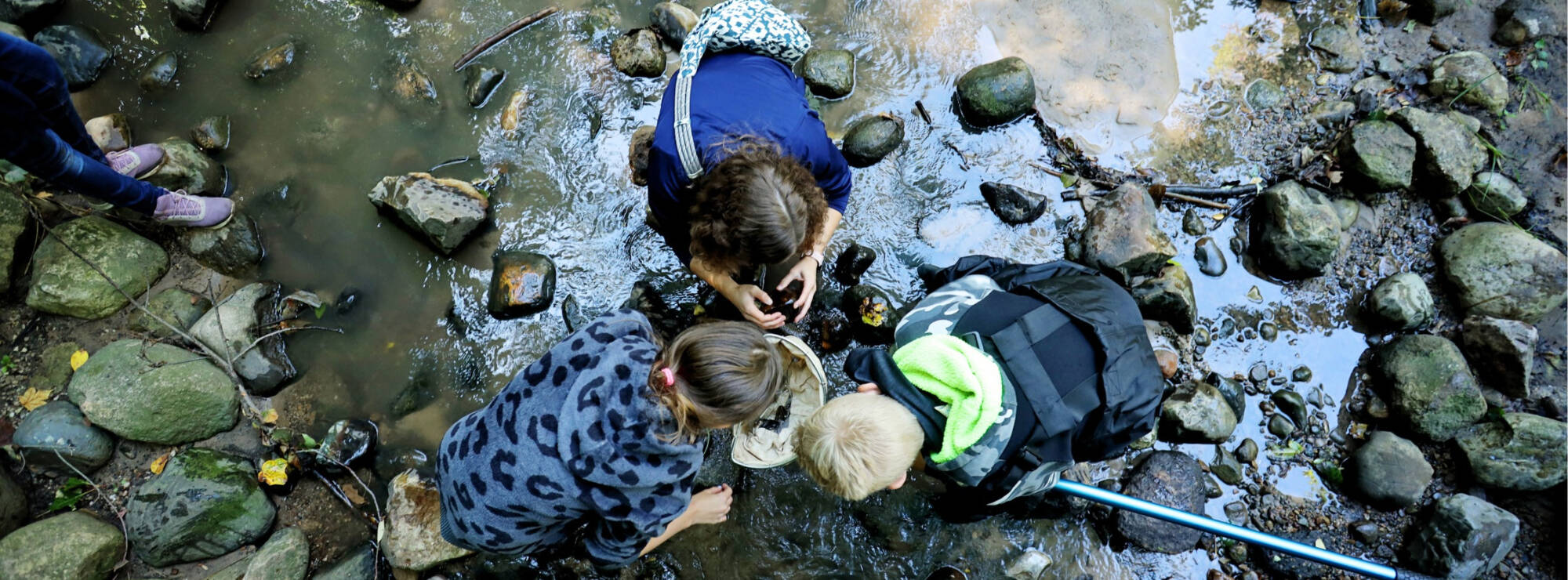
Students also conducted chemical and macroinvertebrate sampling in the campus pond, stream and nearby Paradise Lake to evaluate nonpoint source pollution impacts. Students explored the importance of natural shoreline buffer zones and the elements of an effective buffer for reducing NPS pollution through the creation of shoreline plans for homeowners on Paradise Lake using best management practices. The goals was to plan a possible shoreline for a house or two on Paradise Lake. Students would then approach the homeowner to educate them about healthy shoreline management and show them what their shoreline could look like to help reduce NPS pollution and improve lake water quality.
Students also used art to show the interconnectedness of the wetland ecosystem. Students explored the role of wetlands in natural ecological cycles as well as how wetlands work as a buffer zone for the natural waterway of lake or river and how healthy wetlands help mitigate nonpoint source pollution. In the end, students understood the need to reduce nonpoint source pollution and know small steps that can be taken to achieve this goal.
Fostering Lifelong Stewardship:
Students worked towards the goal to become educated adults and homeowners in regards to healthy watersheds and best practices in land and water management.
Partners:
Ada Parks, Georgia Donovan, Megan Lendman
Teachers:
2
Students:
225
Funder:
U.S. Environmental Protection Agency through the Michigan Department of Environmental Quality
Showcase Video:
https://www.youtube.com/watch?v=rGqnEdX4wH4
Project Description:
Students created a plan to increase the health of the school woodlands, which included eradicating invasive species and planting native woodland plant areas within the forest. They chose plants for purchase, pulled garlic mustard and oriental bittersweet, created signs, and installed the native plants. They also replanted a small area in the parking lot that was previously created to reduce stormwater runoff. The original plants died, so we tried something different in hopes of success.
Our school collaborated with the Adacroft neighborhood association to pull garlic mustard throughout the wooded commons area of the neighborhood. All seventh grade science classes participated in pulling garlic mustard there. Natural Expressions students created a flyer about the plant and why it should be eradicated, and then they distributed flyers throughout the neighborhood while science students worked in the woods.
Fostering Lifelong Stewardship:
Students will become educated adults and homeowners as a result of learning about healthy watersheds and best practices in land management.
Partners:
Adacroft Neighborhood Association, Wild Birds Unlimited, Kent Conservation District
Teachers:
2
Students:
390
Funder:
U.S. Environmental Protection Agency through the Michigan Department of Environmental Quality
Showcase Video:
https://www.youtube.com/watch?v=2J0IiiJOWGA
Project Description:
It’s important to recognize the environmental impacts we make on our property, our watershed, and those downstream of us. CMS reached out to our neighbors to the north (Amway) to see how they’ve instituted best practices in their business and our neighbors to the west (Paradise Lake Association) to put stewardship into practice. By the end of the year, students were able to articulate the positive and negative impacts they have on their place. They considered all the factors in water quality on campus runoff beginning in a detention pond at Central Middle that then flows to Paradise Lake.
The Environmental Health Team at Amway collaborated with Natural Expressions classes on the subjects of waste, alternative energy, stormwater runoff, and green space. We also connected with an educator from the Kent County Dept. of Public Works, who spoke to Natural Expressions students about waste, landfills, recycling, etc. and to explain the Kent County goal to reduce landfill trash by 20% in 2020 and 90% in 2030.
We were able to connect with a homeowner along Paradise Lake to determine the health of the waterbody, where the rain falls on her property, and how she might use best-management practices to positively impact the water’s health.
Students shared their knowledge of healthy watersheds/ecosystems, native trees, and invasive forest organisms with 3rd graders from Ada Elementary.
Finally, CMS Groundswell students shared their knowledge of invasive garlic mustard and removal practices with the rest of the student body and the community in Adacroft neighborhood before and during an invasive plant pulling event in the woodland “commons” area of Adacroft. They also pulled garlic mustard on our campus.
Fostering Lifelong Stewardship:
Students will understand the impact humans have on their watershed. By engaging in rainscaping site assessments they developed skills they can take with them in the future to their homes, cottages, etc. They also know the benefits of native plants on our environment and they know how to identify key invasive ones. They understand how devastating the invasive plants can be on the land. Over the course of the semester, students experienced many different stewardship practices they can build on throughout their lives.
Partners:
Amway, Paradise Lake homeowner, Kent County Department of Public Works, Adacroft Neighborhood Association
Teachers:
3
Students:
370
Funder:
National Oceanic and Atmospheric Administration
Showcase Video:
https://youtu.be/m7y-6dT_zNM
Project Description
CMS students built bridges on land and within neighboring communities. We recognized three issues: an unhealthy forest, neighborhood associations with invasive plant issues, and increased landfill dumpster use.
Picking up from last year, students continued creating trails and removing invasive plants in the south woods. Students recognized the many species of wildlife that call CMS their home and focused on increasing wildlife habitat for birds, herps, and mammals. They did this throughout the campus by planting native plants, building and installing bird nesting boxes, and putting out plywood and aluminum “cover boards'' to attract and document herps on campus.
First semester students learned about issues around waste management, particularly in regards to our school lunches from new Covid-required containers, encouraging others to bring zero waste lunches and to recycle what they could from our cafeteria lunches. They added five recycling bins in the hallways, so students have an option to recycle where there used to be only a landfill bin. We started a new relationship with Ada Place Condos Neighborhood Association where all 7th grade science students pulled garlic mustard and other invasive species in the woodlands there and at school.
In both semesters Natural Expressions learned about Oriental bittersweet, since it is a concern in our community. They created videos to encourage others to identify and eradicate this tenacious plant. During 2nd semester they combined with the art classes for an invasive species forest weaving unit, where they removed bittersweet and created weavings and artists’ statements to leave an impact on campus and the community.
Fostering Lifelong Stewardship
Students have many experiences in the natural world on campus to enjoy themselves and learn first hand about stewardship opportunities. The combination is such that students see a direct impact on a place where they are making memories and as such this encourages lifelong stewardship.
Partners:
John Ball Park, Revery, Ada Place Condos Neighborhood Association
Teachers:
Lea Sevigny, 7-8th grade Communications; Caitlyn Tetreault, 7-8th grade Art; Gina Borton, 7th grade Science; Mark Deppe 7th grade Science
Students:
245
Funder:
GVSU College of Education, Baldwin Foundation
Showcase Video: https://www.youtube.com/watch?v=weTjjpvvDqw
Project Description:
For this project, [my] Senior Composition students researched food sovereignty and food justice issues. They [looked] at places in the Grand Rapids area that focus on providing more equity and access to food. As a final product, they create[d] written portfolio that synthesized their research and field work that could be used by community members to find information and sources for food justice.
Fostering Lifelong Stewardship:
Few of the students had background in this topic, and as privileged students, they were not aware that food can be challenging for people to access. This project educated them about how a business can be for-profit and still have a service component and mission. It also helped students think more critically about where our food comes from and why certain communities have greater access to it while others do not.
Partners:
South East Market
Teachers:
Anne Keller, 12th Grade, English
Students:
19
Funder:
MiSTEM
Showcase Video: https://www.youtube.com/watch?v=AUZBMsPKai4&list=PLV2DqaYFEsPwEUUHkVf4EWeARMMgZa9NL&index=4&ab_channel=GroundswellMichigan