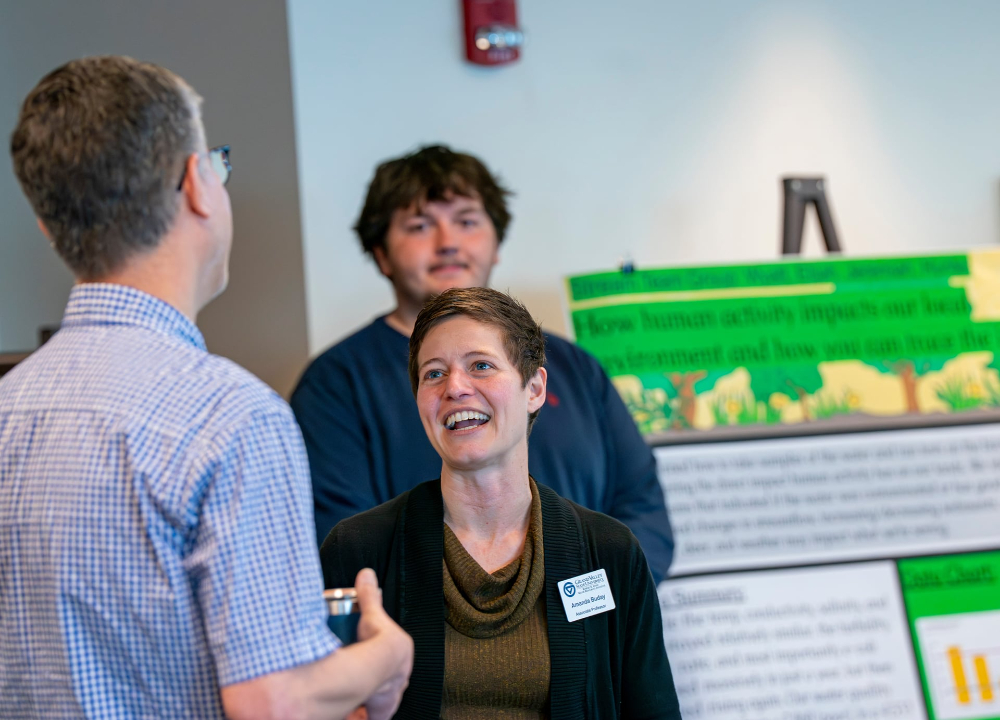
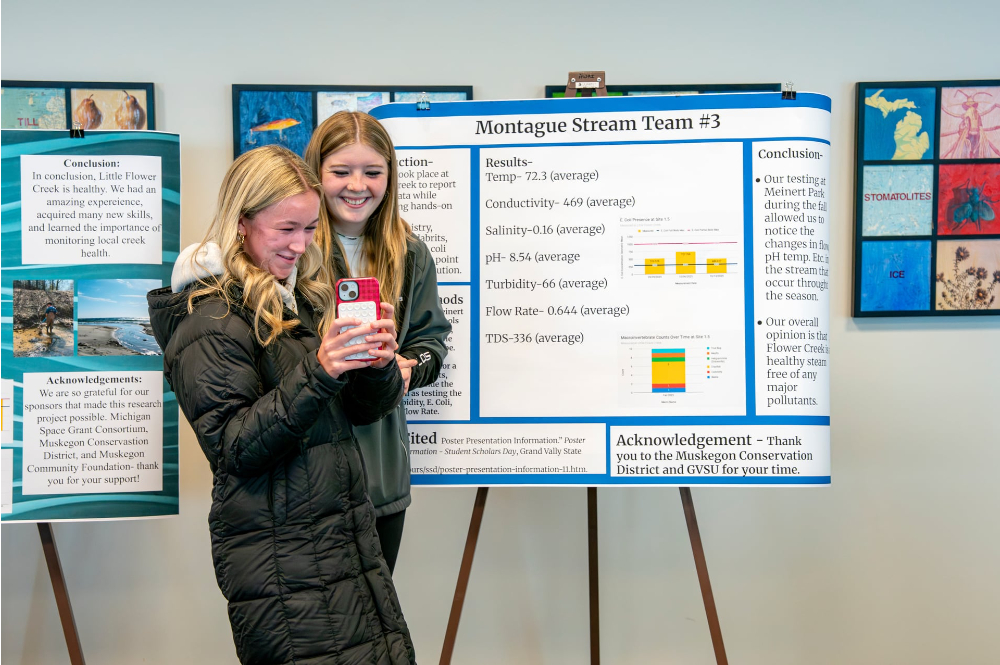
Amanda Buday, associate professor of sociology, chats with
participants during the Stream Team Summit at the Annis Water
Resources Institute in Muskegon on April 21. Ravenna, Coopersville
and Montague high schools took part in the summit.
Photo Credit: Cory Morse
A water monitoring project guided by faculty and the Annis Water
Resources Institute is introducing students from rural West Michigan
schools to environmental science while generating valuable data for
their communities.
The Stream Team project trains students to collect samples and
analyze data from Crockery Creek and its surrounding watershed.
Educators, family members and faculty gathered at AWRI on April 21 to
hear the students’ presentations.
The project began with a community survey led by Amanda Buday,
associate professor of sociology, who sought to understand how local
residents perceived water quality in the watershed. Many, she found,
were unsure of the condition of their water.
“There was a patchwork of information from different agencies, points
of time and parameters,” Buday said. “We realized that there was an
appetite for better information and stewardship about the waterways.”
Her connections led her to Ravenna High’s environmental science
educator Melanie Block, who works with the school’s Future Farmers of
America chapter and teaches an agriscience class.
“At the time, she was teaching a rural technology class,” Buday said.
“So, we got the class out monitoring Crockery Creek, and that started
the whole stream monitoring program.”
Four years later, classes from Montague and Coopersville are a part
of the program, too. Students monitor pH and E. coli levels, salinity,
turbidity and biological indicators, bringing clearer insight into
local water quality.
“These small inland streams are where a lot of people have a point of
contact for their recreational water use,” Buday said. “They hunt in
these streams. They fish in these streams. They take their kids to the
parks where these streams flow through. They have a lot of interaction
with these local waterways.”
The project has also evolved into a cross-disciplinary effort, Buday
said, with faculty from sociology, geology, statistics, biology,
environmental studies and public health contributing their expertise.
Grand Valley students also play a key role by supplying field
training, technical support and peer mentorship.
“We’re hoping that the Grand Valley students are providing a model of
another peer who’s a science student,” Buday said. “Having peer models
who are the 'face of science' for our high school students is important.
“Those trainers are logistically important, but they also have that
peer mentor role, where we’re connecting the high school students
directly to Grand Valley students.”
Participants spent 10 weeks in an accelerator program offered by the DeVos Center for Entrepreneurship & Innovation, in partnership with GVSU's Northern Michigan Region.
Featured
July 14, 2026 (Volume 49, Number 19)
Article by
Shannon Owen