

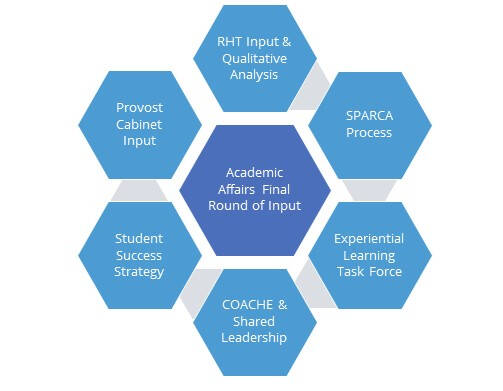
Sources of Input
RHT Input Qualitative Analysis
Academic Affairs collaborated with the RHT effort to gather the data provided by our faculty, staff, and students, which generated more than 4,000 responses. Four qualitative researchers partnered with the Provost Office to code the responses and further analyze them into a thematic report with categories and supporting snippets. This report shaped and informed the initial work for the Provost Cabinet. View the Qualitative Research Summary Report to learn more.
Student Success Strategy
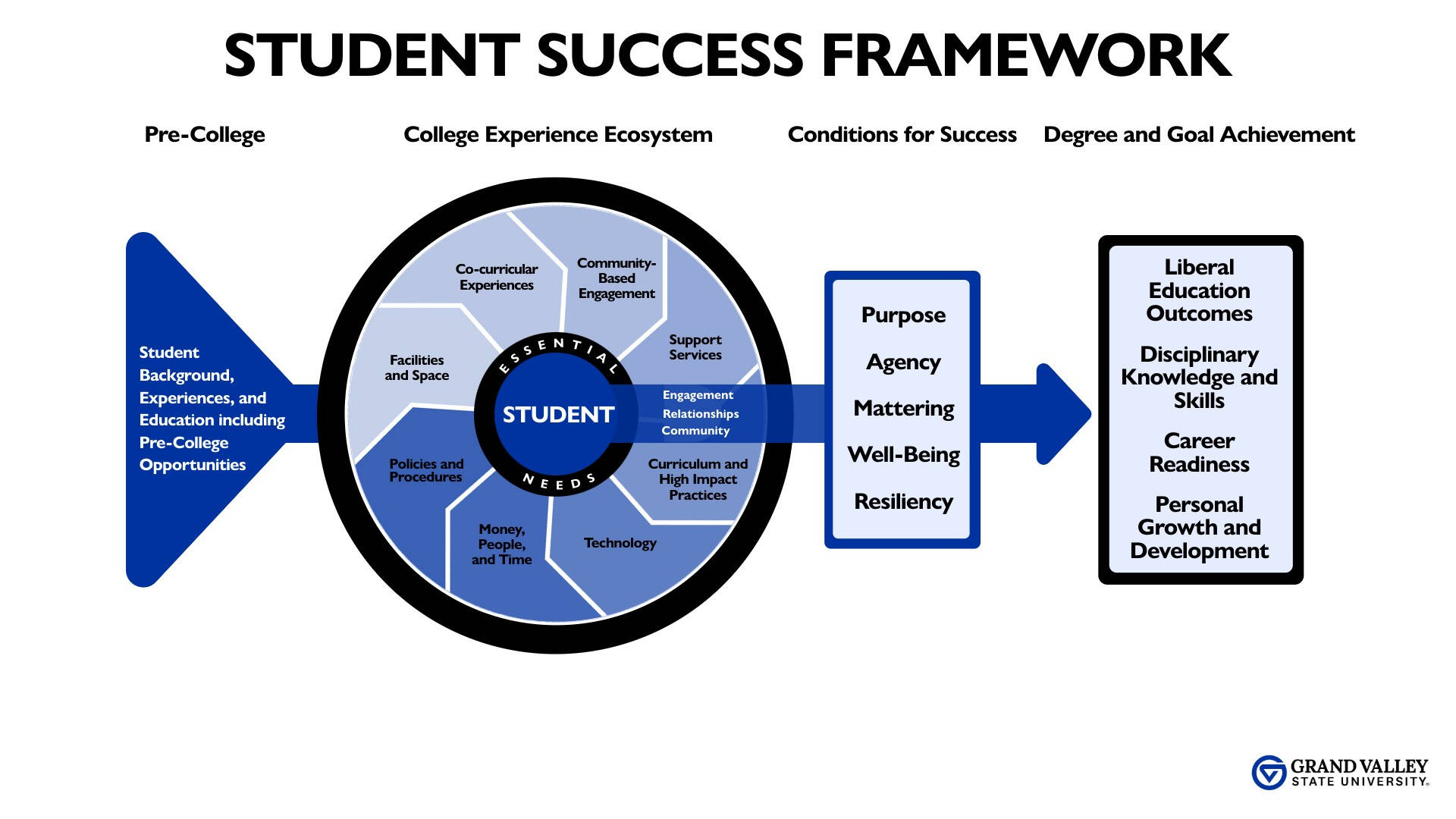
The Student Success Strategy was a cross-divisional effort. It includes a series of possible strategies, strategic goals, objectives, and tactics to advance academic excellence and student success. It also outlines a Student Success Framework, which visually represents how various institutional components contribute to student success. A website dedicated to this work is coming soon, and it will be linked here. The work informed AASF.
SPARCA – Strategic Plan to Augment Research, Scholarship, and Creative Activity
The Strategic Plan to Augment Research, Scholarship, and Creative Activity (SPARCA) was co-created by Grand Valley State University's faculty and leadership. SPARCA centered the university's strength in integrating high-impact teaching with faculty research, scholarship, and creative activity. The draft strategic plan contained many possible strategic goals and objectives, which were kept in mind.
COACHE Report
COACHE provided GVSU diagnostic reports and regular consultations with the COACHE team on making meaning and acting from the data. During the Fall 2024 semester, GVSU faculty had several discussions to review the findings and consider next steps.
The findings of the COACHE Report were kept in mind.
Shared Leadership Workshops
Following the COACHE Report, the COACHE Steering Committee led the creation of workshops that promoted shared governance and leadership. These workshops brought leaders together in a safe, collaborative space where they could begin to rebuild trust and communication. Participants took part in an interactive, modified Appreciative Inquiry workshop. Opportunities and challenges discussed during these meetings were kept in mind.
Experiential Learning Task Force
Experiential education at Grand Valley State University is deeply valued across colleges, units, and university partners, but its implementation varies widely. The growing number of experiential learning initiatives across the institution and the variety of opportunities available to students have surfaced important questions about coordination, efficiency, transparency, and accessibility. Insights from faculty leaders, administrators, and existing initiatives reveal strong momentum, but also structural, cultural, and logistical challenges. In response, Provost Drake tasked a small group to explore enhancing support for experiential education across the institution. The task force surfaced strengths, opportunities, and challenges for experiential learning at GV. These also shaped the upcoming HLC Quality Initiative: Barrier Free Access to Experiential Learning. These themes and the upcoming HLC Quality Initiative informed the development of the AASF.
Provost Cabinet Input
Over the summer, Provost Cabinet worked collaboratively to provide input and feedback on the development of the strategic framework. As part of this work, they considered all the above input sources to begin shaping the strategic framework. They elevated strategic efforts and initiatives under their leadership. Through a series of workshops, they envisioned the shared future of Academic Affairs. Together, they articulated a shared vision, defined strategic priorities, and drafted moves as well as possible actions to drive Academic Affairs forward.