
Spotlights
Interview with 3MT Champion Jaclyn Driesenga
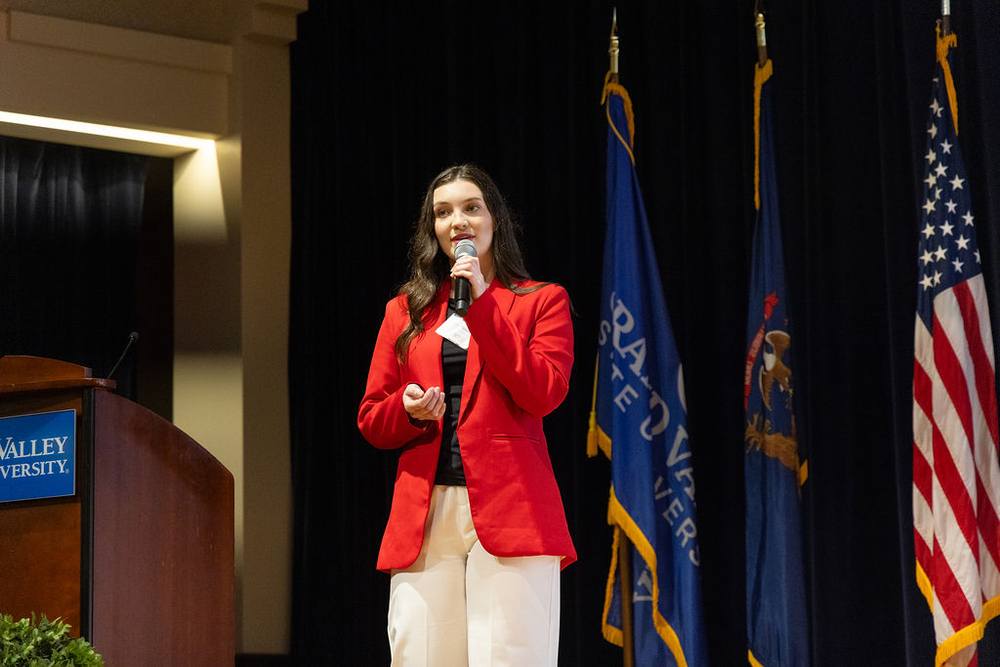
Master of Public Health student Jaclyn Driesenga recently won the Graduate School's 3-Minute Thesis Competition. Her research, titled "Exploring Gaps in Medical Services for Individuals with Down Syndrome: Insights from a Clinical Director Survey," explores what Down syndrome care looks like nationally across a variety of clinics.
Jaclyn surveyed 80+ medical care directors for her project, finding that, "...while 88% of clinical directors felt personally prepared to care for individuals with Down syndrome, only 29% reported that their staff was very prepared to do so." Many clinics also did not provide adequate communication accommodations for individuals with Down syndrome or include them in their own medical decision-making.
We interviewed Jaclyn to discuss her project further and the impact she hopes to make, below:
1. How did you land on this particular research topic?
My research focus stems from a commitment to advancing equity for populations that are often underrepresented in both healthcare and research. Individuals with intellectual and developmental disabilities (IDD) are frequently overlooked, despite the fact that disability is a common part of the human experience. Recognizing this gap motivated me to focus specifically on individuals with Down syndrome, a population that faces unique healthcare challenges but remains underrepresented in public health research.
2. What problem were you trying to solve in your thesis?
Individuals with Down syndrome often face challenges when navigating the healthcare system, particularly when it comes to accessing coordinated, specialized care. At the same time, many healthcare providers report feeling underprepared and lacking the necessary resources to meet the complex needs of this population.
Currently, we don’t have a clear, national understanding of what specialized Down syndrome care looks like across clinics. To address this, my research surveyed over 80 clinical directors affiliated with Down syndrome programs to better understand how care is delivered.
The findings showed that while clinics are doing meaningful work in providing essential services, there are still gaps in areas such as staffing preparation, service availability, inclusive practice, and financial equity. Ultimately, this research helps lay the groundwork for comprehensive healthcare for individuals with Down syndrome.
3. How did it feel to compete, and what was the moment you found out you won?
It’s one thing to feel passionate about your own research—it’s another to communicate that passion in a way that resonates with others. Competing in the 3 Minute Thesis challenged me to turn complex ideas into a compelling story that the audience could connect with. When I heard my name announced as the winner, it was an incredibly rewarding moment. It felt like validation not only of the effort I had put into my research, but also of the significance of the topic itself.
4. What do you want people to walk away thinking or feeling after reading about your work?
I hope people walk away with a greater awareness of the healthcare challenges faced by individuals with Down syndrome. More importantly, I hope they feel a sense of responsibility to be part of the solution, whether that’s through advocacy, education, research, or clinical practice. Every individual deserves access to high-quality, compassionate, and coordinated healthcare. If this work inspires even a small shift in how people think about or approach care for individuals with IDD, then it has made a meaningful impact.
Congratulations to Jaclyn on her win! We look forward to seeing the impact of her research on healthcare facilities that serve people with Down Syndrome, and beyond.
Author: Kennedy Scott, GVSU CHP Marketing and Communications
Interest Area(s)
Public Health
Share this spotlight
Return to the listing of spotlights.