

Spotlights
Four Questions with 3MT Runner Up Rashmeer Mangat
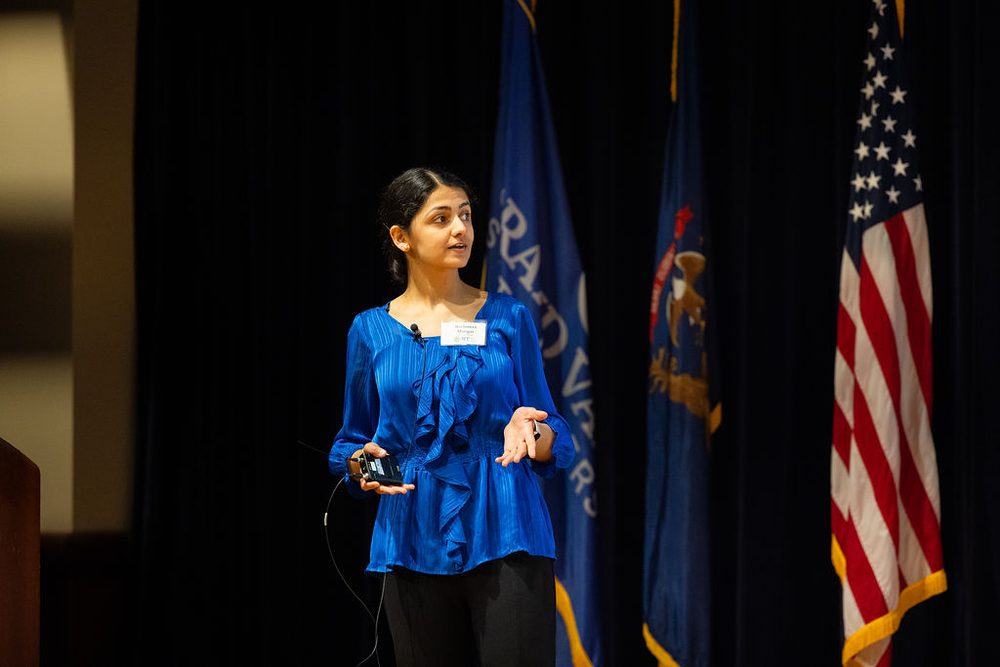
Rashmeer Mangat, a Doctor of Physical Therapy student graduating this year, presented her research, “Exploring Diversity in Low-Fidelity Simulations.” This research examined the use of mannequins, task trainers, CPR dummies, and assistive devices in lab environments to find patterns, themes, and areas for growth in representing diversity in the simulation space.
In Rashmeer’s words, “The goal is to offer actionable recommendations that healthcare programs can use to build more inclusive simulation experiences, so students graduate better prepared to care for a truly diverse patient population.”
Read more of our conversation with her about her innovative project below:
- What drew you to physical therapy, and what sparked your interest in simulation-based education specifically?
Physical therapy felt like a natural fit because of my love for an active lifestyle. Growing up, my family bonded over sports like badminton, tennis, and cricket at family gatherings, and I also grew up doing Bhangra, a folk dance rooted in the state of Punjab in northern India. That energy naturally drew me toward a profession centered on movement and the human body. What separated PT from other healthcare paths was its holistic philosophy of using movement to heal.
My interest in simulation-based education stems from a personal place. My parents speak English as a second language, carry cultural beliefs that differ from mainstream Western medicine, and have navigated a healthcare system that was not always designed with people like them in mind. Watching them navigate that shaped how I think about patient care. I believe healthcare students need early exposure to the full diversity of human experience, including different cultural backgrounds, pain beliefs, and ways the same condition can present. Simulation gives us a safe space to practice navigating that complexity before we ever step into a real clinic.
2. How did diversity in simulations become your focus, was there a moment or experience that highlighted this gap for you?
My interest grew gradually rather than from one defining moment. From a young age, I was always navigating two cultures, which shaped how I see the world, including healthcare. That perspective followed me into my education, where I began noticing things that are easy to overlook like CPR dummies that skewed light-skinned and male. The real world does not work that way. Clinicians treat people of every skin tone, body shape, age group, sex, and ability level. If our training environments do not reflect that reality, we are creating blind spots in students before they ever graduate.
3. Who does this research impact, and why does it matter for PT and patient care?
This research speaks to healthcare students broadly, but for PT specifically, the stakes are direct. Physical therapists work hands-on with patients across a wide spectrum of backgrounds, bodies, and abilities. When students are not exposed to that diversity during their training, they can develop unconscious assumptions that follow them into practice and influence clinical decisions in ways they may not even realize. At its core, this research is about examining your own implicit biases, understanding where they come from, and committing to equitable care for every patient.
4. How do you hope PT programs, including GVSU’s, act on this research? Do you see this shaping how you practice?
My hope is that programs treat diversity not as a standalone lesson, but as something woven into every lab and simulation. That means mannequins and models with a range of skin tones, representation of physical disability with various assistive devices, and appropriately sized equipment for different bodies. It also means not defaulting to predominantly male mannequins when the real patient population is varied. Small, consistent choices like these, repeated across an entire curriculum, build clinicians who are truly prepared for the real world. As for my own practice, this research has strengthened my commitment to getting to know each patient before I ever begin treating them: their cultural background, their beliefs about pain and medicine, their life experiences, and what they bring through the door with them.
Congratulations to Rashmeer for placing in the competition! We are grateful for her dedication to diversity and inclusion in the simulation space and are excited for the impact of her research on both GVSU and the physical therapy profession.
Author: Kennedy Scott, GVSU CHP Marketing and Communications
Interest Area(s)
Physical Therapy
Share this spotlight
Return to the listing of spotlights.