Summer Camps
K-Pop, Minecraft, and Meaningful Learning: VAI Education Expands Summer Programs for 2026
As schools take their first steps into spring, the pressure to prepare meaningful, engaging learning experiences for the upcoming summer has never been more palpable. Districts are balancing staffing shortages, limited planning time, and the need to accelerate student learning for those who need additional support. In recognition of these challenges, Van Andel Institute for Education (VAI Education) has prepared a pair of resources that promise to take the weight off schools and educators alike: a Summer School Professional Development (PD) program that guides K-8 teachers through effective summer school implementation, and unique Summer Camps in science, engineering, and robotics for students in grades K-12.
VAI Summer Camps create space for students to ask questions, collaborate with peers, and explore the wide world of STEM through unique, immersive experiences. These include new camps like K-Pop STEM Stars and Minecraft Makers which show students how learning can be memorable, meaningful, and fun!
Together, these offerings reflect VAI Education's commitment to supporting both teachers and students with high-quality, inquiry-driven learning opportunities that extend beyond the traditional school year.
To learn more about VAI Education's Summer programs, please visit VAIeducation.org.
Events & Resources For Teachers
GVSU Alumnus Launches New Platform Designed to Help K-12 Teachers!
Streamline one of the most stressful pain points in K-12 education: Unexpected teacher absences.
While generative AI tools have changed daily lesson prep, they still require significant time, prompting, and manual editing—luxuries a teacher does not have when waking up with a sudden illness or family emergency. LessonPlansNow.com cuts through the digital clutter by providing "print-and-go" emergency sub plans for $15 per unit.
Built for rapid deployment, each standalone package provides a complete 45-minute block of classroom instruction. The plans include a targeted reading passage, an aligned worksheet, and a curated video lesson structured so that any substitute teacher can easily run the classroom with zero prior notice. Teachers simply do a quick review of the materials, download, and send them to school.
In addition to supporting educators, the platform operates with a focus on sustainability, directing a portion of all sales to water conservation efforts.
GVSU education alumni looking to build out their "emergency sub binders" can view the available units at LessonPlansNow.com.
Science on the Grand Returns!
Van Andel Institute for Education
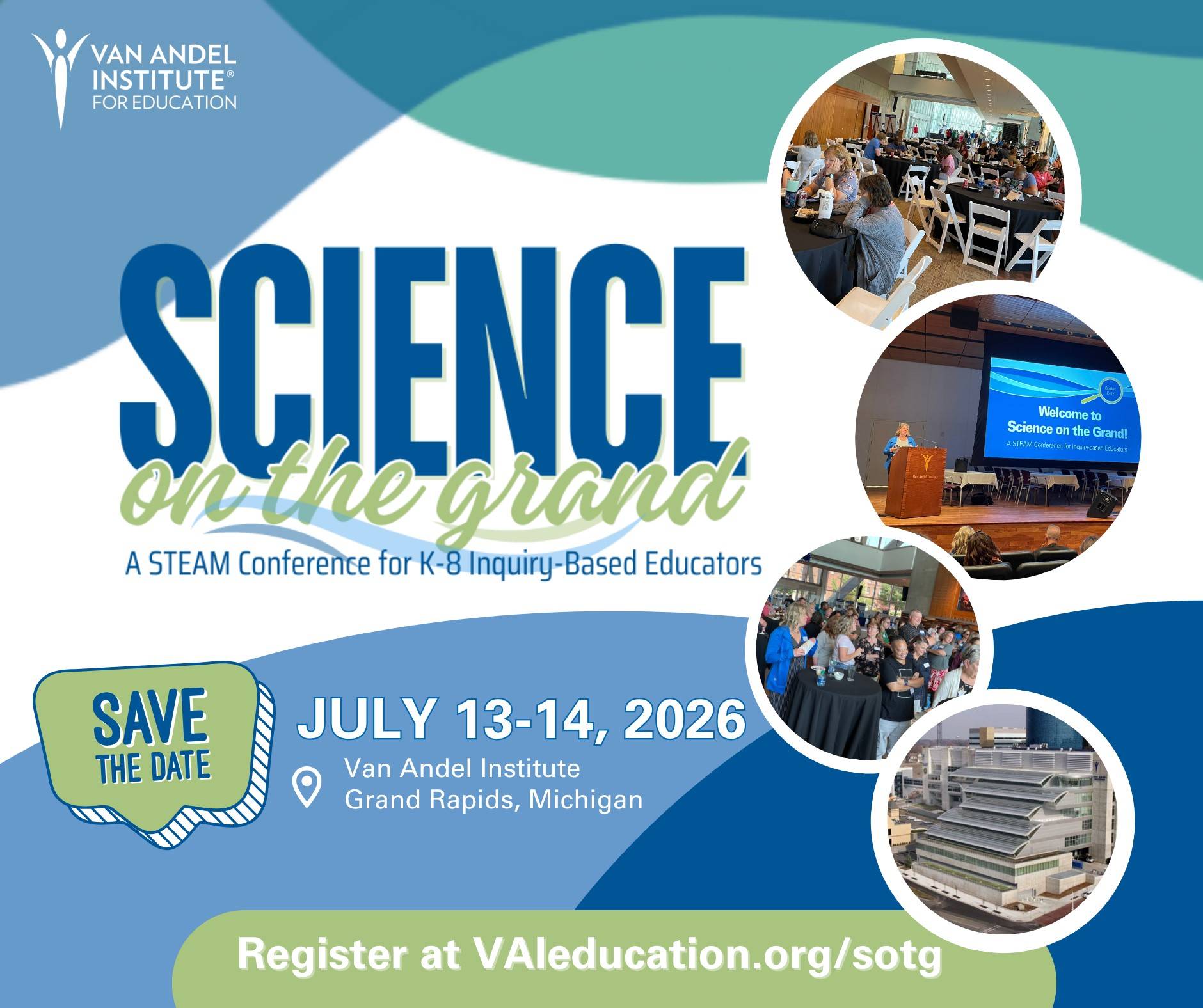
Science on the Grand: A STEAM Conference for Inquiry-Based Educators is returning to Grand Rapids, MI, July 13-14, with a new collection of professional speakers, interactive workshops, and firsthand STEM investigations created to enrich and empower K-8 teachers.
"Teaching can be such an isolating profession," says VAI Education Director and Education Officer, Terra Tarango, "So, when you have the chance to gather and learn with other teachers facing the same struggles and sharing the same passions, it's invigorating!"
Science on the Grand will open with a keynote address from educator and AI strategist, Winston Roberts, who will demonstrate how tools like ChatGPT work through simple, guided activities, and explore ways teachers can use AI behind the scenes to save time and support instruction.
The conference also features over 30 unique sessions designed to equip educators with the latest resources for maximizing student engagement and development. Diverse breakout sessions ensure educators have the flexibility to pursue their interests over the course of the conference while still walking away with relevant, applicable strategies for the classroom.
Early bird registration is now open for Science on the Grand: A STEAM Conference for Inquiry-Based Educators but expires 5/15/26. Be sure to act now and save $100 off of registration.
Beyond the Classroom: STEAM Learning at the Zoo
Educators looking to bring STEAM to life can find engaging, hands-on programs at John Ball Zoo. Designed for K-12 learners, these experiences connect classroom concepts to real-world applications in animal care, conservation, and environmental science.
In Penguineering, students explore what makes a bird a bird while examining penguin nesting challenges and conservation. Exhibit Design invites participants to act as zoo engineers, creating habitats that meet the needs of animals, keepers, and guests.
The Tracking program introduces wildlife research through hands-on telemetry activities. Zoo Careers highlights the many roles that support zoo operations, showing pathways beyond animal care. In Enrichment, students learn how activities promote natural behaviors and support animal well-being.
These programs offer meaningful ways to engage students in STEAM while fostering a deeper understanding of wildlife and conservation.
Website: JBZoo.org
Questions: Email [email protected]
Read & Reviewed: Book Review
Climate Solutions: Telling the Good from the Bad
Review of Hoodwinked in the Hothouse by Climatesolutions.org (2021).
By Andrei Skelly, Kaylynne Dennis, and Bopi Biddanda Annis Water Resources Institute, Grand Valley State University, Muskegon, Michigan.
“We only have One Mother Earth and One Father Sky”
- Indigenous Climate Action www.indigenousclimateaction.com,
Indigenous Environmental Network www.einearth.org,
Just Transition Alliance www.jtalliance.org,
Movement Generation www.movementgeneration.org
Climate Change, Climate Solutions, and this Report
Climate Change is a phrase most of us have become desensitized to, but the effects are widespread and devastating. Almost every aspect of the planet is impacted by global warming, pollution, and biodiversity loss. While various countries and organizations are trying to figure out how to both mitigate and adapt to the effects of the climate crisis, there is still much to learn before true progress can be made. If the proposed solutions for fixing the climate crisis and their impacts are not well-understood, how can we hope to address the challenges of climate change such that the results are favorable, lasting, and sustainable? This report, Hoodwinked in the Hothouse: Resist False Solutions to Climate Change (Hoodwinked, hereafter in this essay; Please see citation details in legend to Figure 1), addresses the issue of false climate solutions head-on. It examines the pros and cons of ongoing and proposed strategies for carbon management and energy generation worldwide, while rightfully keeping climate justice in mind. What is remarkable is that it does so in plain language with ideas buttressed with compelling subtopics, illustrations, cartoons, and quotes. As such, it is a valuable resource for the public, students, researchers, climate activists, community organizers, impacted communities, and even elected officials.
While there are many obvious causes of climate change, such as rising CO2 due to fossil fuel extraction, refining, and use, some causes of climate change are less well known, such as those derived from the climate solutions themselves. These include climate warming from upstream and downstream impacts of alternative green energy generation (e.g., despoilation of land, water, and air by mining for wind, solar, and hydrogen energy sources and related infrastructure construction). Hoodwinked gives us a closer look at these lesser-known issues when it comes to solving the climate crisis. The carbon emissions, environmental pollution, and degradation costs of the predominant carbon and energy solutions are presented in this report. Hoodwinked further explores how many of the so-called “climate solutions” provide false hope and are not making the promised changes. By arguing the pros and cons of different solutions to the climate crisis, Hoodwinked enlightens the reader about how bad ideas and false solutions are the main drivers behind the current global ecological crisis.
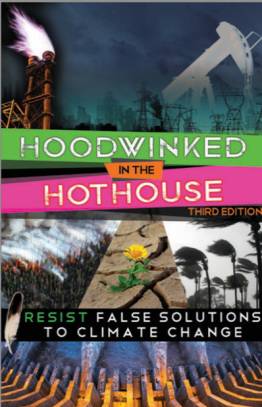
Figure 1. Report Under Review: Hoodwinked in the Hothouse: Resist False Solutions to Climate Change (2021). 3rd Edition. Creative Commons License. Published by www.climatechange.org and freely downloadable at https://climatefalsesolutions.org. pp.77.
According to the report, ideologies such as colonial imperialism, patriarchy, white supremacy, neoliberal globalization, and unbounded capitalism are major drivers of the current crisis. The role that these widespread ideologies and social issues have in perpetuating climate change becomes apparent when one asks, “Who benefits from these proposed solutions?” Who benefits from pipelines on native land? Who benefits from the petroleum refineries that cause asthma and other health issues in Asian, Black, and Latino communities? Who benefits when small-scale farmers have their land grabbed in the name of developing carbon sinks/carbon offsets? False solutions that only further the agenda of the global elite are both directly and indirectly violent. Sprawling camps of male-only workers fracking on indigenous land for natural gas are directly correlated to missing and murdered indigenous women. Overall, Hoodwinked serves as a field guide to not be hoodwinked by every solution that is out there professing to solve our problem of a rapidly warming world.
Report’s Content: The Good and Bad of Climate Solutions, and Sustainable Solutions
Hoodwinked takes aim at many popular energy production methods (e.g., Electric and Nuclear power, etc.) as well as different mitigation strategies (Bioenergy, Hydrogen power, etc. Please see Table of Contents Figure 2). Ironically, the biggest of the current energy production methods
that Hoodwinked criticizes is renewable energy. According to the article, the key issue with these types of energy such as wind, solar, biomass, etc., is how they are produced. For example, solar panels require rare Earth metals, which require mass mining and the destruction of the regional environment. Other issues include how mega renewable energy projects require long-range transmission, degrading the efficiency of energy production. Additionally, major corporations that control renewable energy power production plants often exaggerate the decrease in net emissions and lie about how much net benefit is truly occurring by under-reporting environmental impacts from all parts of the energy production process – a tactic that is termed “greenwashing”.
False reporting and greenwashing by the energy sector further propagates distrust within the climate movement; identifying greenwashing is challenging for activists and the general
public alike. For example, the utilization of hydrogen gas as an energy source is sold to the public as being cleaner. Hoodwinked explains that while the gas itself is clean, the way to get hydrogen is anything but. Hydrogen comes mostly from natural gas and the process of extracting it causes more damage through pollution than is outweighed by the benefits. However, companies that produce hydrogen-based energy say otherwise, claiming how clean and green the gas is. Similarly, Hoodwinked discusses how hydroelectric power is a false solution. Hydroelectric power, mainly coming from energy generated through massive dams, disrupts riverine food webs and reduces deltaic buildup, rendering riverine food webs dysfunctional and coastal communities susceptible to sea level rise. Furthermore, Hoodwinked explains how the construction of these massive dams is a major source of greenhouse gas as the process of cement manufacturing contributes close to 10% of global CO2 emissions. This is true for nuclear power as well; while the power itself is somewhat clean, the means to get that power is not, as these include large-scale mining for trace elements and the costs involved with the indefinite containment of radioactive waste. Hoodwinked also adds that nuclear can be unsafe and much too expensive for how long it takes to build and decommission them safely.
Other issues that are made clearer in Hoodwinked are the different climate mitigation strategies. It discusses geoengineering as one of the riskiest solutions. These are massive projects such as solar shades/reflectors deployed in space or cloud seeding to promote growth of clouds in the upper atmosphere that would reflect sunlight away from Earth which would cost millions of dollars with benefits not being seen for years after completion. Most importantly, any inadvertent and unexpected adverse outcomes would take a very long time to fix – and likely impact those parts of the Earth that did not sign on to these geoengineering experiments; once again, those that suffer the most from climate change are not the communities perpetuating it. Hoodwinked explains how these and other projects, such as carbon pricing, do not address the source of the problem, but just add more complexity to the issues at hand. While not a type of geoengineering, carbon capture struggles with the same issues. Unproven at large scale, just as with geoengineering, carbon capture is an untrue promise. The fact that carbon capture also only takes up carbon (and ignores other potent greenhouse gases such as CH4) and does not focus on stopping emissions can also make it seem like more carbon can be safely emitted without disrupting the climate. While roughly half of current CO2 emissions are annually taken up by the biosphere, the remainder will last decades to centuries. Hoodwinked argues that the real solution should be to cut greenhouse gas emissions now and not be distracted and delayed by false solutions.
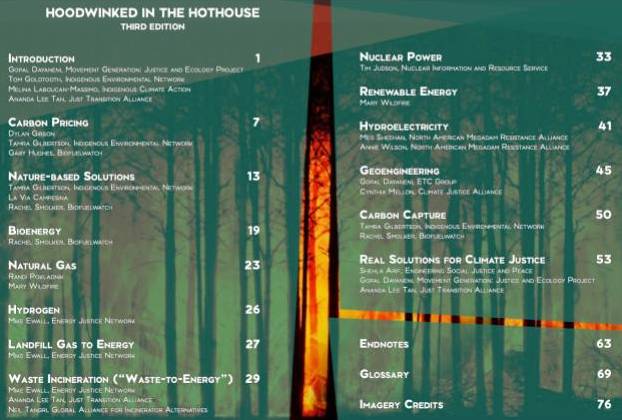
Figure 2. Table of Contents: The report covers both conventional (fossil fuel-based and non-renewable) and green (renewable) technologies of energy production (source: this report https://climatefalsesolutions.org). Endnotes at the end of the report (p. 63-68) list the key sources of information discussed in each of the different chapters, such as bioenergy, nuclear power, geoengineering, etc. Similarly, a glossary of terms (p. 69-75) provides clear and understandable explanations for useful terms such as carbon pricing, climate justice, greenwashing, zero-waste, etc.
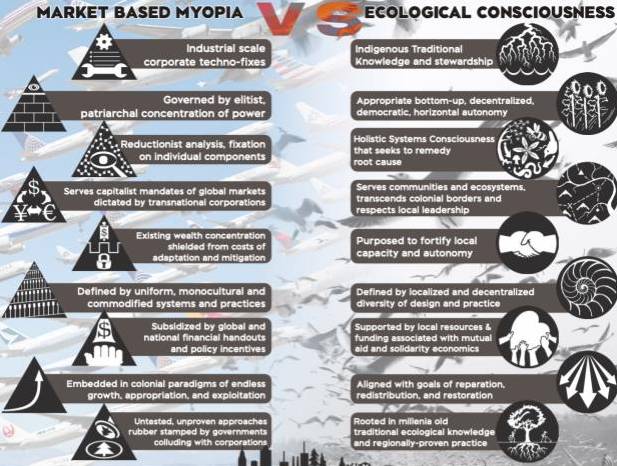
Figure 3. Rationale Behind Unsustainable and Sustainable Solutions: Market-based short-term (unsustainable) solutions and Ecological consciousness-based long-term (sustainable) solutions (source: p. 5-6 in this report; https://climatefalsesolutions.org).
While Hoodwinked chronicles why the many different climate change solutions are not effective, it argues that by focusing on climate justice and reconnecting with nature as humans are meant to, real and sustainable progress can be made. This is done through movement-defined principles, such as those of the environmental justice movement. This allows people to be involved at a community level with combating climate change, not just the policies and practices of governments and corporations. Hoodwinked discusses how climate change must be combated with holistic approaches such as community-based renewable energy or walkable cities, not specific energy production or policy (Figure 3). Indeed, it identifies the following six real solutions to climate change: 1. Be guided by principled practice, 2. Be guided by indigenous traditional knowledge, place-based experience, and public-interest science, 3. Be holistic in tackling all intertwined ecological and social harm, 4. Replace economies of greed with economies serving ecological and human need, 5. Advance deep, direct, participatory democracy, rooted in local self-determination, 6. Center the leadership and needs of those presently and historically harmed (p. 54-62). Hoodwinked calls upon its readers to care for the sustainable ecology of the house/planet we live in, uproot economies of greed, and restore healthy human-nature reciprocities – underscoring the indigenous call that “We only have one mother earth and one father sky.”
Summary
Hoodwinked is unique in the sense that it is all about the importance of recognizing false climate solutions – even those associated with the so-called green technologies. Climate change is a complex issue, and Hoodwinked explains why most solutions – including some of the green energy solutions - are not appropriate to fix the current climate change crisis. All solutions have their limitations: some are only short-term fixes, while many others have unjustifiable environmental and social justice costs. By focusing on the people and nature-based sustainable approaches that protect both economic and ecological integrity, Hoodwinked argues that real and lasting solutions to our climate crisis are possible.
Postscript (April 22, 2026): The 4th edition of Hoodwinked in the Hothouse is due to come out shortly. One of the chapters in it is on how emerging AI that thrives on massive amounts of data – whose massive data centers consume vast amounts of energy and water – will not solve the ongoing climate crisis by itself. Here is a preview of it: https://climatefalsesolutions.org/wp-content/uploads/HOODWINKED-AI-Chapter-ENGLISH_highquality-1.pdf
Thank You for Supporting the InterChange!
Thank you to those who completed our survey. We will be implementing those changes in our next issue released in Spring 2026!
Submit to the InterChange
Be Part of the Legacy, Submit to the InterChange
There are some InterCHANGES going on with our newsletter. We are looking for submissions around the following topics.
- MSO Region 12: Ottawa, Kent, & Muskegon Counties.
- K-12 STEM Lessons & Resources.
- GVSU Faculty & Departments Looking to Collaborate with K-12 teachers or other faculty & vice versa.
- GVSU Faculty, Department & Local Educator Professional Work Highlights.
Of course we are still accepting submissions for STEM articles & events!
2025-2026 Submission Deadlines:
- Fall 2025-September issue: September 3rd, 2025
- Winter 2026-January issue: December 14th 2025
- Spring 2026 -April issue: March 7th, 2026
- Summer 2026 -June issue: June 9th, 2026
- Fall 2026 - September issue: September 13th, 2026
Do you have an article you would like to submit to the InterChange?
Submit it here.