


Research Excellence Award
The Research Excellence Award recognizes undergraduate students for outstanding contributions to and performance in departmental psychological research. One award will be given annually for each major (PSY, BNS). Recipients of the prestigious award will have demonstrated curiosity, critical thinking, open-mindedness, evidence-based decision-making, and overall research excellence. Award recipients are nominated by the Psychology faculty and selected by the Psychology Department Awards Committee.
Psychology faculty will nominate candidates by submitting a supportive letter to the Psychology Department Awards Committee. Along with describing why the student is deserving of this award, please make sure this letter includes:
- The student's GPA
- Relevant coursework
- 1-2 artifacts of their work (e.g., paper or other assignment)
The Awards Committee will send an email calling for nominations beginning in December and faculty will have until mid-February to submit letters. The letters can be submitted anytime up until the deadline.
Winners will be selected in February and be announced in early March. Winners will be recognized at the Psychology Department Awards Ceremony in April. They will receive a framed certificate and they will be featured on the Department website.
2026 Recipients of the Research Excellence Award
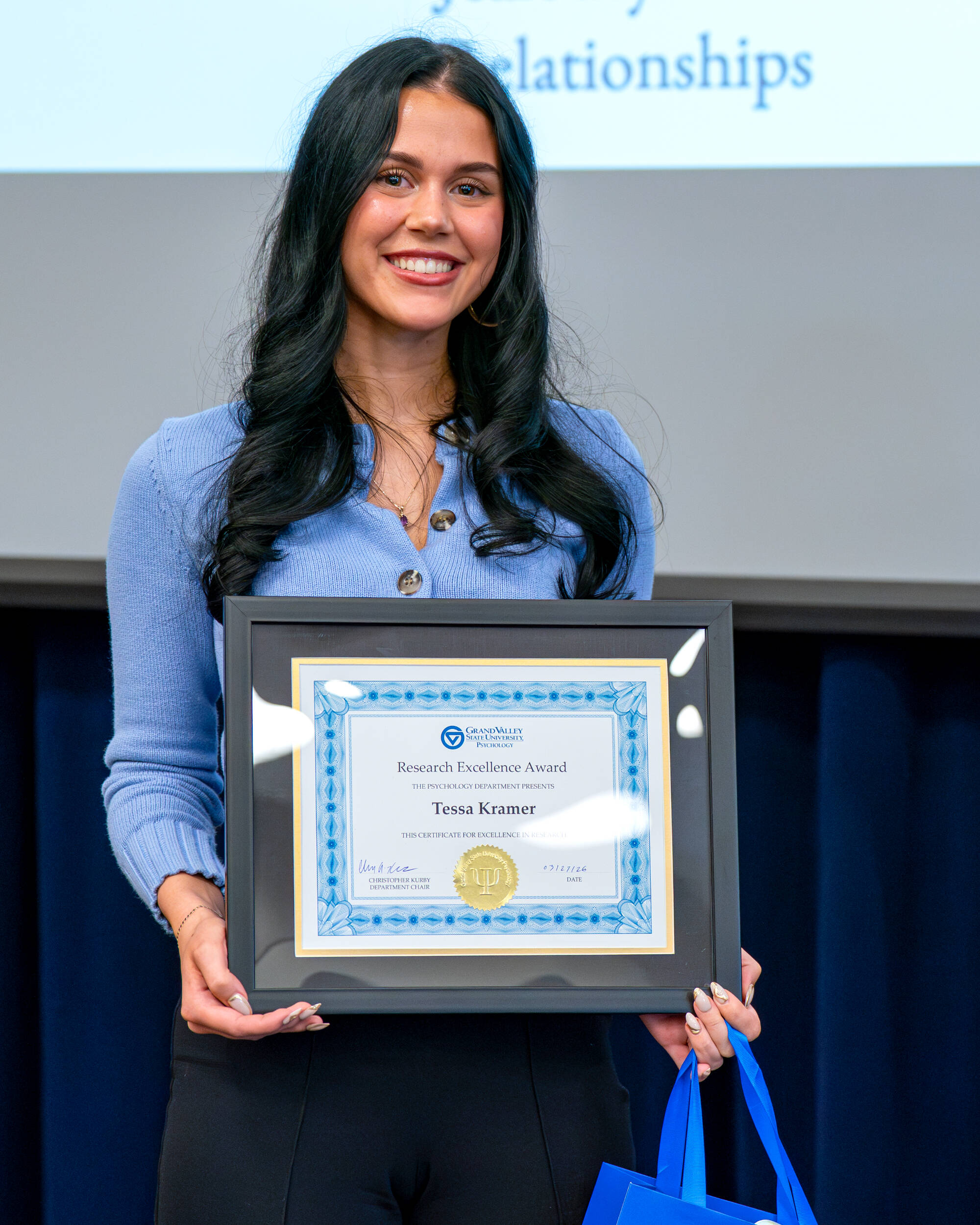
Tessa Kramer (Psychology)
How did you become interested in psychology?
Watching Criminal Minds was what first made me consider pursuing a career in psychology, because it combined my curiosity about how people think with a strong desire to help others. From there, my interest deepened when I was introduced to topics such as consciousness and identity, which fueled my appreciation for abstract concepts. I’ve always loved science, and psychology stood out to me because it allowed me to explore patterns and underlying mechanisms behind human behavior.
What have you learned from doing research?
Doing research has been one of the most valuable experiences I’ve had at Grand Valley. It taught me the importance of creativity and collaboration, as well as technical skills such as experimental design, coding, and statistical analysis. Most importantly, research taught me perseverance and how to push through setbacks and stay committed even when things don’t go as planned.
What are you planning to do after graduation?
After graduation, I plan to pursue the doctoral program in social and personality psychology at Wayne State University. There, I will work in the Biopsychosocial Health Lab and focus on advancing our understanding of health psychology. The lab examines the interplay between psychological processes and social factors in biological systems and how these interactions shape physical health outcomes.
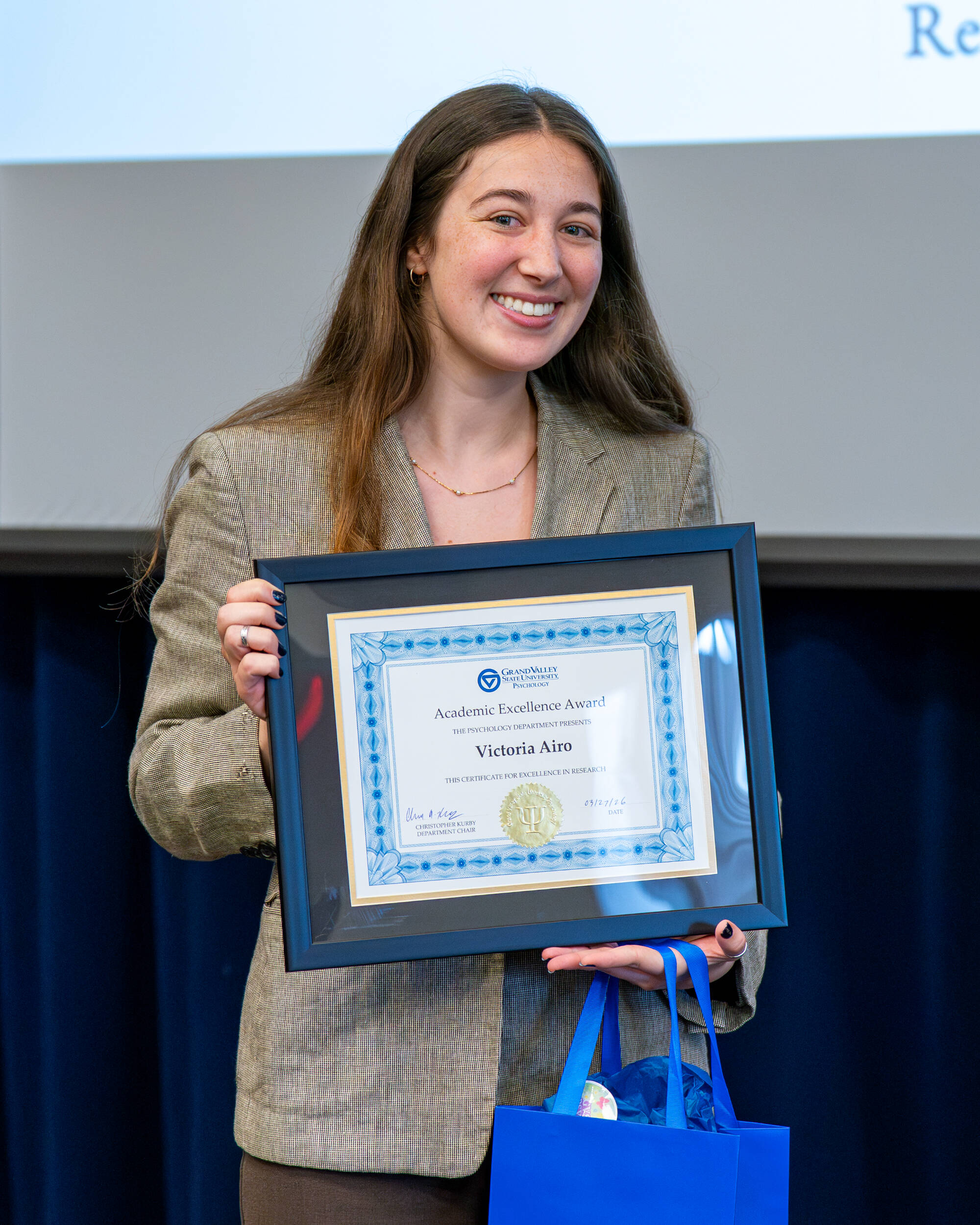
Victoria Airo (Behavioral Neuroscience)
How did you become interested in psychology?
My interest in psychology began in high school when I took AP psychology. I was inspired by my teacher who was entirely overqualified to be teaching at my high school as he had his clinical psychology PhD. I admired his ability to express himself in such an insightful way, and how he was a mentor that every student looked up to and wanted to emulate.
What have you learned from doing research?
One of the most exciting things I learned from my undergraduate research is that the work we do matters. As my lab collaborated with researchers from other countries, I realized that our research could help inform people across multiple cultures and add to the greater discussion of the importance of cross cultural research. Being a part of someone bigger than myself felt so fulfilling and showed me that I want to continue in research in my future.
What are you planning to do after graduation?
I am currently waiting to hear back from post baccalaureate programs in neuroscience as a stepping stone to prepare to continue on to a PhD program in Neurobiology. I intend to do research to understand sensory systems using animal models. My future career goal is to stay in academia and integrate research and teaching.