
Collections Strategy 2025-2030
University Libraries are committed to our mission to champion intellectual freedom to inspire critical thinking, creativity, the pursuit of knowledge, information literacy, and the open exchange of ideas. Our collection strategy is not limited to individual items that we purchase; it encompasses responsible management of our resources to support student success, create responsive spaces for our community, and build strategic partnerships.
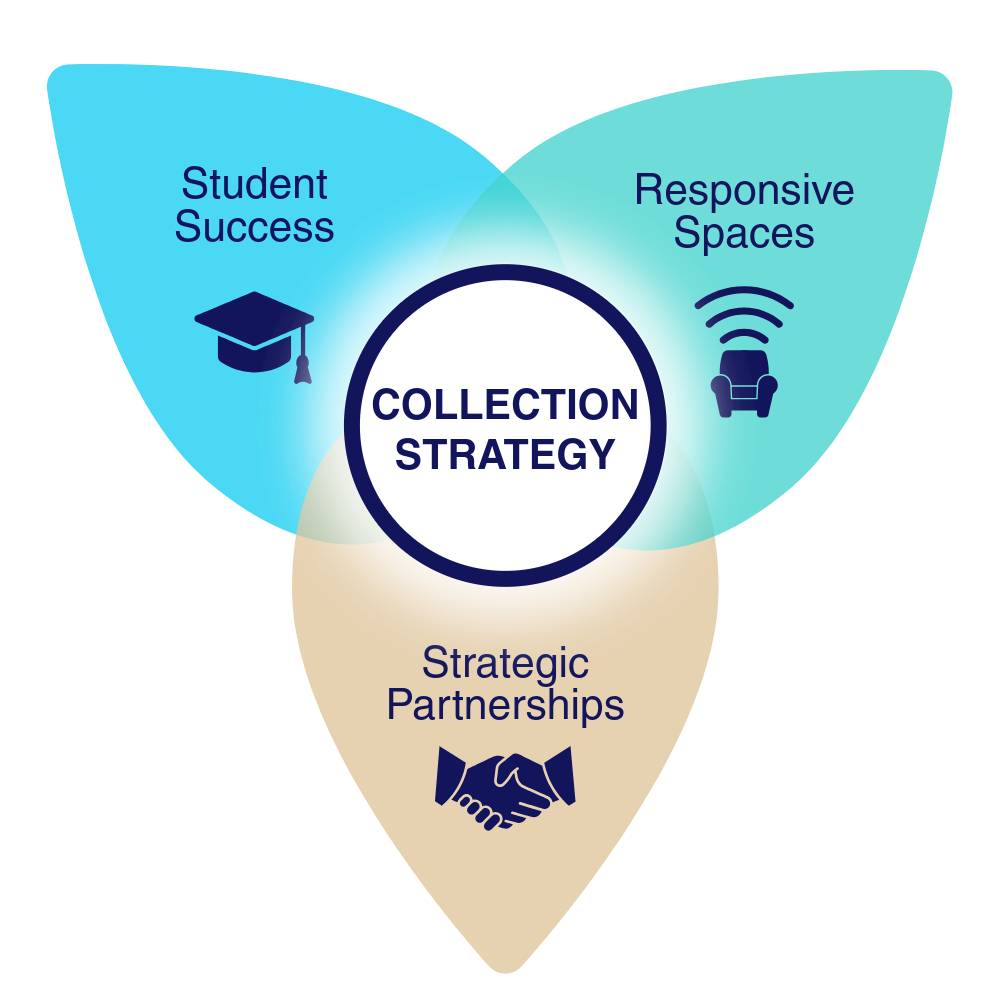
Our Collections Strategy intersects three library strategic priorities.
An infographic titled 'Collection Strategy' illustrates the intersection of three library strategic pillars. he top-left blue petal is labeled 'Student Success' and features a graduation cap icon. The top-right teal petal is labeled 'Strategic Partnerships' and features a handshake icon. The bottom tan petal is labeled 'Responsive Spaces' and features icons for digital devices and comfortable seating. All three pillars overlap at a central white circle containing the text 'Collection Strategy,' indicating that the strategy is driven by the synergy of these three areas.
A Curriculum-Led Collection for Student Success
Our collection strategy prioritizes resources which give direct support to the University’s evolving curriculum and student research needs, as specified in our Collection Development Policy. New resources are evaluated and selected based on the expressed needs of faculty and students, as well as the inclusion of new and evolving University programs.
In addition to direct support to the curriculum, the Libraries' budget also provides support for critical infrastructure that makes the collections usable, including our integrated library system (FOLIO) and the service platform for our institutional repository.
Our strategy also emphasizes the inclusion and promotion of Open Access resources, which help reduce direct costs to students and make access to scholarly work more equitable. Learn more about Open Access at GVSU and how faculty can contribute to Open Access publishing.
Responsive Spaces: Digital and Physical Resources
Both physical and digital resources are vital to the GVSU community.
Current usage indicates a strong preference by our users for electronic materials, which have the advantage of being usable from anywhere at any time, easily searchable, compatible with screen readers and other accessibility software, and more quickly updated with current information. The disadvantages to electronic resources are expensive ongoing subscription costs, unpredictable annual price increases, and reduced control of what is available (for example, an individual Netflix subscriber does not determine what movies are available to them, Netflix does).
Physical materials, on the other hand, give the Libraries greater control over continued access to content, provide users with a browsing experience (Popular Reading collection, music scores, classic literature), provide materials that are only available in physical format (teaching materials in the Curriculum Materials Library). The Library’s physical collections are tailored to those disciplines that benefit from them the most.
All materials in the collection are regularly evaluated to ensure their cost (annual subscriptions, physical space on the shelves, staff time) is justified by the value they bring to our campus (usage, importance to the discipline the resource is supporting. The Libraries actively evaluate the most advantageous access method for our resources, including negotiating with vendors for large subscription packages, individual subscriptions, and one-time purchases of data sets or primary source archives.
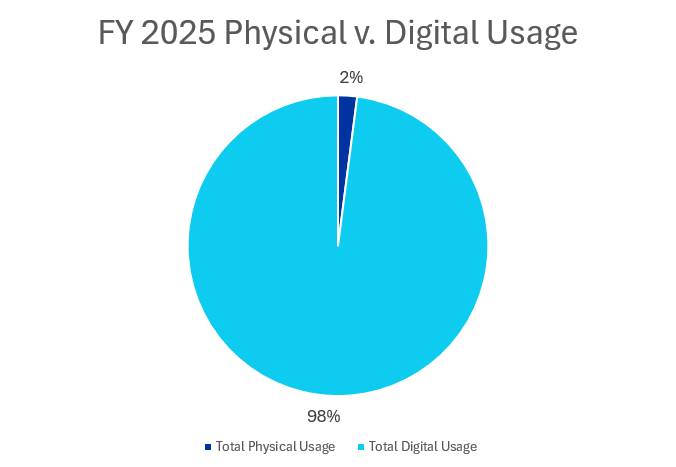
The physical material circulation makes up 2% of the total circulation.
Physical vs. Electronic Materials Strategy
Electronic Resources
- 24/7 Access
- Searchable
- Accessible
- Current
Disadvantages:
- High Subscription Costs
- Unpredictable Price Increases
- Vendor Control
Physical Resources
- Guaranteed Access
- Browsing
- Unique Formats (scores, kits, etc.)
- Tailored towards disciplines that benefit from physical formats
Disadvantages:
- No remote access
- Slower to update
- Availability (many materials are digital only)
Strategic Partnerships: Stewardship and Sustainability
Our usage data shows a strong preference for electronic materials, which carry the challenge of high ongoing costs. On average, subscription-based resources carry a yearly inflation rate of 5-7% with some demanding 20% or more. This impacts the majority of resources the University Libraries acquire and manage. Because the Libraries' collections budget has not increased for many years, this means GVSU pays more each year to provide the same level of coverage. This is not a sustainable or equitable approach to providing resources.
To navigate rising costs and a flat budget, the Libraries engage in strategic partnerships to ensure our resources are used effectively. Participation in the Midwest Collaborative for Library Services (MCLS) consortium allows us to pool our purchasing power with other institutions to secure better prices on subscriptions. The Michigan Electronic Library allows us to share both electronic and physical resources with academic and public libraries across the state. The Libraries have also entered into cost-sharing agreements with departments on campus to support access to resources that are critical to those departments but of limited use to those in other disciplines.
The Libraries have also partnered with the Pew Faculty Teaching and Learning Center and the Rainbow Resource Center to maintain book collections on location at those sites.
Contact Us
We want to hear from you if you have questions or concerns. Contact Matt Ruen, Head of Collections and Digital Scholarship, at [email protected]. We welcome your questions about Open Educational Resources at: [email protected].
You can also contact your subject liaison librarian with questions: Liaison Librarians by department