


What is IPE?
Interprofessional education occurs when students from two or more professions learn about, from, and with each other to enable effective collaboration and improve health outcomes. Once students understand how to work interprofessionally, they are ready to enter the workplace as a member of the collaborative practice team. This is a key step in moving health systems from fragmentation to a position of strength.1
Why is IPE important?
Health systems in the United States are fragmented and may struggle to adequately address the increasingly complex needs of an aging population. In the early 2000s, the Institute of Medicine released a series of reports ringing the alarm about the prevalence of medical errors, patient safety, and the quality of care delivered in the United States ². These reports identified a lack of teamwork, communication, and collaboration among healthcare professionals of different disciplines as a significant source of costly medical errors, and recognized the need to improve interdisciplinary collaboration to advance patient safety. Increasingly, healthcare systems are moving towards team-based models of patient care to reduce costs, improve health through patient-centered care and the reduction of medical errors.
The education of a workforce prepared to meet the demands of this increasingly interprofessional workplace, requires the integration of communication skills, joint accountability for patient care, and skills in shared decision making into the curriculum as well as opportunities to engage in meaningful collaborative clinical experiences before graduation. By integrating IPE into professional health curriculums at GVSU, we are educating a workforce prepared to meet the challenges of interprofessional collaborative practice in the 21st century.
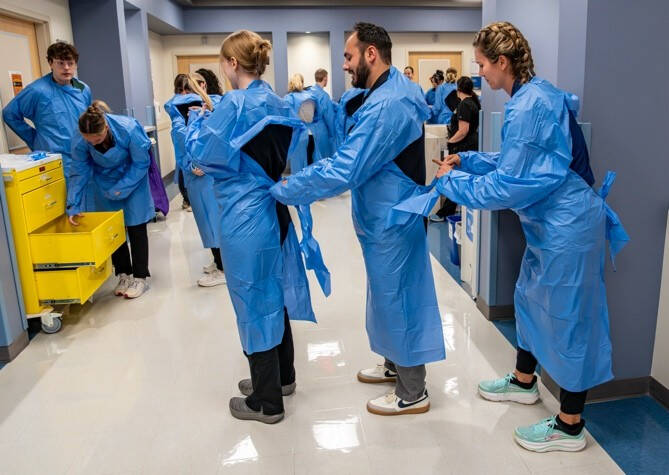
What does IPE/IPP look like in practice?
As the healthcare workforce has shifted to more collaborative care, healthcare education must include and prepare students to work effectively with other disciplines by sharing knowledge and skills around interprofessional education (IPE) and interprofessional collaboration (IPC) (Cadet et al., 2024). Education and collaboration include teaching and learning through exposure and applying that education into practice-based and organization-based interventions (Reeves et al., 2011). According to current research, interprofessional education (IPE) and exposure strongly influence health outcomes for patients and more effectively prepare healthcare workers for the collaboration they must do to support patient outcomes (Cadet et al., 2024).
Cadet, T., Cusimano, J., McKearney, S., Honaker, J., O’Neal, C., Taheri, R., … Cohn, J. S. (2024). Describing the evidence linking interprofessional education interventions to improving the delivery of safe and effective patient care: A scoping review. Journal of Interprofessional Care, 38(3), 476–485. https://doi.org/10.1080/13561820.2023.2283119
Reeves, S., Goldman, J., Gilbert, J., Tepper, J., Silver, I., Suter, E., & Zwarenstein, M. (2011). A scoping review to improve conceptual clarity of interprofessional interventions. Journal of Interprofessional Care, 25(3), 167–174. https://doi.org/10.3109/13561820.2010.529960