News from Grand Valley State University

Collaborative innovation engineers a solution for transforming healthcare education

Project for Interprofessional Simulation Center exemplifies Blue Dot Ecosystem

Six senior engineering students are in the final stages of building an automated medication dispensing unit for the Interprofessional Simulation Center that will transform healthcare education by immersing students in authentic clinical practice experiences.

When it's complete, the mobile unit will provide learners with realistic, hands-on experiences that closely mirror a Pyxis, a medication management system used in hospitals and other healthcare settings. Students will engage in safe medication preparation, dispensing, documentation and administration, while developing best practices for handling controlled substances and other high-risk medications.

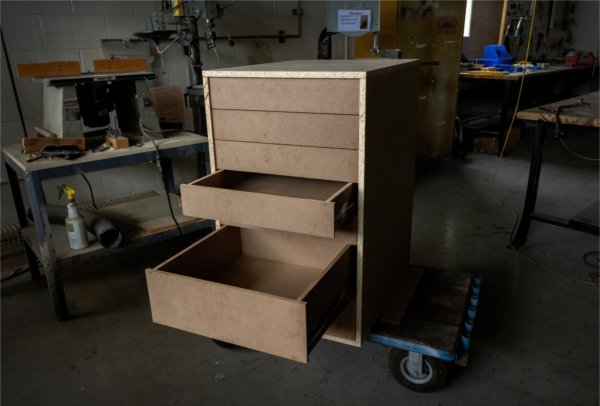
Unique among university simulation centers, the Grand Valley project is a 40-inch-tall cabinet with lockable drawers that will be stocked with mock medications: pills, liquids, and vials. It will be ready to incorporate into high-fidelity simulation experiences in the fall semester. 

Sherri Fannon, associate dean for Interprofessional Simulation and Innovation, said the collaboration among the Padnos College of Engineering, Kirkhof College of Nursing and the Interprofessional Simulation Center is a perfect example of the university's Blue Dot Ecosystem, connecting expertise across disciplines to transform real-world challenges into opportunities for innovation. 

"As technology needs increase, this type of cross-disciplinary collaboration is important to our mission of supporting students by teaching professional competencies in a safe and interactive learning environment," Fannon said.
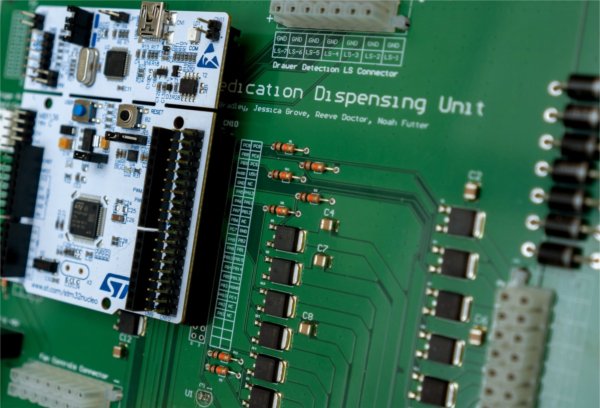
The printed circuit board is pictured. It is the 'brains' of the enclosure that a group of engineering students are making for the Interprofessional Simulation Center.
Image credit - Kendra Stanley-Mills
cabinet in a woodshop with some drawers open
The cabinet will have locking drawers to store mock medications.
Image credit - Kendra Stanley-Mills

The Interprofessional Simulation Center team saw an opportunity to incorporate a Pyxis-like system into labs focused on medication administration. Currently, labs that are centered on calculating medication dosages and injections are completed using printed pieces of paper, said Robin Van Wingen, simulation lab manager. 

"Using this simulation-based education provides students with a safe environment to build competency and confidence, facilitating a smoother transition to real-world healthcare environments," Van Wingen said.

Partial funding for the project came from a 2023 U.S. Department of Health and Human Services, Health Resources and Services Administration (HRSA) grant for multipatient experiences.

The College of Computing is developing a custom electronic health record (EHR) system in another collaboration with the Interprofessional Simulation Center. Fannon said the EHR will integrate with other simulation technologies to create an interconnected learning environment and better prepare students for professional practice.

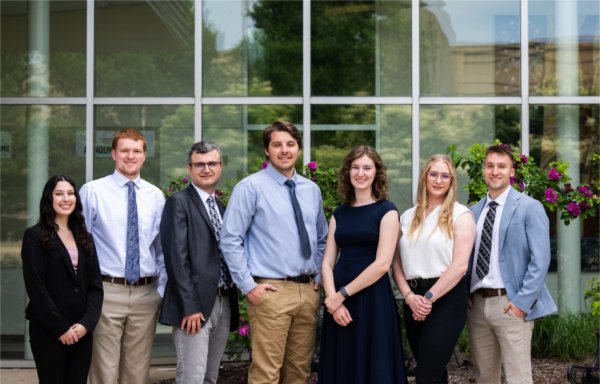
From left are engineering students Rhianna Ruzza, Nathaniel Brinks, associate professor of engineering Ali Olcay, Reeve Doctor, Aliece Bradley, Jessica Grove and Noah Futter.
Image credit - Kendra Stanley-Mills

'Gold standard of engineering'

This is a senior project for the team of six students who represent all engineering disciplines: product design and manufacturing, mechanical, computer, electrical and biomedical. 

They began learning about a Pyxis and designing their machine in early winter. After receiving approval, the students ordered parts and began building. Through the winter semester, they met weekly with Interprofessional Simulation Center staff to provide updates. After the machine is installed, likely in mid-July, they will provide training for faculty and center staff.

Ali Olcay, associate professor of mechanical engineering, said the experience is exactly what the students will experience when they enter the workforce.

"Our engineering program is the gold standard," Olcay said. "Not every program has sponsored senior projects. The goal, just like in industry, is to make the sponsor happy, but at the end of the day, the machine needs to work."

Computer engineering major Aliece Bradley said the project builds on experiences she and her teammates had during their co-op placements, but on a much larger scale and over a longer period. "Going through a co-op experience, you don't necessarily see a project to the end, but here we will," Bradley said. "That's going to give us an edge with employers."

The team also asked students in the Occupational Safety and Health Management program to review the project for workplace safety. 

"It's really a great example of the work they will eventually do," Olcay said. "They're learning time management, working with shipping and delays, and debugging the machine for nearly seven months. And every step has been monitored by the sponsors."

Subscribe

Sign up and receive the latest Grand Valley headlines delivered to your email inbox each morning.