News from Grand Valley State University
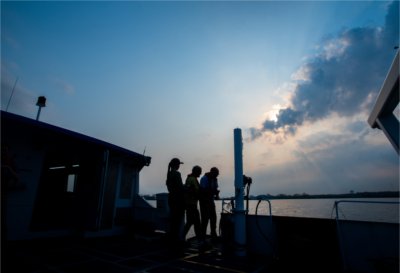
Researchers stand on the deck of the Grand Valley State University Annis Water Resources Institute's W.G. Jackson research vessel as sun rays break through clouds over the water.

AWRI, Muskegon celebrate quarter-century of partnership, progress

For 25 years, GVSU’s Annis Water Resources Institute and the city of Muskegon have grown together, parlaying the institute’s environmental research and stewardship into a catalyst for the city’s economic development.

This year marks the 25th anniversary of the AWRI establishing its permanent home on the shores of Muskegon Lake. Community leaders, civic partners, GVSU administrators, faculty and staff will commemorate that collaborative spirit during a July 13 celebration.

The public also is invited to learn more about the institute's mission and impact during an open house from 10 a.m.-2 p.m. on July 11.

“It’s been a wonderful relationship between the AWRI and Muskegon,” said Al Steinman, the AWRI’s Allen and Helen Hunting Research Professor. “In fact, as the city changed, we saw more acknowledgement and recognition of the importance of the lake as an economic driver.”

The AWRI reaches several milestones this year, including the 40th anniversary of its founding; the 40th anniversary of its research vessel, the D.J. Angus; and the 30th anniversary of its second research vessel, the W.G. Jackson. 
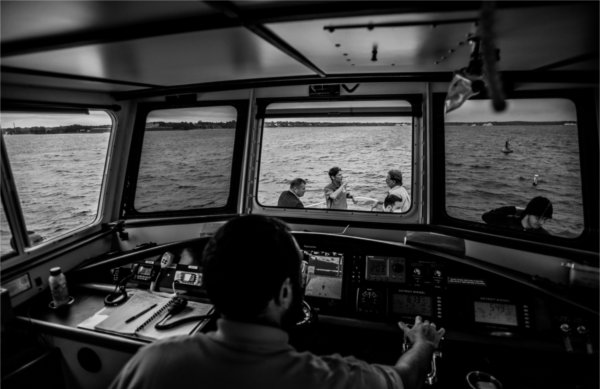
Al Steinman, the Allen and Helen Hunting Research Professor, left, talks with U.S. Senator Gary Peters, right, aboard the W.G. Jackson captained by Eric Hecox, AWRI fleet captain, foreground.
Image credit - KENDRA STANLEY-MILLS
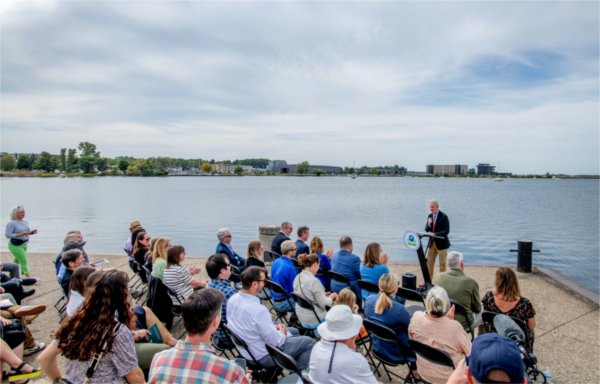
Muskegon government officials, community partners and researchers from the Annis Water Resources Institute gather along the shore of Muskegon Lake to celebrate the lake's removal from the U.S. Environmental Protection Agency's Areas of Concern list.
Muskegon government officials, community partners and researchers from the AWRI gather along the shore of Muskegon Lake to celebrate the lake's removal from the U.S. Environmental Protection Agency's Areas of Concern list.
Image credit - Kendra Stanley-Mills

“It’s just a great testimonial to the support that the community provided to be able to build that kind of a facility that we have in this day and age,” said biology professor Mark Luttenton. “Certainly, the boats are a tremendous asset. Those have been terrific, both from a research and educational perspective.” 

Founded in 1986, the AWRI called Loutit Hall its first home. Two years later, the institute had a new home in Cedar Studios II before moving to the Padnos Hall of Science in 1995. 

Steinman has spent the last 25 years at the institute, succeeding the institute’s first director, Ron Ward, in 2001. He’s seen firsthand the evolution of the AWRI and the city. 

“Muskegon looked to the AWRI at Grand Valley as a catalyst for future growth,” said Steinman. “At that point, they raised the most money ever for a capital campaign to build the Lake Michigan Center.”

“To Muskegon's credit and the community's credit, they validated and were true to their promises.” 

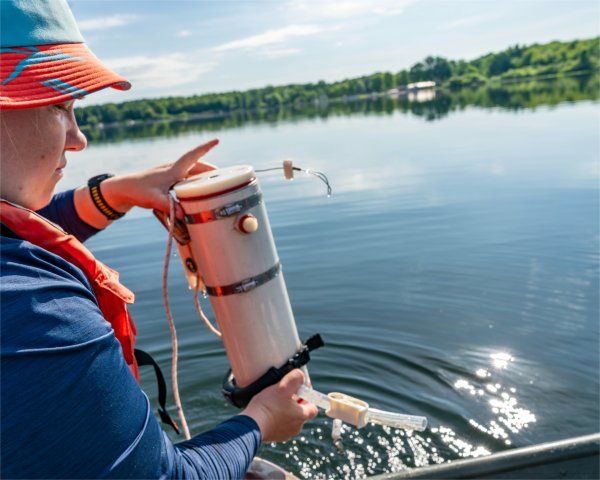
A student researcher uses a water sampler to collect water from McLaren Lake in Oceana County and analyze its salt content.
Katie Tyrrell, a staff member with the Steinman Lab at the AWRI, uses a Van Dorn water sampler at McLaren Lake in Oceana County. The work is part of AWRI’s inland lake salt survey.
Image credit - Cory Morse
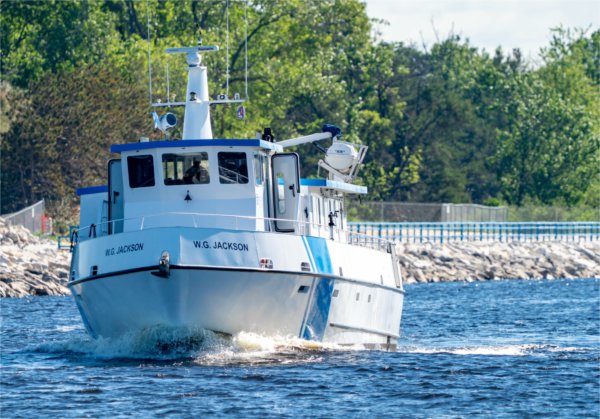
The AWRI's research vessel, the W.G. Jackson, passes through the Muskegon Lake channel en route to Lake Michigan.
Image credit - Cory Morse

The partnership between AWRI and the Muskegon community has produced tangible results, perhaps most notably the restoration of Muskegon Lake. In October 2025, the U.S. Environmental Protection Agency officially removed the lake from its Areas of Concern list.

AWRI’s work extends beyond the ecological stewardship of Muskegon Lake, its surrounding watersheds and the Great Lakes. The research facility also conducts economic studies for its city, state, regional and federal partners, helping quantify the economic benefits of restoration efforts and better understand the return on investment in Muskegon Lake's recovery.

Today, the lakefront reflects that transformation. Once dominated by factories and industry, Muskegon Lake has become a destination for boating, fishing and recreation, while residential and commercial development continues to reshape the shoreline.

“There are a lot of different milestones, so it’s emblematic that all these milestones for the city and the institute are happening at the same time,” said AWRI Executive Director Stuart Jones. “And, it just demonstrates how woven together the community and AWRI are.”

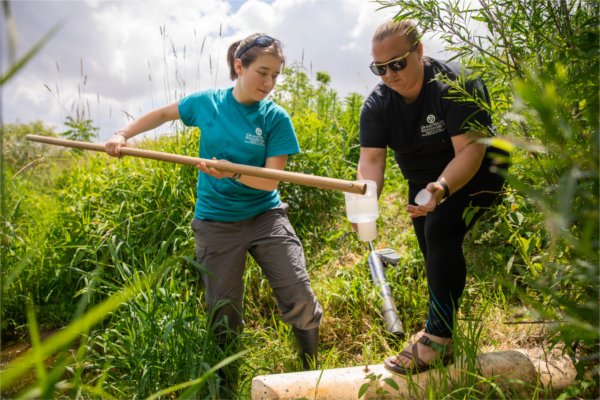
Two researchers from the Annis Water Resources Institute collect a water sample from farmland near Holland to measure phosphorus levels.
Researchers from the AWRI collect a water sample from farmland near Holland to measure phosphorus levels. The research helped farmers improve nutrient management while protecting nearby waterways.
Image credit - Valerie Hendrickson
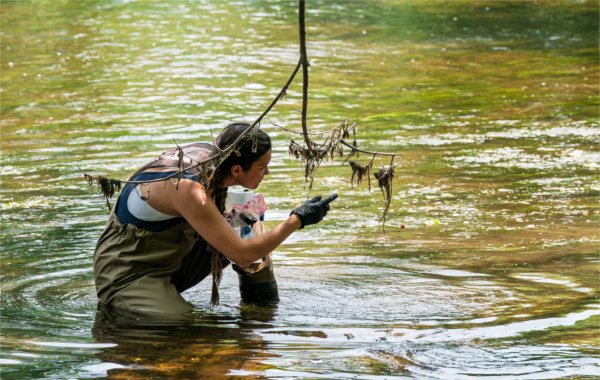
A Grand Valley graduate student crouches in Flat River in Lowell to search for long-jawed orb weaver spiders as part of a research project led by professor Ryan Otter.
Graduate student Addison Plummer searches for long-jawed orb-weaver spiders in the Flat River in Lowell as part of a research project led by professor Ryan Otter measuring mercury and other heavy metal contaminants in Michigan's waterways.
Image credit - Cory Morse

Subscribe

Sign up and receive the latest Grand Valley headlines delivered to your email inbox each morning.