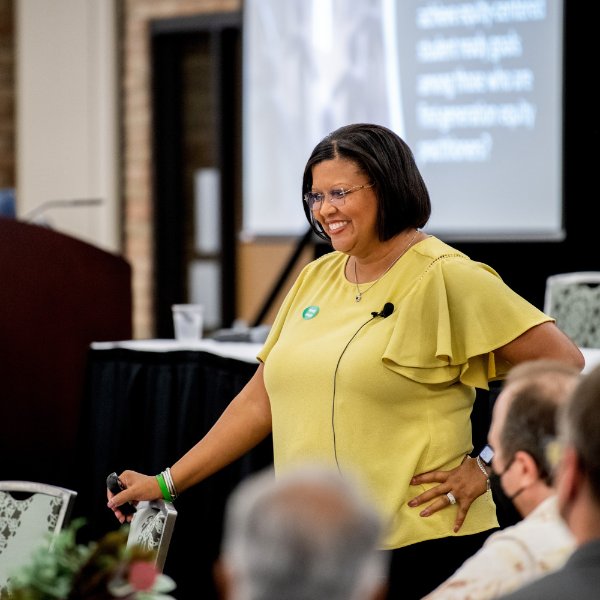


As a first-generation college student, Eliza MacDonald, a senior affiliate faculty member who teaches athletic training, understands the challenges of transitioning from high school to college.
Students need to find new ways to study, are often farther away from family than they have ever been and are being given a lot of new information at once. She remembers it can feel overwhelming.
“I don't forget that, and I don't want other people to feel that way,” she said. “I want to try to help them out the best I can, so I try to put myself in their shoes.”
Seeking to help first-year students make the transition to college, MacDonald participated in the Strong Start Teaching Institute. Offered through GVSU's Pew Faculty Teaching and Learning Center (FTLC) , the Institute provides GVSU faculty with strategies on increasing classroom accessibility targeted toward first year students.
MacDonald, who is in her 15th year of teaching at Grand Valley, used her previous experience and the Strong Start training to shape her courses to fit the unique nature of each class.
She provides purposeful and structured group work for her students to encourage interaction. She surveys her students to determine if the course will feature more lectures or group discussion based on comfort levels and student engagement.
“That's going to dictate how I would teach the course,” MacDonald said. “I like to know what careers they want to go into so I can make it applicable.”
Faculty members who go through the Institute are given information on ways to effectively communicate expectations and reflect on how instructors can help make their classroom more accessible to students.
“The wonderful thing about the Institute is that we engaged with evidence-based practices that have been shown to directly impact student success,” said Christine Rener, director of the Pew FTLC and vice provost for instructional development and innovation at GVSU.
The Institute is designed to explore learning strategies that will assist them in finding success during their time at Grand Valley. Faculty were challenged to consider new ways to write syllabi to better accommodate a student who may not have experienced a collegiate-level syllabus before. Faculty were also encouraged to share information on resources available on campus throughout the semester.