News from Grand Valley State University
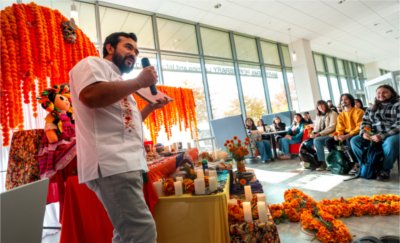
Rolando Mancera speaks in front of the Ofrenda at GVSU's Día de los Muertos celebration

GVSU celebrates Día de los Muertos at Ofrendas Vivas event

First-year Grand Valley student Ava Barajas attended the opening of the University's Día de los Muertos celebration on October 29 because she wanted to get more in touch with her cultural background. Barajas said she struggled to find a connection to Latino culture in her hometown. She said coming to the Día de los Muertos celebration was exactly what she was hoping for.

“It makes me feel so seen. It makes me feel included,” Barajas said. “It’s really nice to see [Latino culture] represented here at Grand Valley.”

The event, titled "Ofrendas Vivas," is hosted by GVSU's Office of Multicultural Affairs, the Kaufman Interfaith Institute and GVSU Libraries on the main floor of the Mary Idema Pew Library near the GV Brew. Ofrendas Vivas, or living offerings, will run from October 29 through November 2 and is open to all GVSU community members.

Día de los Muertos, or Day of the Dead, has its roots in pre-colonial Mesoamerican cultures. During the colonial era, Catholicism gained a foothold in the region and its influences were folded into the celebration. Typically celebrated on November 1 and 2, Día de los Muertos is about honoring loved ones who have passed.
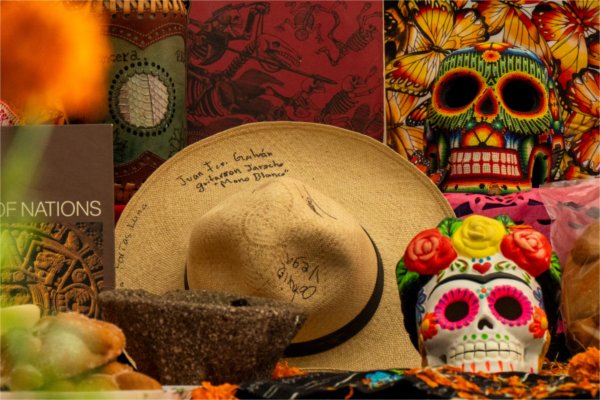
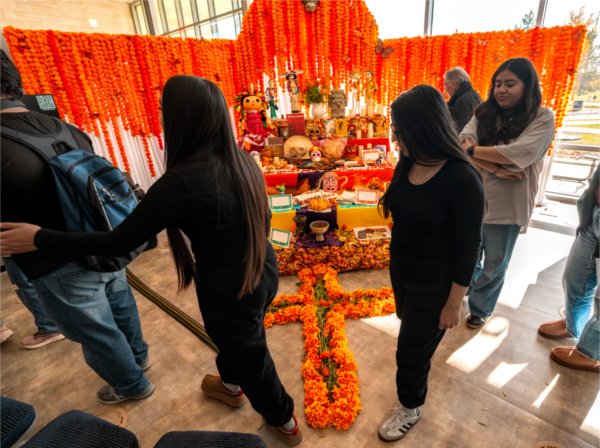
Offerings and decorations on GVSU's ofrenda, including a hat with a message on it and decorated skulls.
Central to Grand Valley’s celebration is the ofrenda designed by Mancera. It is, as its name suggests, a place for people to place offerings to their ancestors.
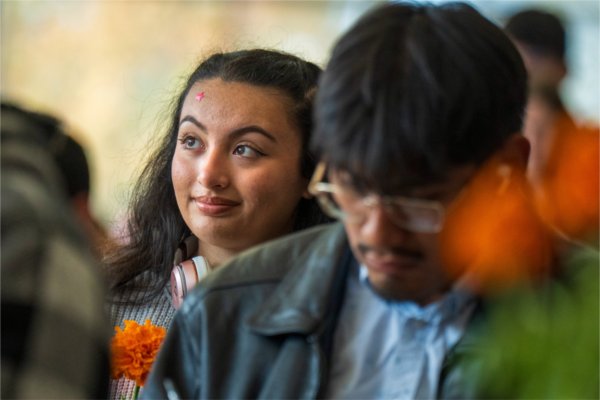
Ava Barajas listens to the lecture during GVSU's Día de los Muertos celebration.

The celebration kicked off with a short lecture from local artist Rolando Mancera. Mancera has collaborated with Grand Valley for six years as the designer and author of the university's ofrendas, or offering altars.

Mancera spoke about the history of Día de los Muertos in Mesoamerican regions, its importance to Mexican and Guatemalan culture and the details and meanings that go into constructing an ofrenda.

“[Día de los Muertos is] a day to remember,” Mancera said. “A day to remember the people that passed away, the people that we love, the people that we always want to remember in our hearts.”

Central to Grand Valley's celebration is the ofrenda designed by Mancera. It is, as its name suggests, a place for people to place offerings to their ancestors. Traditional ofrendas feature pictures of passed loved ones, candles, cempasúchiles, or marigolds, food and items of significance to the deceased. While photos and personal items were not included on GVSU’s ofrenda, OMA invited participants to fill out letters to their deceased loved ones to place on it.

Mancera's ofrenda has many of the traditional features of an ofrenda. It was decorated with cempasúchiles, pan de muerto, or bread of the dead, as well as decorations that are representative of the four elements.

Tiburcio Lince, director of OMA, said the goal of the event was to offer a space for community members to explore and learn about Latin American culture.

“We want to talk about why, in our Mexican, Guatemalan and other Central American cultures, we would celebrate an event like this,” Lince said. “The reality is that death is so integrated into our daily lives.

“The more that we talk about death, the more we breathe, and the more connected we are to what is our short existence.”

GVSU students walk passed the ofrenda
Students were invited to share letters to passed loved ones and place them on the ofrenda before receiving pan de muerto and Mexican hot chocolate

Subscribe

Sign up and receive the latest Grand Valley headlines delivered to your email inbox each morning.