

Four questions with Theresa Bacon-Baguley
Theresa Bacon-Baguley is the associate dean for research for the College of Health Professions and a professor in the Physician Assistant Studies (PAS) department. Bacon-Baguley joined Grand Valley's faculty in 1991 and is now in phased retirement. She reflects on the launch of the PAS program, which will celebrate National PA Appreciation Week through Oct. 12.
What drew you to physician assistant education?
My path to physician assistant (PA) education is a little different because I am not a PA. I practiced as an advanced certified emergency room nurse, earned a Ph.D. in medical physiology and completed postdoctoral training in pathology at the University of Michigan. What has always excited me about healthcare is the intersection of science, critical thinking and patient care.
I served on the committee that established GVSU’s PAS program, which admitted its first class in 1995, and I have been involved with the program ever since.
Throughout my career, I have tried to instill in students the importance of understanding the “why” behind medicine: Why are these symptoms occurring? Why am I ordering this test? Why is this treatment appropriate? Connecting the science with clinical reasoning is fundamental to becoming an excellent healthcare provider.
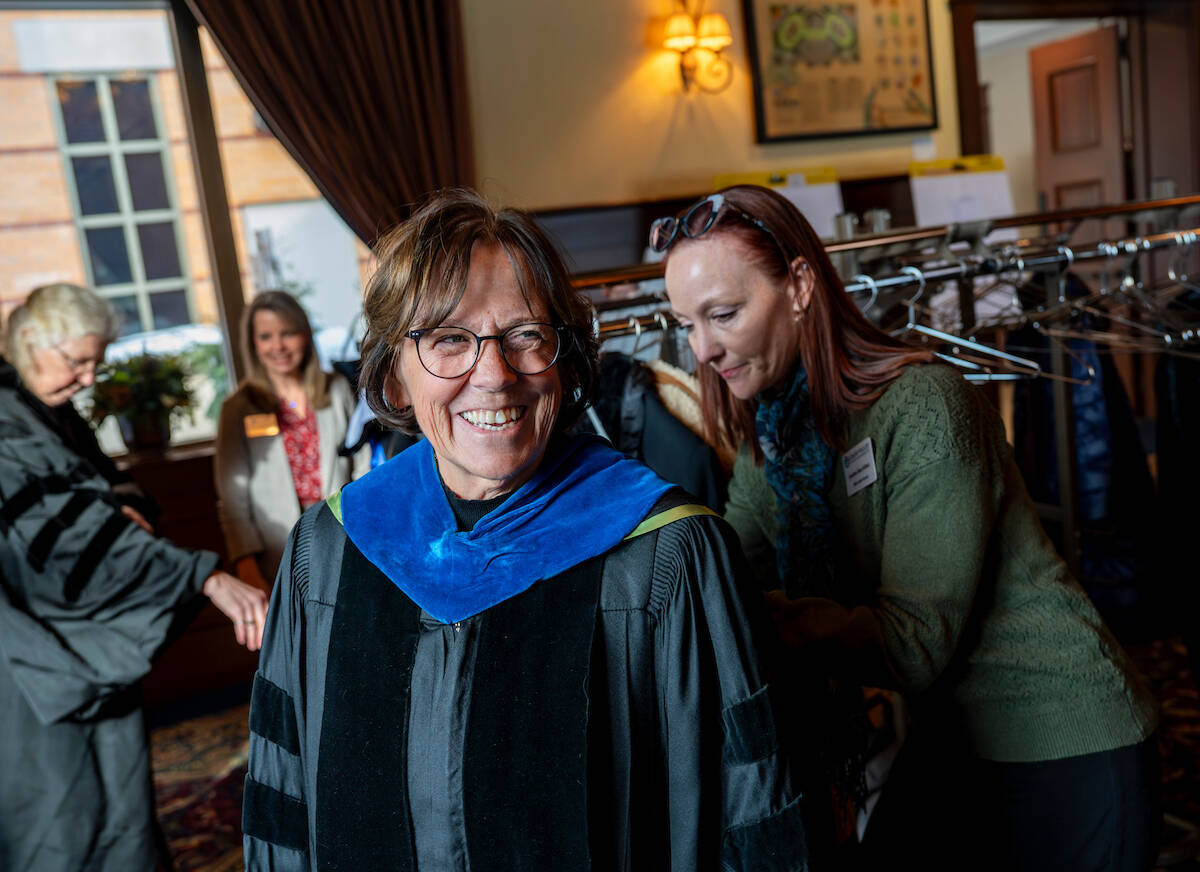
Theresa Bacon-Baguley smiles as Justine Rau Kibet lends assistance during robing at the Faculty Awards Convocation in February, when Bacon-Baguley earned a Niemeyer Award. (Cory Morse)
How will the College of Health Professions recognize PA Appreciation Week?
PA Appreciation Week allows us to celebrate the profession and recognize the students, faculty, alumni, preceptors and healthcare partners who help educate the next generation of PAs. It also highlights the important role PAs play in expanding access to healthcare, particularly in communities where access to providers is limited.
At GVSU, we encourage our students to use the week to promote and advocate for their profession in the communities they serve. Our students and faculty participate in the state PA organization’s conference and support fundraising efforts for a local nonprofit organization. PA Appreciation Week is not only a celebration, but an opportunity for our students to educate others about the profession and give back to their communities.
How do you describe GVSU students who major in physician assistant studies?
Our students are bright, hardworking, compassionate, curious and dedicated. What we strive to instill in them goes beyond mastering the enormous amount of medical information required to become a PA, which we sometimes refer to as drinking from the firehose. We want our students to become critical thinkers who continually ask “why?” Knowing what to do is important, but understanding why you are doing it allows a clinician to apply that knowledge when the patient in front of them does not look like the patient described in a textbook.
How do the Traverse City and Grand Rapids cohorts collaborate?
Although our students are located in Grand Rapids and Traverse City, there is one PAS program and one cohort. The curriculum is delivered across both locations so students and faculty can interact in real time during lectures, discussions and other learning experiences. At the same time, the Traverse City campus maintains a distinct rural focus, preparing students to serve communities in northern Michigan.
That sense of being one cohort begins on the first day, with team-building activities designed to reinforce that PA education is a journey they are undertaking together and that collaboration will be essential to their success. Throughout the program, Traverse City students travel to Grand Rapids for simulation experiences, working together through clinical scenarios that develop teamwork and clinical decision-making skills.
The connections extend beyond the classroom. Each December, the program holds a formal dinner in Traverse City that brings all students together for an evening of celebration and student-created awards, including our much-anticipated “paper plate awards.” It is always rewarding to see how well students have come to know and appreciate one another.