
10th Roger That! Conference: Space and Time (INT 100/201 approved)
Friday, February 20, 2026
All day
Online, Robert C. Pew Grand Rapids Campus
Alumni, Community, Faculty, Staff, Students
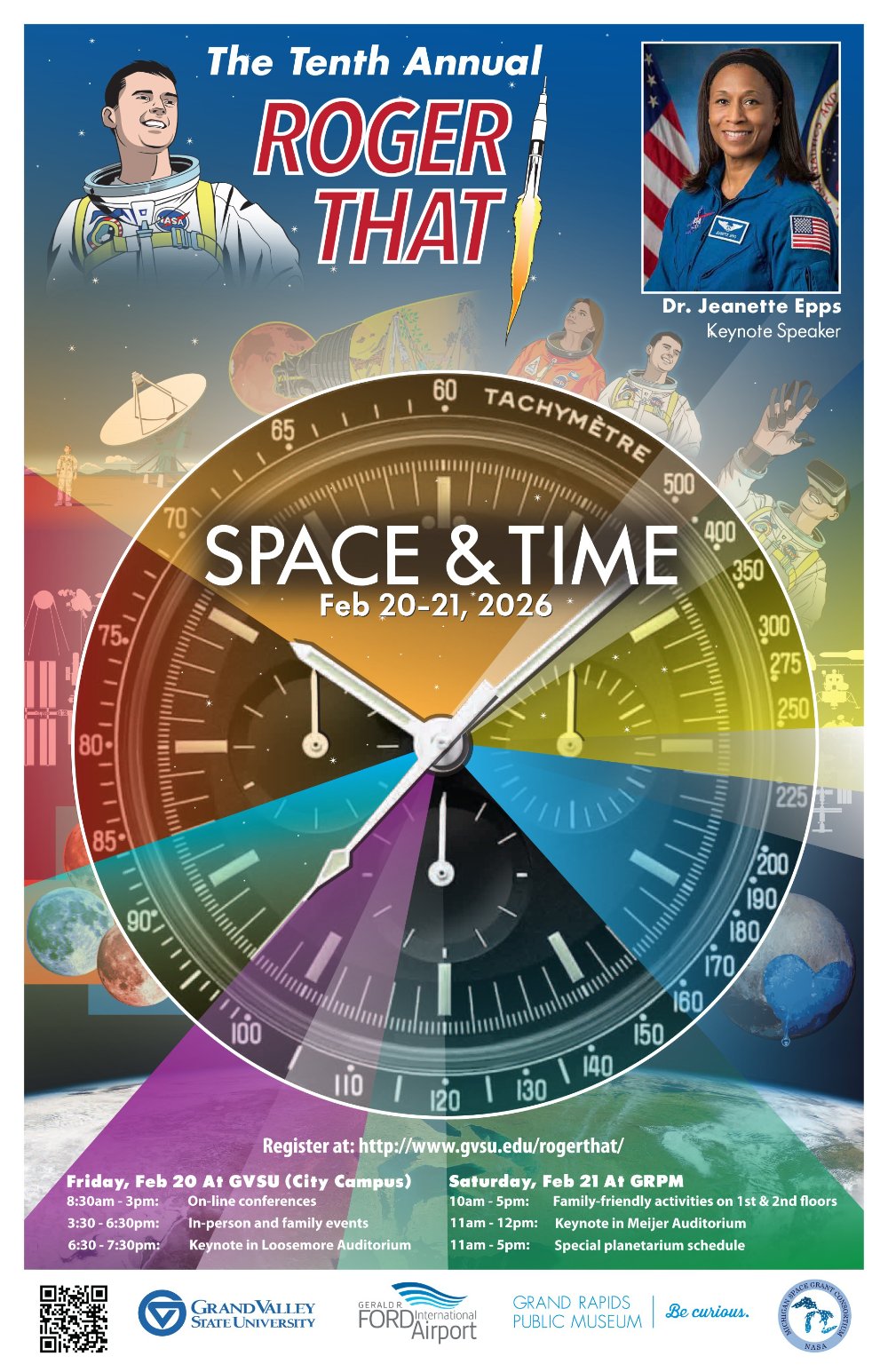
The 10th Roger That! Conference – A Celebration of Space Exploration in Honor of Roger B Chaffee will be held on Friday, February 20th, and Saturday, February 21st at GVSU and GRPM. The theme of this year’s conference is Space and Time – the many ways humans measure, understand, and imagine time as it relates to outer space. From the nanoseconds that govern spacecraft navigation to the millennia that shape cosmic evolution, our sense of time connects human experience with the rhythms of the universe. This year’s speakers will explore interplanetary time synchronization, lunar and Martian timekeeping, gravitational waves, and the technologies that make deep-space exploration possible. There will be workshops for all ages and a special in-person panel focused on traditional and cultural ways celestial bodies have guided calendars and seasons throughout history.
The conference is in hybrid format - register so we can send you the Zoom link. Events at GVSU are free and open to the public while those at GRPM are free with admission.
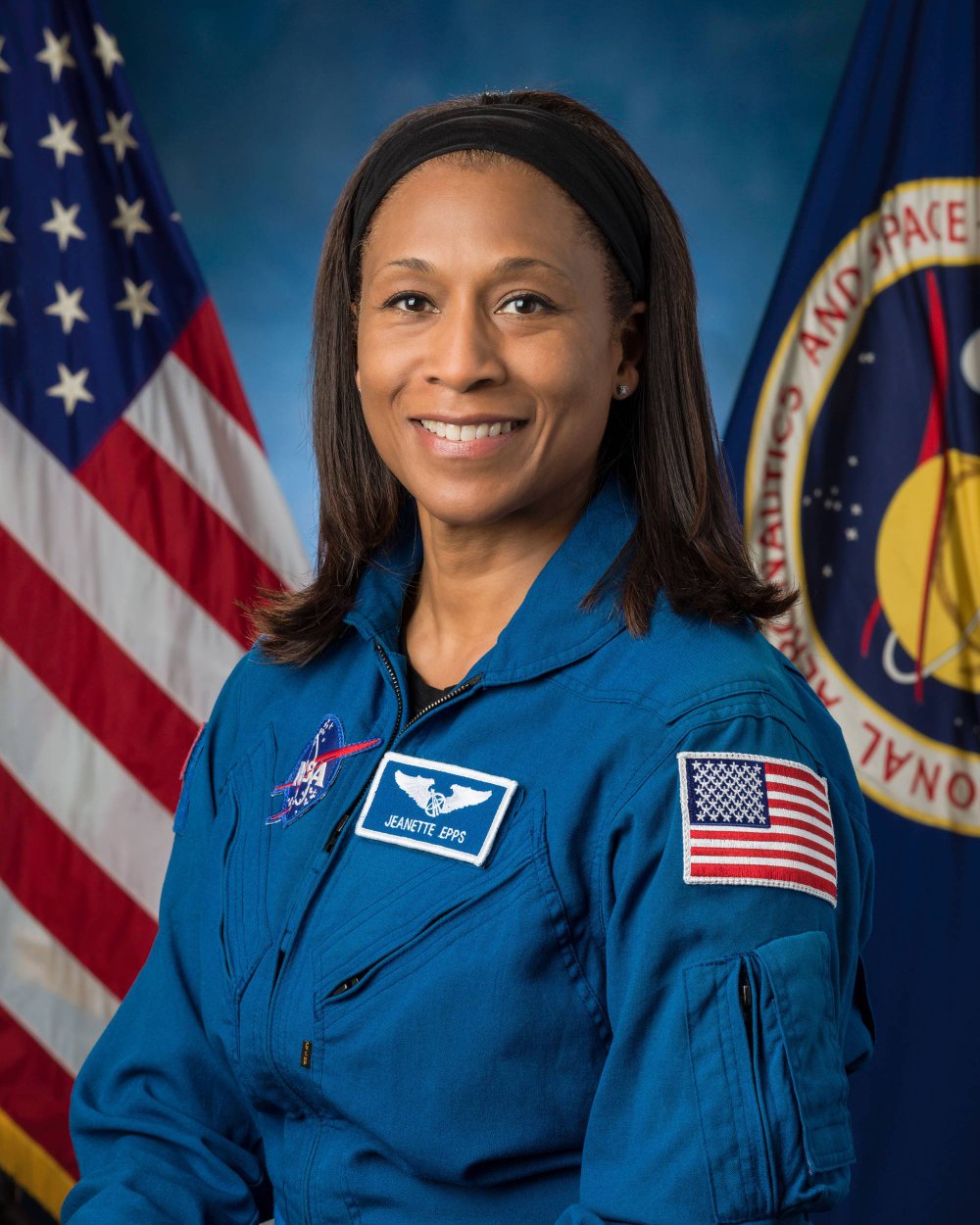
Our keynote speaker, Dr. Jeanette J. Epps, is an aerospace engineer, former CIA intelligence officer, and retired NASA astronaut who spent over 230 days aboard the International Space Station as a mission specialist for SpaceX Crew-8. Selected by NASA in 2009, she has trained extensively with both SpaceX and the Russian space agency, Roscosmos, developing expertise in robotics, spacewalk operations, and international mission coordination. She will be speaking in-person at 6:30 pm on Friday, February 20th at the Loosemore Auditorium and again at 11 am on Saturday, February 21st at the museum. Dr. Epps’ talk is titled Launch your Curiosity: Igniting a love for STEAM.
Our lineup of speakers (virtual) on Friday, February 20th will include anthropologist Kevin Birth, who will discuss the challenge of interplanetary time synchronization and its historical roots; Father Paul Gabor of the Vatican Observatory, speaking on timekeeping on the Moon and Mars; Amanda Stark, principal investigator for NASA’s MARVL (Modular Assembled Radiators for Nuclear Electric Propulsion Vehicles) project at Langley Research Center; and Keith Snedegar covering telemetry, tracking, and time during the Apollo missions.
At 3:30 pm on Friday we will transition to in-person activities at the Loosemore Auditorium at GVSU with physics and engineering workshops for kids of all ages! Join our panel to discuss how different communities understand and organize time through celestial rhythms, drawing on cultural traditions, lived experience, and contemporary practice.
There will be more family-friendly activities at the museum all day Friday and Saturday.
This event is recurring on Saturday, February 21, 2026.
Location Information
On Friday, Feb 20th, Roger That! activities will take place at GVSU's Loosemore Auditorium in the DeVos Center on the Downtown Pew campus. Complimentary Parking is located in the Seward Ramp Lot at 520 Lake Michigan Dr. Grand Rapids, MI 49504. For parking at the Grand Rapids Public Museum on Saturday Feb 21st, please click here.
The Richard M. DeVos Center, Loosemore Auditorium
401 West Fulton
Street
Grand Rapids, MI 49504
Contact Information
Brad Ambrose, [email protected]
Karen Gipson, [email protected]
Samhita Rhodes, [email protected]
Deana Weibel, [email protected]
Hosting Department, Organization, or Business
College of Liberal Arts and Sciences, Padnos College of Engineering,
Grand Rapids Public Museum
Tags
anthropology astronaut engineering family int100 int201 k12education physics science space
Share this event
This event was added to the calendar by Samhita Rhodes (rhodesam@gvsu.edu) on Wednesday, January 28, 2026 and was last updated on Thursday, February 5, 2026 at 12:21 p.m.
Similar Events
4:30 p.m. - 5:30 p.m.
Fail Forward Panel (INT 100 Approved)
Allendale Campus7:30 p.m.
GV Arts Celebration: Ying Quartet, From Mozart to Childs (INT 100/201 approved)
Allendale Campus6:30 p.m. - 8:00 p.m.
Interfaith Book Group: The Road to Wisdom (4 meetings)
Online7:00 p.m. - 8:00 p.m.
The James W. Carey Memorial Lecture: Strengths, Shadows, and Supportive Confrontation: Transformative Learning Theory in Action (INT 100/201 approved)
Robert C. Pew Grand Rapids Campus7:30 p.m.