

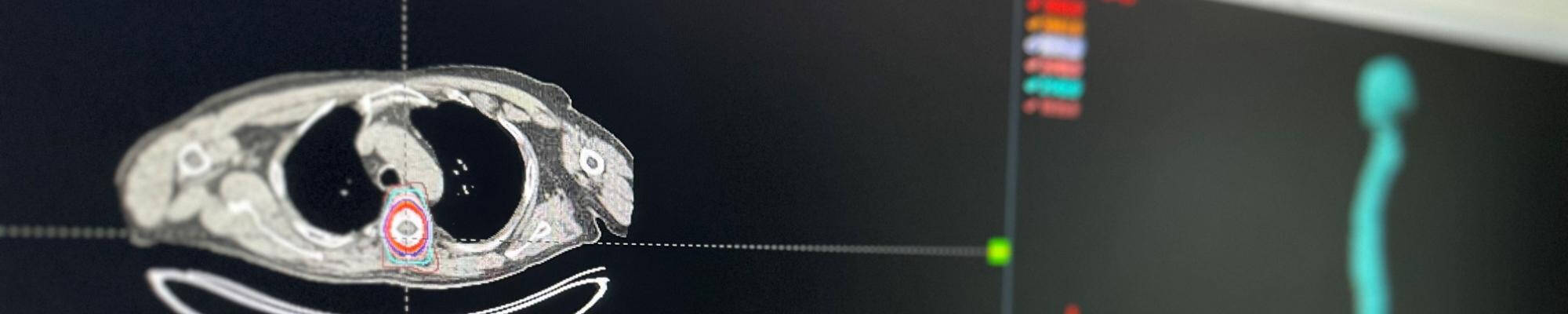
Medical Dosimetry Virtual Information Session
We invite you to join us for an Online Information Session to discuss the program and answer any questions you may have to help you get started with our next cohort. Register for a session today!
- Tuesday, October 27th, 2026 from 08:00 PM to 09:00 PM EST (eastern time zone)
- Register Here: https://apply.gvsu.edu/register/Oct27
- Thursday, December 10th, 2026 from 08:00 PM to 09:00 PM EST (eastern time zone)
- Register Here: https://apply.gvsu.edu/register/Dec10
What is Medical Dosimetry?
According to the American Association of Medical Dosimetrists (AAMD) at www.medicaldosimetry.org, the Medical Dosimetrist is a member of the radiation oncology team who has knowledge of the overall characteristics and clinical relevance of radiation oncology treatment machines and equipment, is cognizant of procedures commonly used in brachytherapy and has the education and expertise necessary to generate radiation dose distributions and dose calculations in collaboration with the medical physicist and radiation oncologist.
The Medical Dosimetrist performs calculations for the accurate delivery of the Radiation Oncologist's prescribed dose, documents pertinent information in the patient record, and verifies the mathematical accuracy of all calculations using a system established by the Medical Physicist. We perform, or assist in, the application of specific methods of radiation measurement including ion chamber, thermoluminescent dosimeters (TLD), or film measurement as directed by the Medical Physicist. Another area that we may contribute to is giving technical and physics support to the Medical Physicist; this support could be in radiation protection, qualitative machine calibrations, and quality assurance of the radiation oncology equipment. Also, we often take on the role of educator in facilities that have radiation oncology residents, radiation therapy students or medical dosimetry students.

Watch the Video to Learn More about Dosimetry
Why Study Medical Dosimetry at Grand Valley?
- Experience. Includes clinical experience performing treatment planning activities in radiation oncology centers.
- In-demand. Advances in treatment planning combined with increases in radiation oncology centers has increased the demand for certified medical dosimetrists.
- Flexible. Available as a 3 term lockstep cohort program for full time students or 5 to 6 terms for part time students. The program is a hybrid/online format to encourage working professionals to engage with this program.
- Convenient. Clinical education courses are held at clinical radiation oncology centers and courses are online, with one on-site meeting at the Cook-DeVos Center for Health Sciences in downtown Grand Rapids.
- Accredited. The medical dosimetry program is accredited through the Joint Review Committee on Education in Radiologic Technology.
Watch the Video to See What Makes GVSU's Program Unique
Program Overview
GVSU’s Master's in Medical Dosimetry program is a JRCERT Accredited 12 month hybrid/online program (September-August) that is comprised of didactic and clinical education for a total of 38 credits. Students remain at one clinical location for the entire year (which are across the US) and are required to come onsite to GVSU a total of one time during the year (3-day orientation). The remainder of the courses are online. The curriculum meets the requirements prescribed by the American Association of Medical Dosimetrists, so that successfully completing the 38-credit hour didactic and clinical curriculum qualifies graduates to be eligible to sit for the MDCB examination and become a Certified Medical Dosimetrist (CMD).
Student Handbook: Medical Dosimetry Program Student Handbook 2026-2027
Admissions Process
Application Deadline: February 1
Apply Now
Admission to the medical dosimetry program is competitive and requires completion of a bachelor's degree prior to admission. Application can be made through the GVSU graduate admission website.
Accreditation
The GVSU Medical Dosimetry program is accredited by the Joint Review Committee on Education in Radiologic Technology (JRCERT).
20 North Wacker Drive, Suite 2850
Chicago, IL 60606-3182
312-704-5300
Email: [email protected]
The program’s current accreditation award is 8 years. General program accreditation information and the current accreditation award letter can be found by visiting JRCERT's website. The next site visit is tentatively scheduled for the Third Quarter of 2027. The program will adhere to the JRCERT standards. Students have the right to notify the JRCERT if they believe the university is not adhering to these standards.
Program Effectiveness Data
Program effectiveness data can be found in the document Program Effectiveness Data, which includes the program's credentialing examination rate (MDCB board pass rates), job placement and program completion rates. The JRCERT also publishes this data: https://www.jrcert.org/programs/grand-valley-state-university/.
Mission, Goals and Outcomes
Mission Statement
- The program’s mission is to provide graduates with the knowledge, clinical skills, and professional behaviors for a career in Medical Dosimetry.
Program Goals
Upon completion of the program students will be able to:
- Demonstrate clinical competence.
- Communicate effectively.
- Develop critical thinking and problem solving skills.
- Demonstrate professional behavior in clinic and the profession.
Student Learning Objectives
- Students will apply didactic knowledge to treatment plans.
- Students will generate clinically acceptable IMRT/VMAT treatment plans.
- Students will communicate effectively with healthcare staff.
- Students will communicate effectively through written work.
- Students will evaluate, critique, and recommend changes to the radiation therapy plan as necessary.
- Students will participate in the development of optimal treatment strategies.
- Students will demonstrate professional behavior in the clinic.
- Students will engage in the medical dosimetry profession.