

GVSU Professor Pens New Book on Collaborative Environmental Management
Many high school courses, from biology and environmental science to social studies and economics, discuss the "tragedy of the commons." The phrase gained popularity after ecologist Garrett Hardin wrote a 1968 essay by that name. Since then, it has become a short-hand way of describing the misaligned incentives that lead to the destruction of a shared resource. Hardin asserted that there were two, and only two, ways to avoid the "tragedy." One way was to privatize the resource and let market forces allocate the resource efficiently. The other was for a central government to impose restrictions on the resource users. Hardin assumed that the resource users themselves were trapped by the misaligned incentives and could not sustain their own shared resources. This approach has influenced the teaching of environmental challenges for over half a century. But Hardin's metaphor is at best incomplete.
Political scientist Elinor Ostrom spent her career showing the limits of Hardin's ideas. Between the market and government regulation lies a broad range of civil society institutions that can govern how shared environmental resources are managed. From Maine's "lobster gangs" to irrigation communities in Nepal, Ostrom showed that, under the right circumstances, community members could come together and manage their shared resources. It's not easy, and communities are not always successful. But Ostrom's research found that communities are not trapped by circumstances and destined to ruin their resources. For this work, Ostrom was awarded the Nobel Prize in Economics in 2009 for her work on "economic governance, especially the commons."
In her Nobel Prize address, Ostrom emphasized that "humans have a more complex motivational structure and more capability to solve social dilemmas" than they are given credit for. Ostrom's work showed that in between the market and government regulation lies a vast area of solutions created by, and for, local communities. "A core goal of public policy," Ostrom continued, "should be to facilitate the development of institutions that bring out the best in humans."
Ostrom was the first woman to win the Nobel Prize in Economics. Ironically, Ostrom earned a Ph.D. in political science after being rejected by the UCLA Economics department, which did not want to admit women into the program. Ostrom broke many barriers and influenced generations of students and colleagues during her 50-year career as a professor at Indiana University. She passed away in 2012.
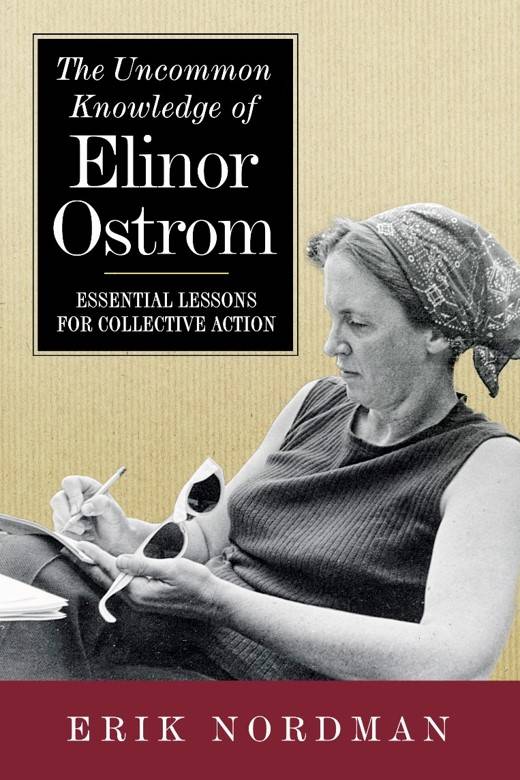
In Professor Erik Nordman's new book, The Uncommon Knowledge of Elinor Ostrom: Essential Lessons for Collective Action, tells the story of Ostrom's journey from Depression-era Los Angeles to her Nobel Prize. It introduces readers to Ostrom's groundbreaking ideas about collaborative environmental management. The book's non-technical, narrative approach will appeal to high school and college students as well as adults interested in environmental issues. A sample curriculum and additional resources are available on the book's website.