

2026 Engineering Design Conference
Project: Fish Pass
Team 16

Team Members
Samantha Knight
Christopher Mills
Eryn Petriko
Trent Spradlin
Faculty Advisor
Karl Brakora
Sponsor Advisor
Dan Zielinski
Abstract
The FishPass project is a small form Radio Frequency Identification (RFID) Passive Integrated Transponder (PIT) detection system used to monitor fish movement. The PIT monitoring system operates by first implanting PIT tags into fish, allowing each fish to have unique identification. As tagged fish swim through designated passage points, they pass through antennas (looped copper wire) submerged in the water. The antennas power the tags and enable them to transmit their identification signals. The antennas are connected to tuning boards, which adjust the system’s capacitance to properly match the antenna characteristics for optimal signal detection. The tuning boards interface with PIT readers through twin-axial cables, allowing the readers to process the received tag signals. The PIT readers are comprised of two connected modules. The first module is a half-duplex 134kHz remote power RF module, while the second module is an RS-232 control board. The PIT readers then transmit detection data via RS-232 communication to a central computer system. The computer logs the data and can be remotely accessed, enabling users to retrieve detection records and monitor system performance without needing to be physically on-site.
Industry Sponsor
https://glfc.org

The mission of FishPass is to provide up- and down-stream passage of desirable fishes while simultaneously blocking and/or removing undesirable fishes.
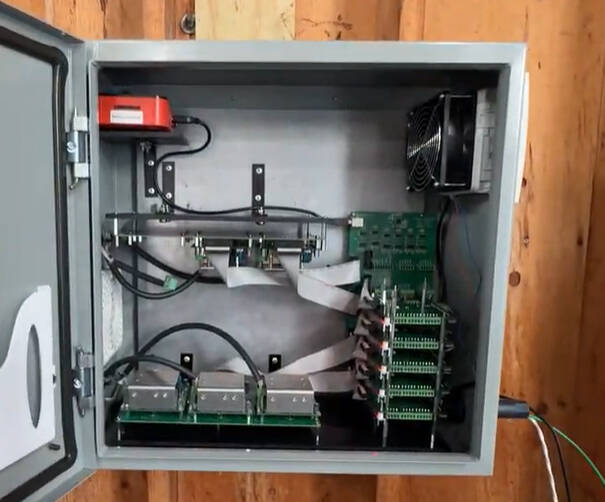
Project Photo
Project Poster
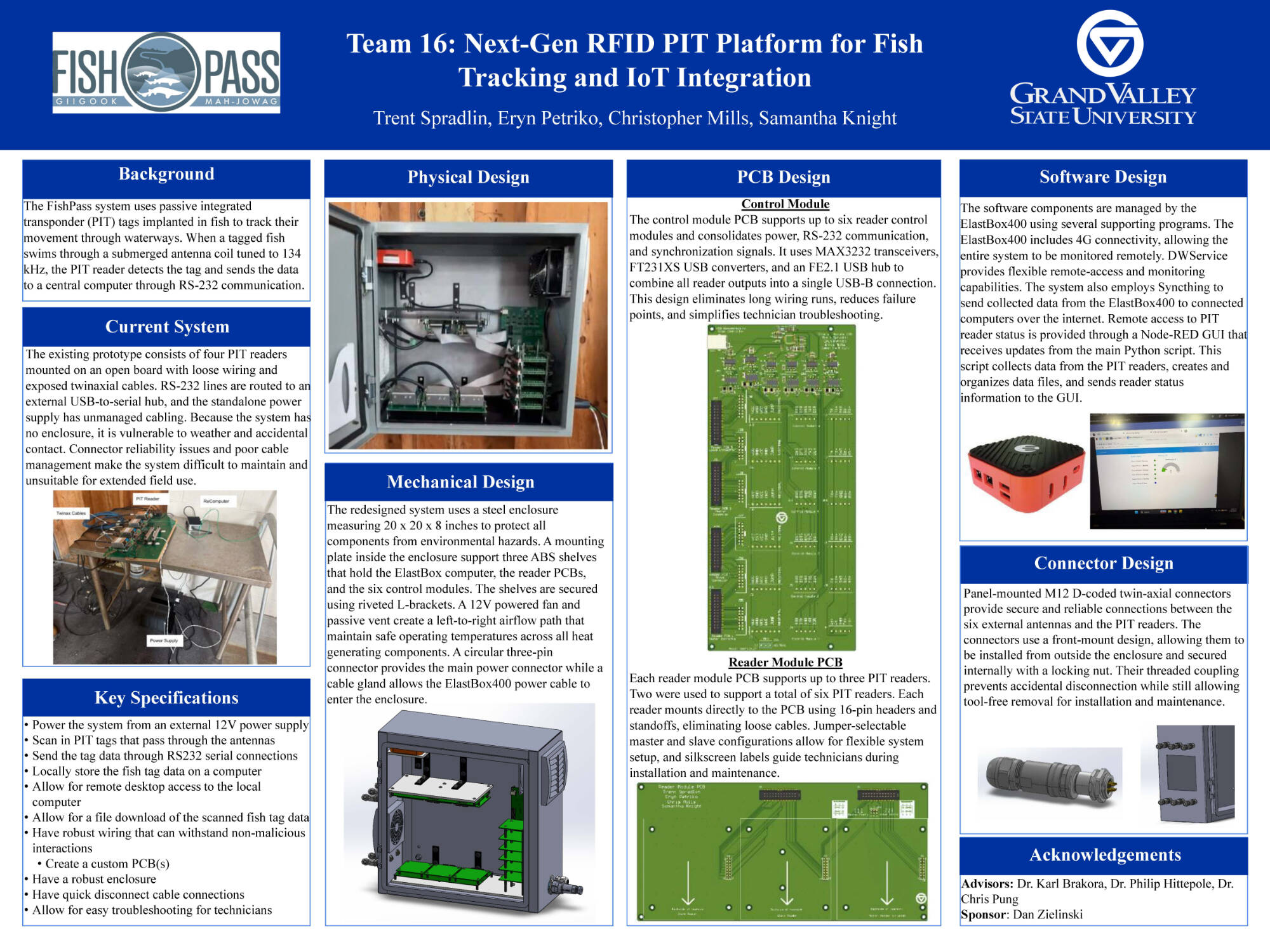
Click to open PDF
Project Video
