

In the News
5 Ways the FTZ Program Helps Build a Stronger U.S. Economy
July 08, 2025
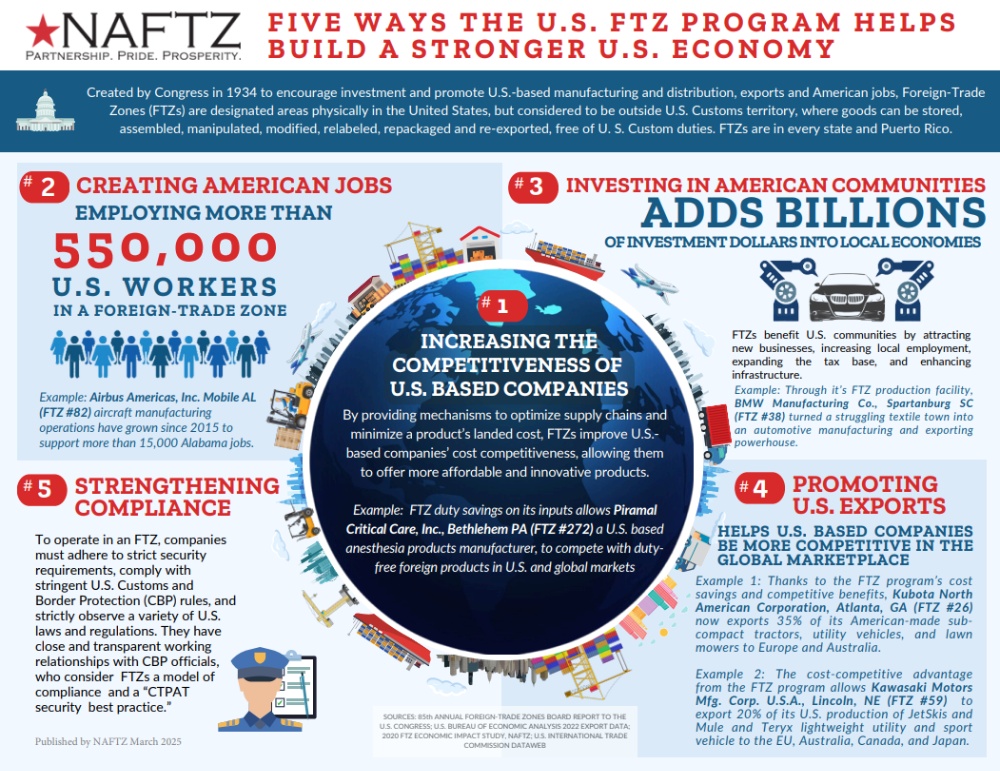
Originally Published by NAFTZ, March 2025
Since its creation by Congress in 1934, the U.S. Foreign-Trade
Zone (FTZ) program has helped position the United States as a
competitive force in global trade. By allowing goods to be imported,
processed, and re-exported without immediate payment of customs
duties, FTZs support U.S.-based companies and strengthen the broader
economy. Here are five key ways FTZs make an impact:
1. Increasing the Competitiveness of U.S.-Based Companies
FTZs give U.S. companies a competitive edge by optimizing supply chains and reducing landed costs. This makes it easier for American businesses to offer high-quality, affordable products, both domestically and abroad.
Example: Piramal Critical Care, Inc. in Bethlehem, PA (FTZ #272) uses FTZ duty savings to compete with duty-free foreign anesthesia products in both U.S. and international markets.
2. Creating American Jobs
The FTZ program directly supports over 550,000 U.S. workers. By making it more viable for manufacturers and distributors to operate in the U.S., FTZs help retain and grow domestic employment.
Example: Airbus Americas, Inc. in Mobile, AL (FTZ #82) has expanded operations significantly since 2015, now supporting more than 15,000 jobs in Alabama.
3. Investing in American Communities
FTZs channel billions of dollars into local economies by attracting new businesses, expanding tax bases, and improving infrastructure. This investment revitalizes regions and supports long-term economic health.
Example: BMW Manufacturing Co. in Spartanburg, SC (FTZ #38) transformed a struggling textile town into a thriving hub for automotive manufacturing and exports.
4. Promoting U.S. Exports
Thanks to reduced operational costs and improved efficiency, FTZ companies are able to boost their exports and reach more global markets.
Example 1: Kubota North American Corporation in Atlanta, GA (FTZ #26) now exports 35% of its U.S.-made tractors and utility vehicles to Europe and Australia.
Example 2: Kawasaki Motors Mfg. Corp. U.S.A. in Lincoln, NE (FTZ #59) exports 20% of its U.S. production of JetSkis and sport vehicles to international markets including the EU, Australia, Canada, and Japan.
5. Strengthening Compliance
Companies operating in FTZs must adhere to strict security measures and work closely with U.S. Customs and Border Protection (CBP). As a result, FTZs are often seen as models of compliance and best practices in trade security.
The FTZ program is more than a logistics strategy—it’s a cornerstone
of U.S. economic resilience. By lowering trade barriers, supporting
domestic growth, and boosting international reach, FTZs continue to
build a more dynamic, competitive, and secure future for American
businesses and workers.
View the Original NAFTZ PDF Here.