
AI Collective Meeting Summaries
Permanent link for Meeting 004 (July 2026): Preserving the Human Mark, Highlights from the July AI Collective on August 13, 2026
Posted by: Joseph Van Harken – Innovator in Residence | Categories: Emerging Tech, AI Collective, Higher Ed Pedagogy, Institutional Strategy
As the summer sun warmed up the Grandview Collaboration Hub, the GVSU AI Collective gathered for its July meetup to tackle a challenge sitting at the heart of higher education: How do we leverage AI for administrative efficiency and assessment without eroding human connection, intent, and authenticity?
This month’s hybrid session paired a deep dive into Zoom’s emerging enterprise AI suite with a thought-provoking framework on human-centric communication.
Smart Automation: Inside Zoom’s AI Ecosystem
Joining us remotely, Mike Williams from Zoom showcased how collaboration tools are evolving beyond static video grids. As AI note-taking bots increasingly invade online meetings, Zoom is taking a different approach by embedding individual, permission-aware tools directly into the user interface.
Key takeaways from the Zoom update include:
- My Notes & Lecture Enrichment: Zoom’s native "My Notes" tool transcribes and enriches individual notes in real time without dropping third-party bots into the room. The system can format outputs into specialized templates such as lecture summaries that highlight core concepts and potential exam topics grounded strictly in the transcript.
- The Federated Model Engine: Behind the scenes, Zoom operates a "federated model" orchestration layer. Instead of relying on a single AI provider, the system dynamically routes prompts to the best tool for the job switching between OpenAI (GPT-5.5), Anthropic, Perplexity, and Gemini based on whether the task demands mathematical precision, creative drafting, or live web searching.
- Simulating Real-World Assessment: Mike shared how AI video/audio simulations are entering clinical and professional spaces. For instance, medical or law students can interrogate a simulated AI patient or courtroom witness, with the entire interaction payload feeding into Canvas or Blackboard speed-graders for faculty evaluation.
Try It Out: GVSU faculty and staff interested in exploring Zoom’s AI capabilities can submit an IT service ticket at https://services.gvsu.edu/TDClient/60/Portal/KB/PrintArticle?ID=28046 to request early access.
Communication Without Erosion: Where is Your Human Line?
Our second presentation was led by Arya Jadhav (Faculty, College of Computing), who challenged the room to look closely at how LLMs are quietly altering our communication habits and self-confidence.
When administrative tasks are overwhelming, plugging AI into daily email streams is tempting. However, Jadhav demonstrated how raw AI communications, like a generic policy update announcement, often default to syntactically perfect yet vapid, unemotional, and institutional language.
"Language touches the part of our brain that craves connection with another human," Jadhav noted. "If a system mimics emotive responses, we risk giving it more trust than it actually deserves."
What AI Communication Style Are You?
To help us evaluate our habits, Jadhav broke down four distinct user profiles:
- The Skeptic: Uses AI minimally, primarily for simple info-seeking.
- The Minimalist: Selectively applies AI to polish drafts or handle routine admin formatting.
- The Strategist: Intentionally integrates AI into complex planning, workflows, and decision-making.
- The Enthusiast: Deeply embeds AI across major intellectual products and core work tasks.
The consensus? Regardless of where you fall, the intent must originate with the human. Whether you write a rough first draft and use AI to condense it for an 18-year-old student audience, or feed a detailed "blob" of clear intent into the prompt, the final judgment, voice, and responsibility must remain yours.
Please click here to download this month’s AI Collective slide deck, which includes Jadhav’s full presentation, Designing AI-Enhanced Communication Without Eroding Human Engagement .
The Assessment Reality Check
The open floor portion of the meeting brought out candid reflections on student assessment. Faculty shared experiences ranging from a return to paper-and-pencil exams to using AI as an adversarial "thought partner" that helps students find loopholes in their own ideas.
One essential tip for faculty building AI course assistants: Always instruct your AI tutor to follow the Socratic Method. Rather than handing students direct answers, the AI should guide them through thought-provoking questions so they derive the conclusions themselves.
Join Us for the Next Session!
The AI Collective thrives on community dialogue, from seasoned coders to those just taking their first steps.
- Stay Connected: Join the active conversation on the AI Collective Zoom IM Channel to post questions, share prompts, and discuss emerging higher ed tech news.
- Mark Your Calendar: Our next meetup takes place on the last Friday of August, please register now and share the link! NOTE: Our September session slated to move to the Allendale campus!
See you at the next Meet Up!
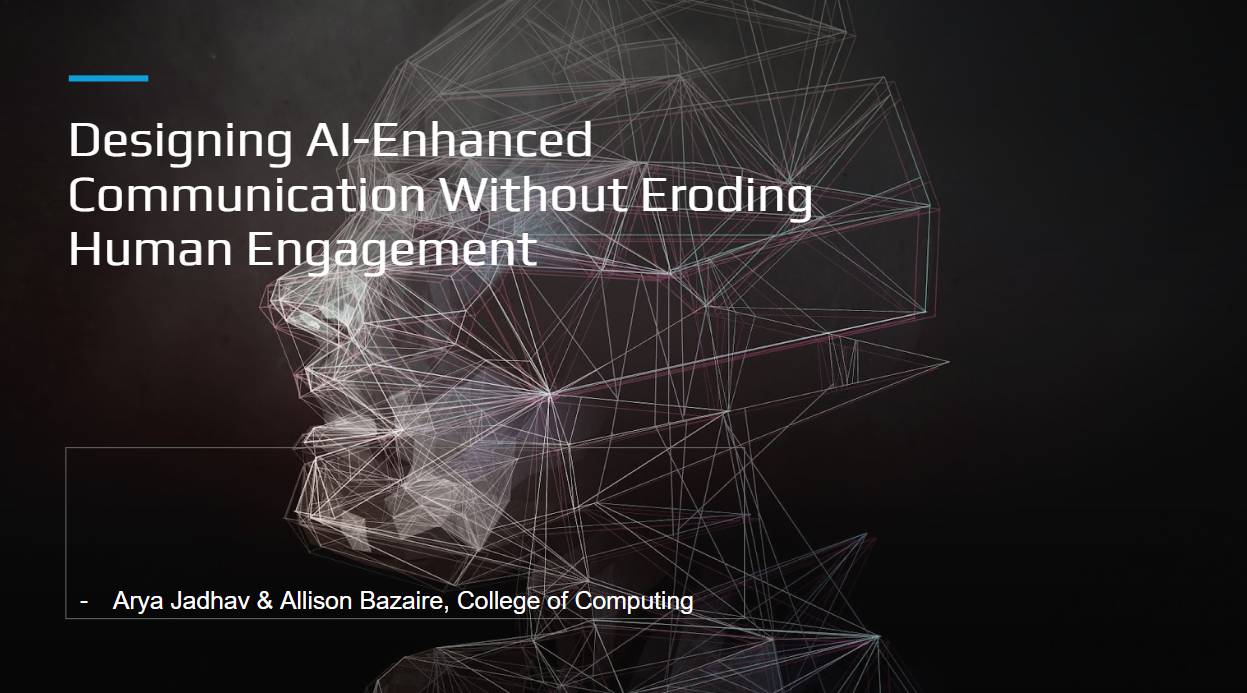
Designing Al-Enhanced Communication Without Eroding Human Engagement - Arya Jadhav & Allison Bazaire, College of Computing
Categories:
AI
AI Collective
Posted
by
Joseph Van Harken
on
Permanent link for Meeting 004 (July 2026): Preserving the Human Mark, Highlights from the July AI Collective on August 13, 2026.