
AI Collective Meeting Summaries
Permanent link for Meeting -003 (June 2026): Shaping Our Future Together on July 8, 2026
Bridging Grassroots Innovation with Institutional Realities: Highlights from the AI Collective June 26, 2026 (Meeting - 03)
Posted by: Joseph Van Harken – Innovator in Residence | Categories: Emerging Tech, AI Collective, Higher Ed Pedagogy, Institutional Strategy
Following the momentum of our official launch, the GVSU AI Collective gathered once again at the Grandview Collaboration Hub (CEC) to tackle one of the most pressing questions on campus: How do we push past basic chatbot prompts to build meaningful, custom workflows—while navigating the realities of institutional data, policy, and compliance?
This month’s session highlighted the incredible ways our community is experimenting with "vibe coding" custom solutions.
Engaging with "Citizen Development"
Our feature presenter this month was Paul Hillman, Professor of Management at the Seidman College of Business, who shared his journey from an AI skeptic to a champion of "citizen development".
Faced with the logistical nightmare of manually evaluating 360 individual student speech transcripts across three class sections using the virtual-reality based emotional intelligence software Ovation, Professor Hillman knew traditional grading wouldn't scale. Without an existing solution available, he turned to AI-assisted development.
Without writing a single line of traditional code, Hillman utilized high-level vibe coding platforms to build custom applications tailored specifically to his classroom workflows:
-
EngageU: A physical classroom layout app built via Lovable. With a touchscreen interface, Hillman maps required student seating charts and logs real-time participation and attendance metrics directly during class, seamlessly exporting the data via CSV from the vibe coded app directly importing it into Blackboard.
-
BEARS: A custom workflow tool designed to handle weekly business ethics reflection sheets (BEARS). By embedding discrete rubric logic behind every question, the app analyzes student submissions for core grammatical structures and domain knowledge, enabling Hillman to deliver hyper-personalized, high-quality email feedback to 120 students within 48 hours.
The Vibe Coding Spectrum: The Collective took time to break down the technical layers behind these tools. While surface-level tools like Lovable or Bolt allow non-programmers to rapidly prototype custom front-end facades, deeper agentic platforms (like Cursor or Claude Codex) delegate tasks to specialized micro-agents capable of conducting deep data analysis, checking code syntax against security frameworks like the OWASP Top 10, or executing complex file conversions autonomously.
For Hillman’s students, this isn't about letting a machine think for them. He enforces strict "voice checks" to ensure real subject retention, treating AI proficiency as a foundational baseline for the modern workplace. "I would never hire an accountant who refuses to use Excel for fear it might do something wrong," Hillman noted. "The human is still completely in the loop."
Voices from the Collective: Cross-Campus Case Studies
Our hybrid audience and remote attendees from across the university showcased just how rapidly AI is being leveraged in traditional operations:
- Consulting & Research: Jeff Williams, Director of Consulting Services at the Dorothy Johnson Center for Philanthropy, shared how his 12-person unit manages 30 to 50 external research projects a year. His team utilizes GitHub Copilot for web development, Claude for data science, and NotebookLM to check hand-coded research variables across hundreds of client documents.
- Data Foundations: Kurt Partlo, Director of Data and Analytics, emphasized that high aspirations for embedded AI must be built on a secure, ethical corporate data lakehouse designed fundamentally to support student success.
- Remote Frameworks: Joining us virtually from Minneapolis, Mike Williams from Zoom discussed how he leverages Model Context Protocol (MCP) servers to bridge native platform engineering with advanced LLMs like Claude and OpenAI to prototype immersive educational tools.
Building Institutional Momentum
As part of the AI Collective Meetup, Co-facilitator Eric Kunnen provided a briefing on the central AI Steering Team's recent retreat and strategy workshop.
After a year of collaboration, surveys, and town halls, the AI Steering Team (sponsored by Chief Digital Officer Milos Topic and Provost Jen Drake) is shifting its focus toward strategic institutional alignment. As the Fall semester approaches, more information will be shared with the campus community around the advancement of AI at GVSU.
What’s Next for the Collective?
The AI Collective is a living, breathing community kitchen, we don't just look at the tools; we cook with them and evaluate the output together.
- Join the Conversation: If you haven’t yet, join the active AI Collective Zoom IM Channel to share your prompts, test custom scripts, and crowd-vibe with fellow Lakers.
- Next Month's Spotlight: We are thrilled to welcome Mike Williams from Zoom as a featured presenter to give us a deep-dive look into the cutting-edge educational AI pipelines currently being integrated natively into Zoom. And, we’ll hear from some faculty members who have recently submitted AI-focused proposals for the November 3 GV Tech Summit.
See you at the next meetup on July 31!
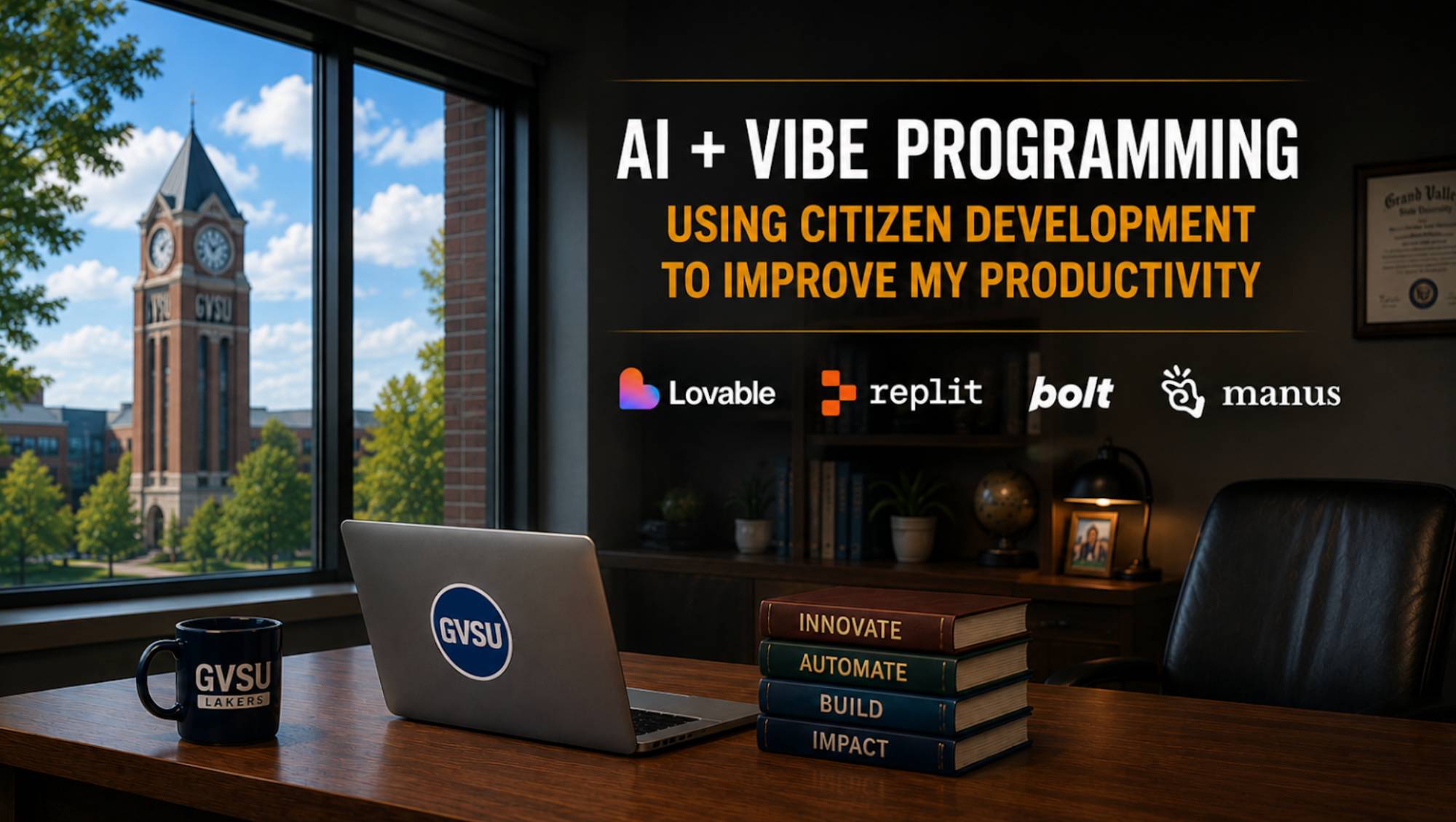
Seidman College of Business Professor Paul Hillman shares his journey from an AI skeptic to a champion of "citizen development". View the full presentation here.
Categories:
AI
AI Collective
Posted
by
Joseph Van Harken
on
Permanent link for Meeting -003 (June 2026): Shaping Our Future Together on July 8, 2026.