

From hot plates to household materials: Teaching chemistry at Bellamy Creek
Inside a Michigan correctional facility, a GVSU faculty member is helping incarcerated students discover science.
Any Grand Valley student who takes a chemistry course led by affiliate professor Angela Slater quickly learns she has high academic standards for the class.
“I have high expectations for my students,” Slater said.
Those expectations don’t waver when her environment changes. A classroom is a classroom.
This year, Slater joined other GVSU faculty members who teach in the Bellamy Creek Program, an avenue for incarcerated students at Bellamy Creek Correctional Facility in Ionia to earn a bachelor’s degree in public and nonprofit administration.
“These students are earning the same bachelor’s degree as our students on the Valley or City Campuses, and they have risen to the occasion. They exceeded those expectations."
The program recently completed its second year with a cohort of 16 students under the stewardship of acting director Aaron Yore-VanOosterhout.
The program’s five-year path toward a bachelor’s degree includes many of the same classes that any GVSU student would take. In Slater’s case, that meant adapting CHM 201, an introductory chemistry course designed for pre-service elementary teachers, for the Bellamy Creek cohort.
Aaron Yore-VanOosterhout, acting director of the Bellamy Creek Program, leads the class in a discussion.
Aaron Yore-VanOosterhout, acting director of the Bellamy Creek Program, leads the class in a discussion.
“We want people to succeed. We want people to have a more fulfilling career and life upon release. This is a population we have not served adequately up until now, and this is our opportunity.”
Bellamy Creek students were required to take a science course as part of their degree requirements and voted on which field to study. After presentations from faculty members, the choice came down to geology or chemistry.
Chemistry won the vote, but there was one evident issue: how to safely conduct laboratory work inside a correctional facility.
Fortunately, Slater also has experience teaching chemistry in similar settings through the Hope-Western Prison Education Program at Muskegon Correctional Facility.
“There was a lot of communication between our prison administration at Bellamy Creek and the warden at Muskegon Correctional Facility, who said, ‘OK, I understand your concerns. This is how we did it. These are the things we agreed to. These are the things we didn't agree to,’” said Yore-VanOosterhout.
Traditional lab equipment required modifications. Gone were the Bunsen burners with their open flames and replaced with electric hot plates. Glass test tubes and beakers were out; heat-resistant plastic substitutes were in.
“Once you're inside, you don't have anything. You can't quickly print something. You can't pull up something on the Internet. You have what you have. So planning for a five-hour class, including a lab, is quite the challenge.”
Slater made other adjustments, paring her lab exercises down to their most basic elements, she said.
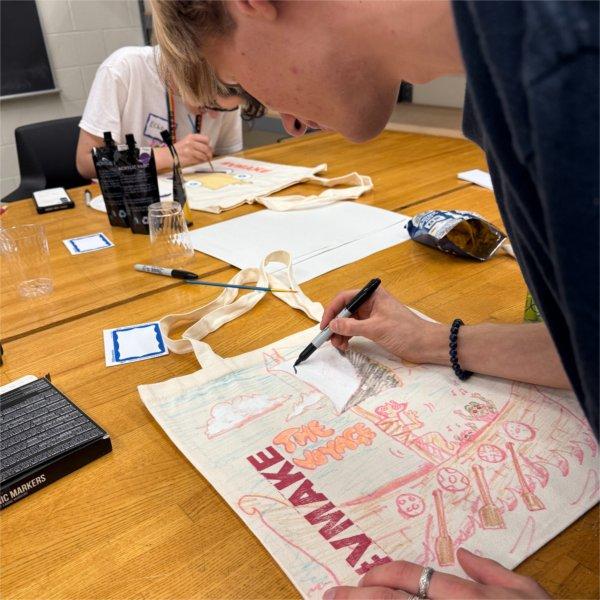
“If there's a chemistry class that we can do in prison, it's one that's based around stuff we can bring into an elementary school,” Slater said.
“It gave a really good base to start, using a lot of things that are in common households. We call it kitchen chemistry.”
The limitations of teaching inside a correctional facility also required Slater to rethink her approach to instruction, particularly for the five-hour class and lab sessions. Preparation was essential, she said.
Yore-VanOosterhout said Slater’s ability to engage students despite those limitations was remarkable.
“She's so limited, as are the students, but she's able to convey this information and keep their attention through a five-hour class,” Yore-VanOosterhout said. “That just blew my mind.”
Slater’s efforts, and that of her students, paid off. The class culminated with the students presenting a science fair to their classmates and GVSU faculty.
The success of the class has also drawn the attention of other universities. Slater said she is consulting with Eastern Michigan University as it explores implementing a similar course in its prison education program.
“As an educator, it validates to me this belief that I've always had that students are able to achieve at a high level with sufficient support,” Slater said.
“For students who have been out of school for decades to be able to meet and exceed those expectations validates that for me.”