One important difference is response time in the event
of a problem. Astronauts in low Earth orbit can return to Earth
relatively quickly if necessary. By contrast, astronauts on a lunar
mission cannot be back on Earth within hours.
The experience of space also changes. Astronauts in low
Earth orbit are used to looking out at the Earth below them, often
through the cupola on the International Space Station. As they
travel toward the moon, the Earth becomes smaller and more distant,
and the sense of being away from the planet becomes much more pronounced.
At the same time, missions to the moon carry a
different kind of cultural and symbolic meaning. This is only the
second period in which the United States has sent astronauts toward
the moon, and there is a sense of returning to something that was an
important part of American national identity. The moon also captures
the imagination in a way that the International Space Station does
not. It is visible from Earth, and people can look up and know where
astronauts are in a very direct way. That creates a different kind
of connection between space exploration and everyday experience.
You have researched astronauts who went to the moon.
How has that experience shaped or even changed them?
It really depends on the individual. Astronauts who
have gone to the moon have not all responded in the same way, but
many describe it as a profoundly different experience from being in
low Earth orbit.
One of the astronauts I interviewed, whom I refer to by
the pseudonym Zack, talked about being in orbit around the moon and
how strange it felt. He described the lunar surface as dry, hostile
and almost lifeless in comparison to Earth. From that perspective,
you are very close to another planetary body, but it is not one that
feels welcoming or alive. It creates a strong contrast with Earth,
which is full of oceans, vegetation, weather and human life.
That contrast seems to be a key part of the experience.
Astronauts in low Earth orbit are used to seeing Earth as something
close and present, something they can return to relatively quickly.
When you are near the moon, the Earth becomes smaller and more
distant, and the environment around you feels much less forgiving.
Buzz Aldrin famously described the moon as “magnificent desolation,”
and that phrase captures something many astronauts have tried to convey.
At the same time, astronauts have also described
moments of enjoyment and even playfulness, particularly when they
are on the surface. The moon’s one-sixth gravity allows for movement
that is impossible on Earth, and there is well-known footage of
astronauts hopping, experimenting with movement and interacting with
the environment in new ways. Some astronauts have also described the
experience as perspective-changing.
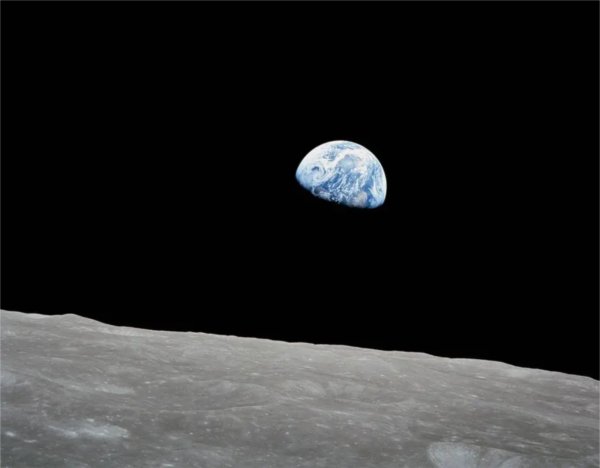
Apollo 8, which is the closest historical parallel to
Artemis II, produced the “Earthrise” photograph, taken by Bill
Anders, which allowed people on Earth to see their planet in a
completely new way. Overall, the experience of going to the moon
seems to heighten awareness of both difference and distance. It can
make Earth feel more precious and the moon feel more alien at the
same time.