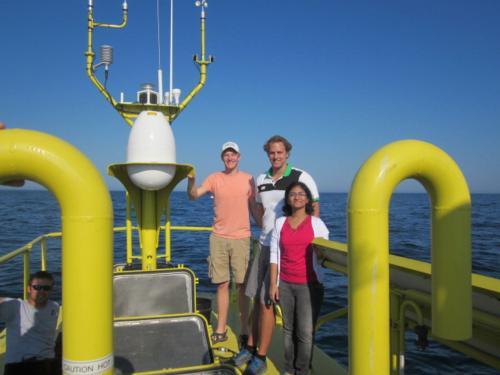
From left are students Tyson Spoelma, Aaron Clark and Divya Vemula.




A group of Grand Valley student researchers traveled seven miles
off the coast of Lake Michigan July 18 to visit the Offshore Wind
Assessment research buoy.
The students are helping to analyze data collected from the buoy
to determine the amount of power that could be created if wind
turbines were installed in Lake Michigan. The study is led by Grand
Valley’s Michigan Alternative and Renewable Energy Center.
“It was a great opportunity for the students to inspect the
operating systems they are getting data from, and to experience real
field work that scientists and their support teams engage in,” said
Arn Boezaart, director of MAREC.
Boezaart said students collected the computer cards that have
been capturing data points since the buoy deployed off the coast of
the Muskegon Channel in April.
This season is the third
and final research season of the Offshore Wind Assessment.
The students are Tyson Spoelma, an undergraduate student
majoring in statistics; Aaron Clark, a graduate student majoring in
biostatistics; and Divya Vemula, a graduate student majoring in
computer information systems.
About the Offshore Wind Assessment project
The primary objective of the Lake Michigan Offshore Wind
Assessment project is to gain a better understanding of offshore wind
characteristics and dynamics, as well as potential wind energy. Other
related physical, biological and environmental characteristics related
to Great Lakes wind have been evaluated, including water quality
characteristics, the water and air boundary layer, and bird and bat
activity. Data collected will be used by NOAA’s National Weather
Service in preparation of its marine forecasts.
About the WindSentinel research buoy
The research buoy, one of two such research platforms in the
world, is a six-ton, 20-by-10 foot boat-shaped structure that can
measure wind characteristics up to 175 meters above the water using
advanced laser pulse and Doppler wind sensing technology in remote
locations. It was constructed by AXYS Technologies of British
Columbia, and is equipped with a Vindicator laser wind sensor
manufactured by Catch the Wind Inc. of Virginia.
Sign up and receive the latest Grand Valley headlines delivered to your email inbox each morning.