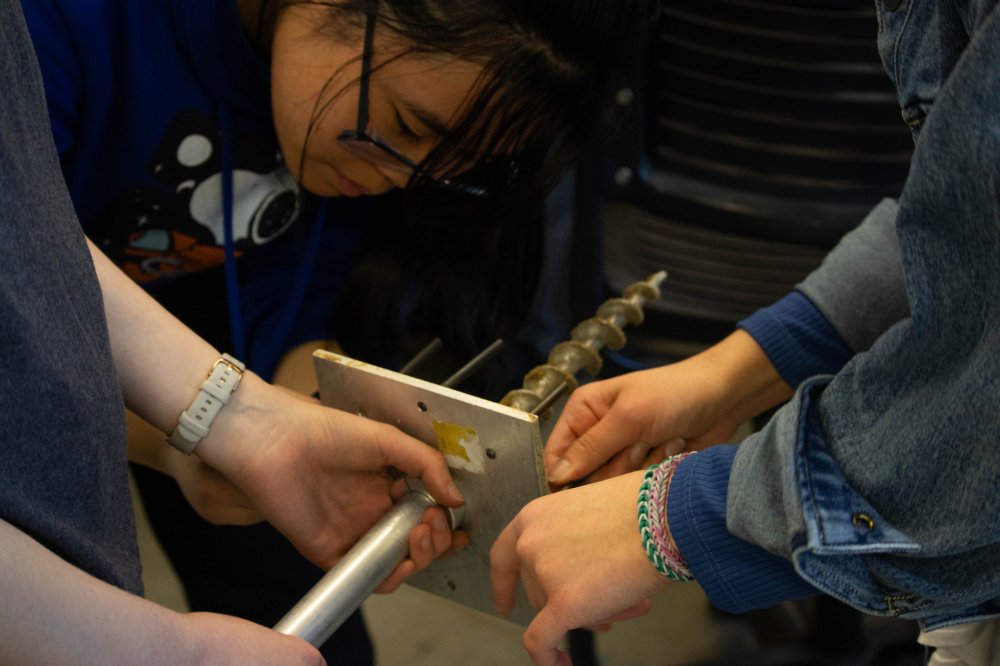
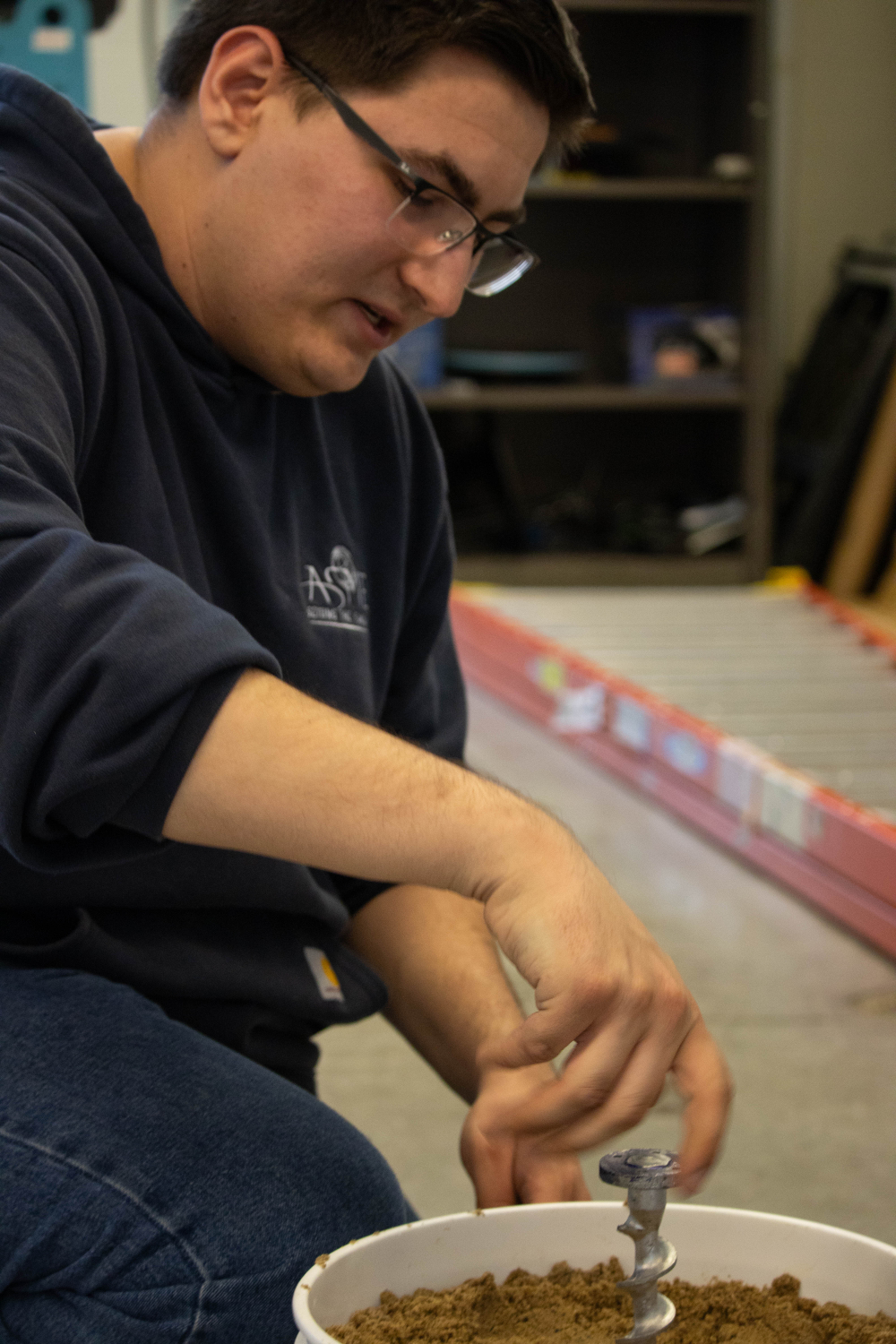
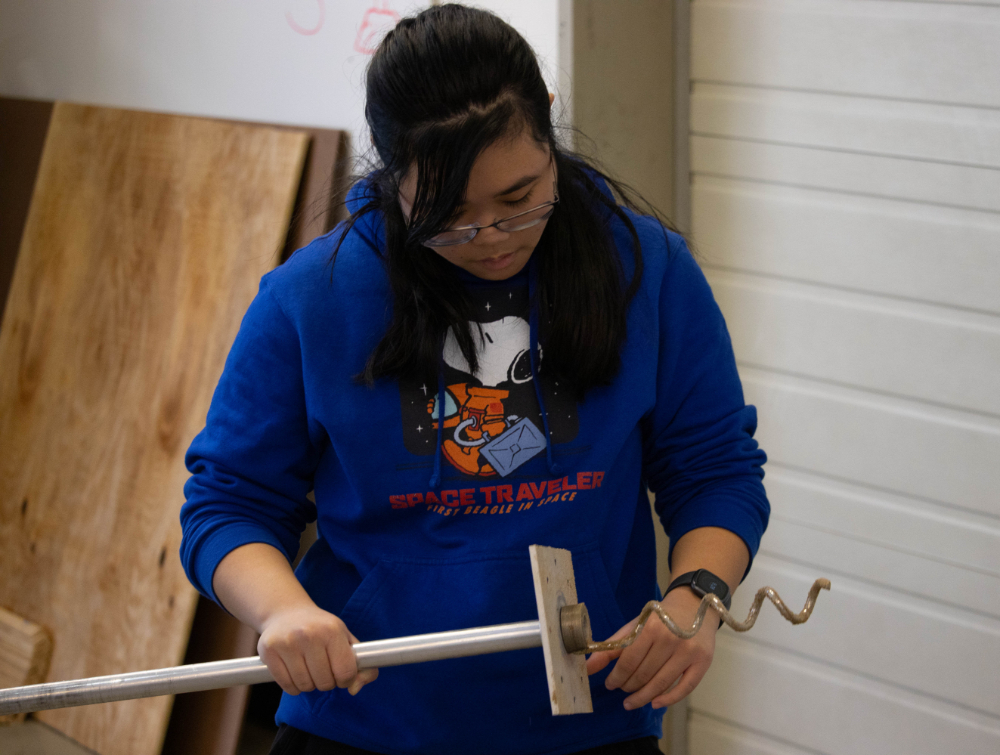
Members of the Astro Anchors refine their device for the Micro-g NExT
challenge. Some team members will travel to Houston in June to watch testing.
Photo Credit: Thomas Garrett
The Grand Valley student chapter of the American Society of
Mechanical Engineers (ASME)
is completing a challenge from NASA and will travel to Texas soon for testing.
The Micro-g NExT challenge includes designing a flag, flagpole and
anchoring system that can be deployed on the surface of the moon with
ease by a fully suited astronaut. Final testing will take place at the
NASA Johnson Space Center, with certain designs to be potentially used
during the upcoming Artemis III missions.
The 12-person ASME team tackling this challenge call themselves the
Astro Anchors. This team worked to develop a simple, yet effective,
design that met all of NASA’s constraints, moving them from Phase I of
the challenge to Phase II. They join three other universities in the
country selected to move on from the first phase of the Lunar Flagpole Challenge.
“In this team, I have gotten to help design, machine and test
different parts of the prototype," said Scott Strayer, ASME vice
president and Astro Anchors team captain. "Soon I will help test
the device at NASA, a hands-on experience I will never forget."
The Astro Anchor’s design included a modular flagpole system with few
mechanical components to reduce the time required to deploy the system
from a stowed configuration. The team is now refining the design for
the final testing on June 2, when seven student representatives will
travel to the Johnson Space Center in Houston, Texas, to accompany
their devices as it is tested at NASA’s
Neutral Buoyancy Laboratory.
Each team member brings their specific skills to the project. Strayer
might be machining a part for the prototype; Tasmiya Shaikh, treasurer
for ASME, might be working on community outreach with Allendale High School.
“We didn’t have any connections with the high school even though we
were so close to each other," Shaikh said. "Now we have
established that connection and are working collaboratively with these
younger learners on this amazing project. We hope those who come after
us will continue to care for that important relationship."
Sanjivan Manoharan, assistant professor of mechanical engineering, is
the project’s faculty advisor. Strayer said if it wasn’t for the
constant advice and support from Manoharan, they would have never made
it to the second stage. He also credited their sponsors: Aavneo
Technologies LLC, GVSU Center for Scholarly Excellence and the GVSU
School of Engineering.
“These are the types of big projects we do at ASME, the ones we might
face in our future careers that prepare us to work as a team, to solve
problems and achieve a goal,” said Strayer.
Participants spent 10 weeks in an accelerator program offered by the DeVos Center for Entrepreneurship & Innovation, in partnership with GVSU's Northern Michigan Region.
Featured
July 14, 2026 (Volume 49, Number 19)
Article by
Shannon Owen