

Rachel Powers Research
β-lactams, like penicillin, are the most widely prescribed class of antibiotics (right). In response to their extensive use and misuse, bacteria acquired the ability to destroy b-lactams, allowing resistant strains to develop. Many of these antibiotic-resistant bacteria express the enzyme β-lactamase that cleaves the defining lactam ring and renders the antibiotic inactive. As a result, antibiotic resistance has emerged as one of the leading public health crises of the 21st century, and with the emergence of multi-drug resistant (MDR) bacteria, such as Acinetobacter spp., physicians are presented with a major clinical challenge.
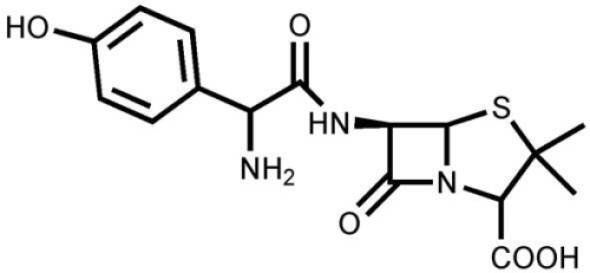
Amoxicillin, a β-lactam antibiotic
In an effort to overcome resistance, inhibitors have been developed to block the activity of these enzymes. Of particular concern is MDR Acinetobacter that possesses clinically threatening b-lactamases from all four β-lactamase classes. In collaboration with colleagues at GVSU, as well as research groups the University of Modena (Italy) and Case Western Reserve University, we characterized a novel series of boronic acids as high affinity inhibitors of a class C β-lactamase from A. baumannii: Acinetobacter-Derived Cephalosporinase (ADC-7). The class D β-lactamase OXA-24 is another key resistance determinant in A. baumannii. X-ray crystal structures of several of β-lactamase/boronic acid complexes have been determined. On-going research in the Powers' lab focuses on the optimization of these lead molecules as broad-spectrum β-lactamase inhibitors with activity against two problematic β-lactamases contributing to resistance in A. baumannii.
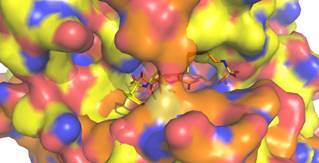
Superpostion of ADC-7 and OXA-24 active sites
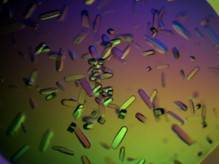
β-lactamase crystals
Selected Recent Publications (since 2020)
Penzotti P., Gutkind G., Powers R.A., Power P. 2026. Environmental species from the Telluria group as the putative origin of bifunctional β-lactamases. Microbiol Spectr 14:e03428-25. https://doi.org/10.1128/spectrum.03428-25
Powers R.A., Wallar B.J., Jarvis H.R., Ziegler Z.X., June C.M., Bethel C.R., Hujer A.M., Taracila M.A., Rudin S.D., Hujer K.M., Prati F., Caselli E., Bonomo R.A. 2025. Resistance to oxyimino-cephalosporins conferred by an alternative mechanism of hydrolysis by the Acinetobacter-derived cephalosporinase-33 (ADC-33), a class C β-lactamase present in carbapenem-resistant Acinetobacter baumannii (CRAb). mBio 16:e00287-25. https://doi.org/10.1128/mbio.00287-25
Powers, R. A., June, C. M., Fernando, M. C., Fish, E. R., Maurer, O. L., Baumann, R. M., Beardsley, T. J., Taracila, M. A., Rudin, S. D., Hujer, K. M., Hujer, A. M., Santi, N., Villamil, V., Introvigne, M. L., Prati, F., Caselli, E., Bonomo, R. A., & Wallar, B. J. (2023). Synthesis of a Novel Boronic Acid Transition State Inhibitor, MB076: A Heterocyclic Triazole Effectively Inhibits Acinetobacter-Derived Cephalosporinase Variants with an Expanded-Substrate Spectrum. Journal of Medicinal Chemistry, 66(13), 8510-8525., doi: https://doi.org/10.1021/acs.jmedchem.3c00144
Introvigne, M.L., Beardsley, T. J., Fernando, M. C., Leonard, D. A., Wallar, B. J., Rudin, S. D., Taracila, M. A., Rather, P. N., Colquhoun, J. M., Song, S., Fini, F., Hujer, K. M., Hujer, A. M., Prati, F., Powers, R. A., Bonomo, R. A., & Caselli, E. (2023). Sulfonamidoboronic Acids as "Cross-Class" Inhibitors of an Expanded-Spectrum Class C Cephalosporinase, ADC-33, and a Class D Carbapenemase, OXA-24/40: Strategic Compound Design to Combat Resistance in Acinetobacter baumannii. Antibiotics, 12(4), 644, doi: https://doi.org/10.3390/antibiotics12040644
Mitchell, J. M., June, C. M., Baggett, V. L., Lowe, B. C., Ruble, J. F., Bonomo, R. A., Leonard, D. A., & Powers, R. A.(2022). Conformational flexibility in carbapenem hydrolysis drives substrate specificity of the class D carbapenemase OXA-24/40. Journal of Biological Chemistry, doi: https://doi.org/10.1016/j.jbc.2022.102127
Curtis, B. N., Smolen, K. A., Barlow, S. J., Caselli, E., Prati, F., Taracila, M. A., Bonomo, R. A., Wallar, B. J., & Powers, R. A. (2020). Structural insights into inhibition of the Acinetobacter derived cephalosporinase ADC-7 by ceftazidime and its boronic acid transition state analog. Antimicrobial Agents and Chemotherapy, 64(12), e01183-20, doi: https://doi.org/10.1128/AAC.01183-20