

Atomic Spectroscopy
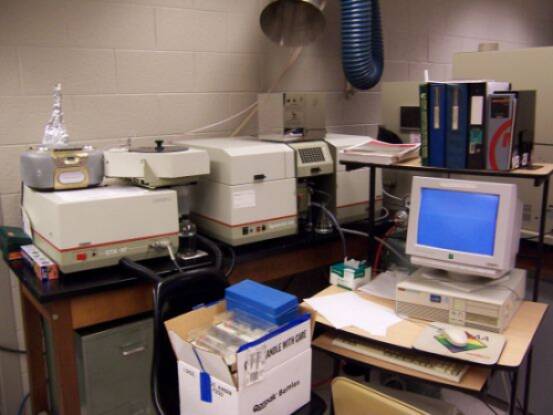
SpectrAA 200 Atomic Absorption Spectrometer with flame and graphite furnace.
When an atom becomes excited it can emit light at discrete frequencies determined by the energy levels available to it. For example, if the electron in a hydrogen atom is excited to the 6s orbital, it can give off light by jumping down to the 5s, 4p, or 3d orbitals. This atomic absorption spectrum is similar to a fingerprint as it is unique to every atom. By taking this spectrum for an unknown sample, we can determine whether a particular atom is present.
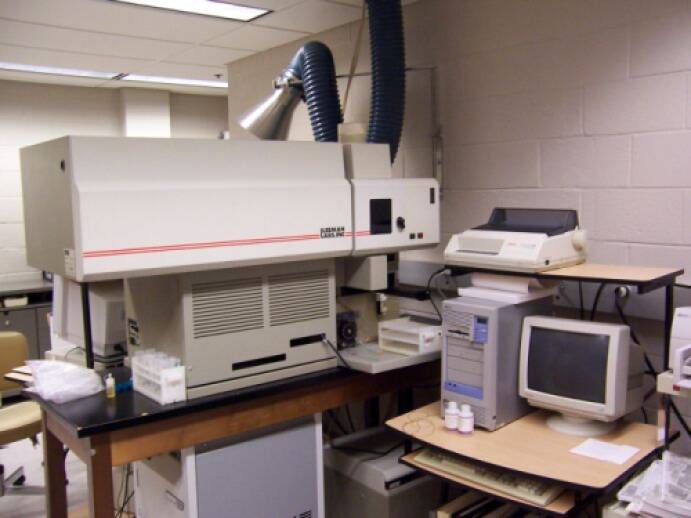
Leeman PS/1000 Inductively Coupled Plasma Spectrometer.
Page last modified July 1, 2026