Relevant Podcasts
Creating a Resume - Advisor Chat
In this Work Like a Laker podcast episode, GVSU Career Center advisors break down the essentials of resume writing, including formatting tips, what to include, and the purpose of a resume.
What Really Happens After I Submit My Resume Online?
In this episode, learn tips for creating ATS-friendly resumes, including how to use keywords, spot applicant tracking systems, and format your resume for online applications.
Resume Boosters: Building Beyond the Basics
In this episode, learn creative ways to strengthen your resume with non-traditional experiences like research, volunteering, student organizations, and certifications.

Starting or updating a resume can feel challenging, especially if your existing resume is outdated or you have a variety of experiences to showcase. If you are two years or less post-graduation, we recommend starting with our standard resume guide. This guide is designed as a tool to help you rework your existing resume and answer questions about format, content, and structure, making it easier to present your skills and experiences in the most effective way.
INTRODUCTION
A resume is a professional document highlighting qualifications for a job. It should be a snapshot of past skills and past experiences that make you a strong candidate for the position. A resume should not be a comprehensive map of everything, but rather a summary of experience that showcases why you are a strong candidate.
Two Main Types of Resumes:
º Chronological: Lists work history in reverse chronological order, starting from the most recent experience and working backward.
º Functional: Used mainly for people with gaps in work history, highlighting notable skills instead of chronological order.
TARGETING
A resume is an essential piece to any job search. It is a tool you can use to market yourself to employers and highlight your most important experiences and skills. Because a resume is a marketing tool, you should tailor it to each position you apply for, paying close attention to keywords in the job description and replicating them on your resume.
FORMATTING
DO NOT USE TEMPLATES
- Can be restrictive in making minor edits and formatting
- They don't always include the best headings or format for your experience
- Even with all the different templates out there, the same ones always get used, which reduces your originality
FONT
- 10-12 point font
- Make it easy to read (Times New Roman, Arial, Calibri)
DESIGN
- It should primarily use black text on a white background
- Text should utilize bolding, italicizing, underlining, or dark, neutral colors to emphasize specific information and make the resume unique.
PAGES
- One page: fill the full page
- Two pages: If you have been out of school for a while, two pages are more than acceptable. If a two page resume is what works best for you make sure you have enough information to complete the two pages.
Step-By-Step Breakdown
- Full name
- Address: You do not need to list the full address, but the city and state should be in this section
- Professional email or the email you check the most often
- LinkedIn URL (customize the URL to make it more visually appealing)

Professional Summary / Objective Statement
A brief statement at the top of your resume can help employers quickly see your strengths. A professional summary works well for those with several years of experience, highlighting key skills and accomplishments you've built over your career. An objective statement can be useful if you're changing careers, returning to the workforce, or pursuing a new path aligned with your goals. Neither is required, but when used thoughtfully, they can help your most relevant strengths and experiences stand out, showing how your unique background adds value.
- When writing a Professional Summary, tailor your professional experiences to the job description.
- This section can be bullet points to make it easy to read.
Example Professional Summary: ED Registered Nurse with 5 years of experience in emergency care, skilled in rapid triage, trauma response, and patient stabilization in fast-paced environments. Dedicated to delivering high-quality care while collaborating seamlessly with multidisciplinary teams under pressure.
- An Objective Statement is especially useful when changing fields.
- Great place to highlight your transferable skills you have from other positions.
Example Objective: Marketing professional with a background in brand development, seeking to transition into a sales role to leverage my strong communication, relationship-building, and strategic outreach skills to drive revenue growth and exceed company goals.
Work Experience
You likely have a variety of professional and personal experiences, and it can be challenging to decide what to include. Focus on highlighting your most relevant accomplishments and experiences that connect directly to the job you're applying for. Tailor your descriptions by using keywords and phrases from the job posting, even if they weren't your main responsibilities. Whenever possible, show measurable results or impact, and include transferable skills gained from both paid and unpaid experiences. Your goal is to demonstrate how your background aligns with and adds value to the position you want.
- This should take up the most room on the page because of it's importance.
- Continuously tailor your resume to different jobs you are applying for.
- Only include relevant experience that can be transferable to the job you are applying for.
- Keep formatting the same:
- organization, dates worked, location, position, and accomplishment statements.
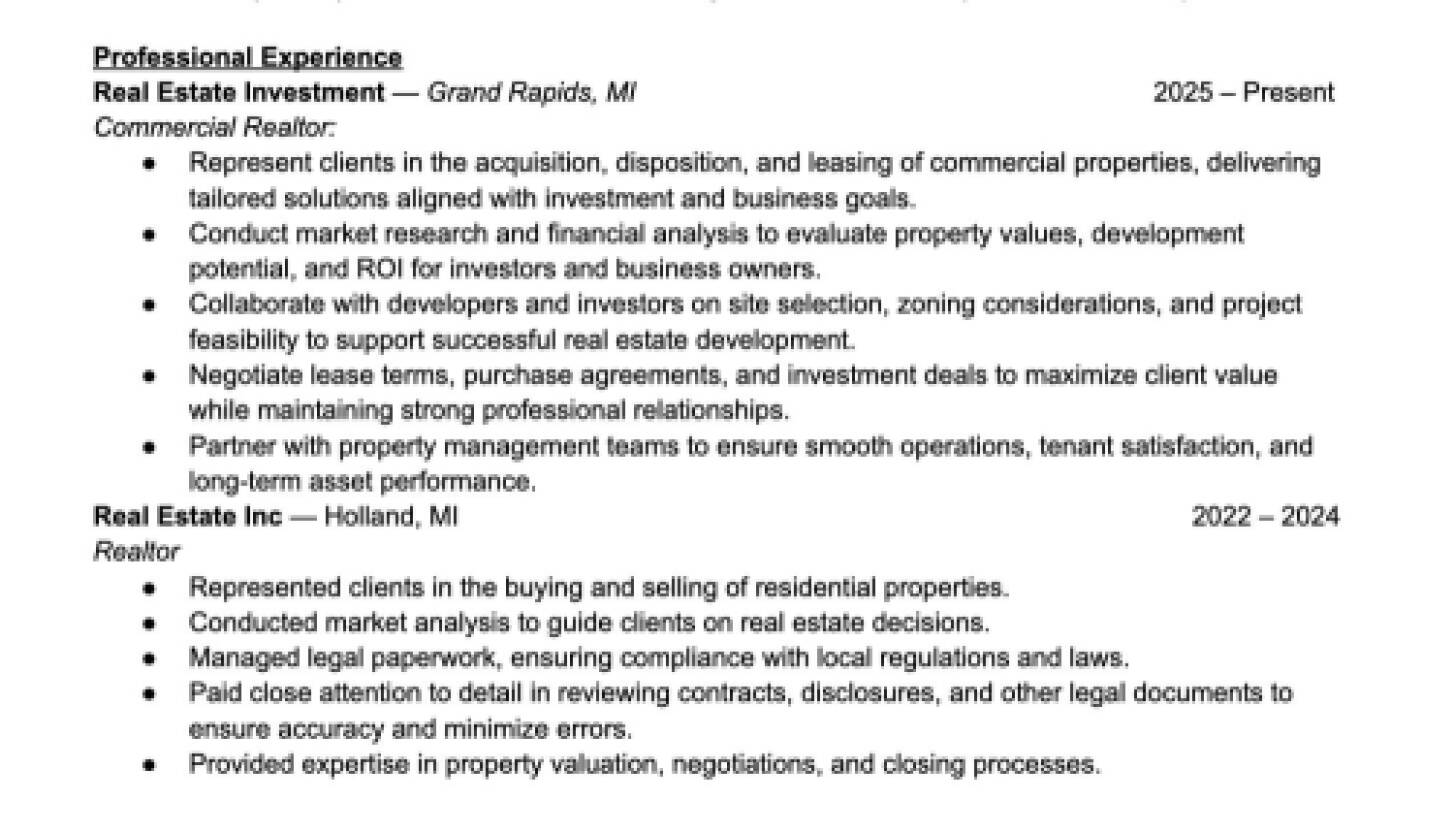
Accomplishment Statements
Many resumes include standard statements that list tasks or responsibilities, but these only show what you did and not the impact you made. Turn standard statements into accomplishment statements by adding details and outcomes that demonstrate your results. This approach makes your experience more compelling and shows employers the value you bring.
Accomplishment Statement Formula = Action Verb + Outcome with Quantifiers and Adjectives
Start Sentence With Action Verbs
Adapted to overseas living in Zemmer, Germany.
Analyzed secondary data for a 19-county region of Michigan.
Add Numbers and Quantify When Possible
Supervised eight front desk employees, ensuring excellent customer service to 150 residents.
Include Adjectives
Add Adjectives For Questions Like Who, What, and Which
Ex: Identified target audience and developed theme for a philanthropic event hosting 45 members of the local business community.
Include Your Result
Developed seismographic program with five team members to measure the deterioration factor of rock strata to assist researchers analyzing compounds for repair and upkeep of a monument.
BEFORE: Managed and trained switchboard staff.
BEFORE: Managed social media accounts for the organization.
BEFORE: Tracked patients and administered medications.
AFTER: Managed and trained switchboard staff to ensure adequate coverage and excellent customer service.
AFTER: Increased social media engagement by 25% over the course of 6 months by crafting campaigns and tracking posting data.
AFTER: Provided intensive, 24-hour care to 8 adult patients while accurately distributing patient medication following medical guidelines.
Use this list as a reference for beginning your accomplishments statements.
Education
If you created your resume during or soon after college, your education may currently appear at the top. As your professional experience grows, it's often more effective to move your education section toward the bottom, especially if your degree isn't directly related to the position you're seeking. Use your judgment to decide where it best fits based on what you want to emphasize. You only need to list schools where you earned a degree or credential; it's not necessary to include institutions you attended without completing a program.
- Write out the full degree (Bachelor of Business Administration)
- Include minors and emphases.
- Add the month and year of graduation.
- 3+ years after graduating, you do not need to add GPA.

Additional Experience and Involvement
Many professionals have valuable experiences and skills that extend beyond their formal work history. These could include volunteer roles, community involvement, leadership activities, or other relevant experiences and help employers see you as a well-rounded candidate. These examples highlight transferable skills such as communication, teamwork, organization, and problem-solving that apply to any workplace. Showcasing them demonstrates both your professional strengths and the personal qualities that make you an asset to an organization.
Skills
- The skills section can also be under a professional summary, depending on what you want to highlight.
- List hard skills rather than soft skills.
- Try to avoid phrases such as "time management" or "detail oriented"; these can be shown in accomplishment statements.
Hard Skills:
Ex: Knowledge in Python, Adobe, Canva, SAP Systems, Microsoft Suite
Soft Skills:
Ex: Organizational skills, Hard working, Communication, Time management
Leadership/Volunteer Experience
- You can highlight both formal roles and informal leadership when describing your involvement in projects, teams, or extracurricular activities
- Volunteer experience on a resume is a great way to show skills, leadership, and community involvement
- You can list it here and add a quick summary to along with it if necessary.
Formal: Appointed as Event Coordinator for the Environmental Club, managing logistics for a campus sustainability fair with 15 vendors and 300 attendees.
Informal: Volunteered to mentor new members and facilitate post-event reflection meetings, helping shape next year's programming priorities.
As we know a lot of our adult learners are veterans. While veterans my not have a whole lot of professional experience there are a lot of transferable skills that translate nicely to a resume. When it comes to translating military skills onto a resume, knowing the right word choice and format can be challenging, but our career resources are here to help honor your service by turning your valuable experience into professional opportunities.
- Resume Engine: A free online tool that helps military veterans translate your service details such as branch, rank, and specialty into civilian-friendly résumé language. You can also connect with veteran-ready employers.
- Hire Our Heroes (HOH) Preparing Your Resume: This video walks you through how to craft an effective résumé, offering guidance on translating military-experience into civilian terms, aligning skills with job requirements, and presenting accomplishments clearly.
AI tools can offer support when putting together your application materials; however, it still takes a human to pull it together.
Inspiration
Use AI as a starting point. Résumés and cover letters are a reflection of your personal skills and experiences as it relates to what you're applying to. Personalization is still necessary, but AI may give you a place to start. AI tools can help you identify key words and phrases to use if you don't have a strong job description to work from.
Feedback
Resume AI, a GVSU Career Center tool, is a great way to compare your résumé to a job posting you are applying for and receive instant feedback. Regardless of how you use AI tools, remember, your application materials should be an honest reflection of who you are and why you are applying. Be authentic in your writing and avoid taking AI suggestions verbatim.
Using AI Responsibly in the Job Search
Listen to this Work Like a Laker episode to learn how to use AI responsibly and effectively during the job search — from resume reviews to interview prep and career exploration.
Applicant Tracking Systems (ATS) are web-based tools often used by employers as a way for candidates to apply. When submitting a resume through an ATS, keep the formatting basic — use Web-standard fonts and eliminate tables, graphics, and headers/footers. Robots can't see design, they can only
read content.
To help your resume stand out, carefully review the job description to ensure key words, phrases, and experiences are reflected where it makes the most sense. ATSs often use keywords from the job description to surface the most relevant resumes to the top of their review pile.
Considering checking out Jobscan's Resume Skills Report, which is a tool that allows you to view top resume skills by job title based on data from 10+ million job listings. Jobscan also offers an ATS Toolkit that includes many free resources to help you navigate an ATS.