
Community Connection
Fauvel Leads Interdisciplinary Honeybee Projects
Honeybees in Michigan will play an important role nationally thanks to research projects led by Anne Marie Fauvel, affiliate faculty of liberal studies, and others at Grand Valley.
During the summer, Fauvel concluded phase three of a four-phase, interdisciplinary research effort that studied bee pollen to project the health of hives in 19 Michigan counties.
The Michigan Pollen Check project enlisted the help of 20 beekeepers who were trained to collect pollen and then submit hive data via a mobile app developed by two Grand Valley students and Jonathan Engelsma, professor of computing.
Fauvel said the beekeepers watched video tutorials on how to correctly use the pollen traps. The videos were created by Emily Noordyke, a biology graduate and member of the GVSU Beekeepers Club. Noordyke and Rebekah Suttner, a computer information systems major, worked together to develop the app.
“By the end of the summer, we will have this Michigan data collected, then we can connect with Bee Informed Partnership,” Fauvel said. Bee Informed Partnership is an organization formed to research the mortality of honeybees; it is funded by the USDA and includes researchers from six universities.
Fauvel served as Noordyke’s Student Summer Scholars mentor in 2016. Noordyke collected data and cared for the bees in apiaries at the Meijer Campus in Holland and the Sustainable Agriculture Project on the Allendale Campus.
That project stemmed another, which was funded with an interdisciplinary grant from the Center for Scholarly and Creative Excellence. Fauvel said that led to the collaboration with Engelsma and Suttner, and the second phase of the project.
“The fourth phase will come in summer 2018 when we can collaborate with the national project,” Fauvel said.
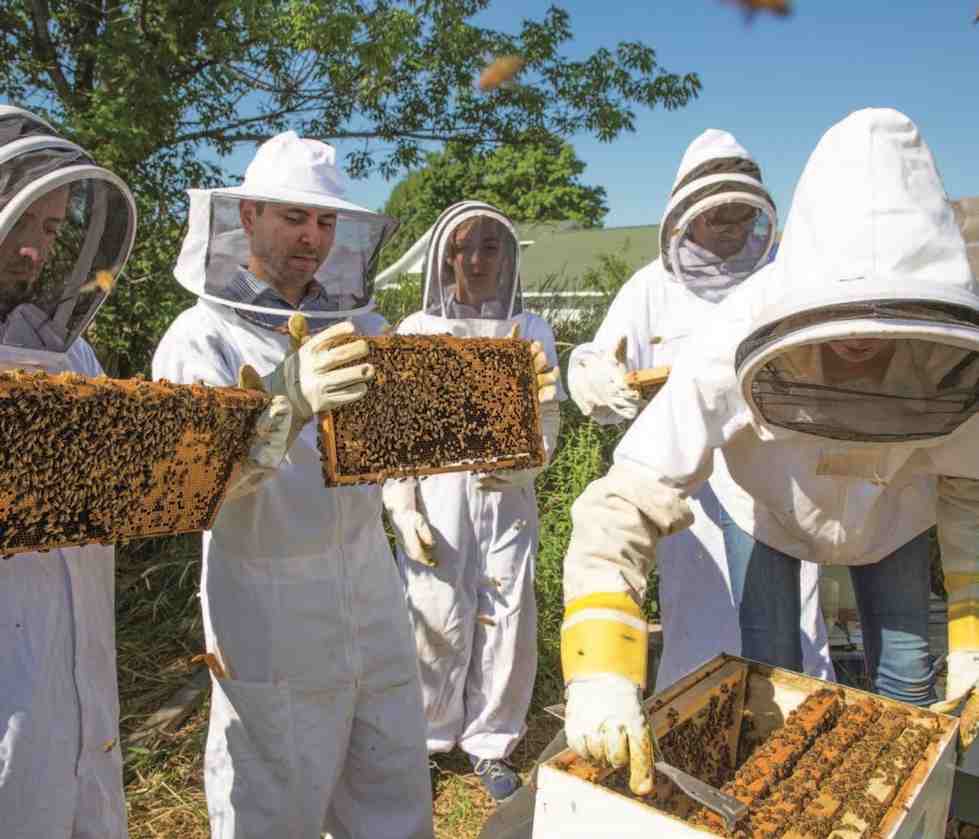
Students inspect bees at the Sustainable Agriculture Project.
Campus, Community Support Kutsche Office of Local History Projects
Kimberly McKee, director of the Kutsche Office of Local History, reflected on her first year in that role and said she was grateful for community and campus enthusiasm and support for the office and its initiatives.
Highlights from the 2016-2017 academic year are detailed below.
The Nuestra Comunidad Hispana exhibit, a collaborative partnership, showcased stories and photographs of Holland area Latino/a residents. Partners were Latin Americans United for Progress, Herrick District Library, Meijer Campus in Holland, City of Holland, St. Frances de Sales Church, and Holland Museum.
“It’s exciting to see how much community support there was for that project,” McKee said.
Voices of GVSU: Activism through the Decades was displayed in an exhibit at the Mary Idema Pew Library Learning and Information Commons, through
a collaboration with the Office of Undergraduate Research and Scholarship and University Libraries Special Collections and Archives. This exhibit was part
of the office’s Histories of Student Activism project.
The exhibit was curated by undergraduate research assistant Andrew Collier, a women, gender, and sexuality studies major. McKee said his position was funded by the Office of Undergraduate Research and Scholarship through its Undergraduate Research Assistant in the Humanities fund. Courtney Wagasky, a studio art major, designed the exhibit artwork.
“Students across the country were holding protests and being active on their campuses,” McKee said. “We wanted to show the legacies of student activism at Grand Valley.” Complementary events included a presentation by Louis Moore, coordinator of African/African American studies, and a panel discussion by student activists.
The successful Local History Roundtable featured a keynote address by Bich (Beth) Minh Nguyen, author of Stealing Buddha’s Dinner and other books.
The first faculty Community Collaborative Grant was awarded to Kathryn Remlinger, professor of English. Remlinger will use the grant in partnership with an undergraduate research assistant and community partners for her project, “How Much Dutch? The Linguistic Landscape of Holland, Michigan.”
McKee worked closely last summer with outgoing director Melanie Shell-Weiss and said their collaboration created a smooth transition period.
She said special events for Friends of the Kutsche Office of Local History are planned next year to expand their participation beyond the roundtable.
"Students across the country were holding protests and being active on their campuses. We wanted to show the legacies of student activism at Grand Valley.” — Kimberly McKee
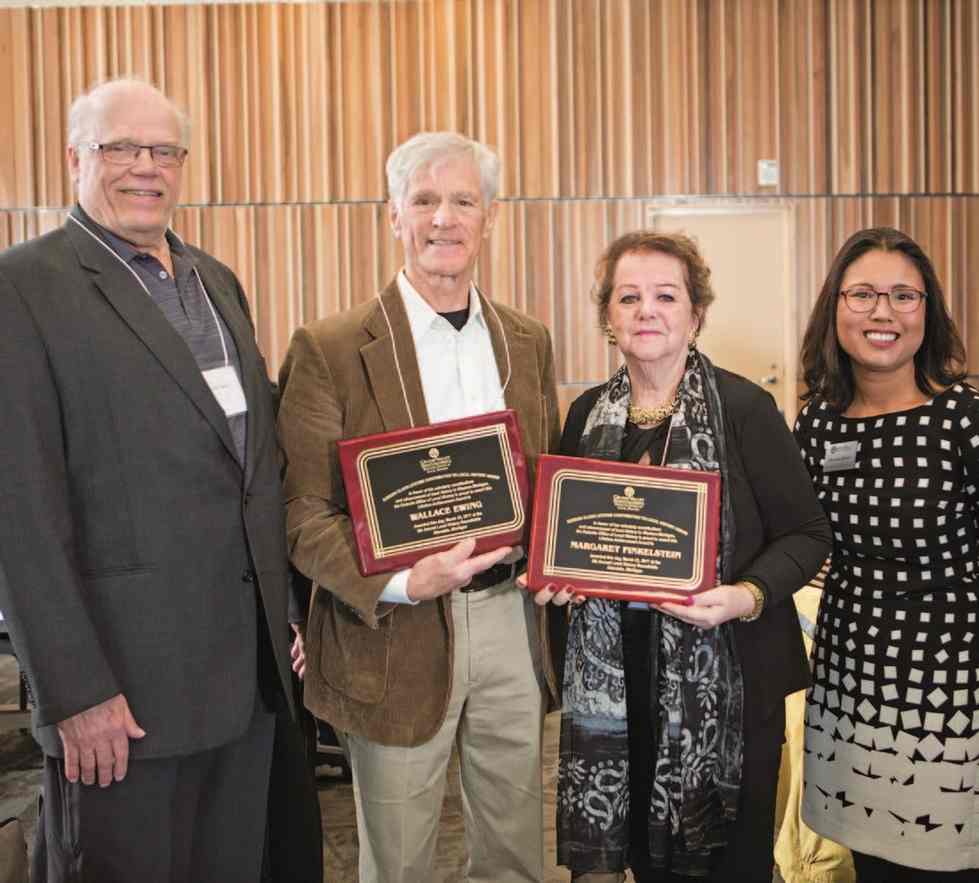
Gordon Olson, Wally Ewing, and Margaret (Peg) Finkelstein -- winners of the 4th Annual Gordon Olson Award, and Kimberly McKee, director of the Kutsche Office of Local History. Mary Idema Pew Library, GVSU, Allendale, Michigan. Photo by Kristina Bird, Adam Bird Photography.
Civil Discourse Symposium Spotlights Policies Regarding Immigrants, Refugees
Panelists at the third annual Padnos/Sarosik Civil Discourse Symposium told their own stories of coming to America as immigrants or working to help immigrants and refugees find their place in Michigan.
The event was held November 10 at the L.V. Eberhard Center. Anne Hiskes, dean of the Brooks College of Interdisciplinary Studies, said she hoped the timing of the symposium encouraged participants “to move beyond the divisiveness of the presidential election and work together to support immigrants.”
Jack Mangala, Padnos/Sarosik professor of civil discourse, said the symposium expanded on his course, Immigration: Think Global, Act Local. Students in the class have discussed opportunities and challenges that immigrants face, and they have connected with local organizations that support that community.
Mangala, a native of the Democratic Republic of the Congo, also said he challenged students to find their own immigration story.
“I’ve asked them to find a personal link that connects them or their family to the larger immigration story,” he said. “At its core, civil discourse is about this need we all have to be heard and understood. It requires a shift from the argument culture — so dominant in today’s society — to a culture that favors dialogue and deliberation.”
Panelists were Lupe Ramos-Montigny, member of Michigan State Board of Education; Raquel Garcia Andersen, director of partnerships and community outreach for Global Detroit; Susan E. Reed, managing attorney for Michigan Immigrant Rights Center; Kizombo Kalumbula, pastor of family life for Tabernacle Community Church; Anh Nguyet Tran, president of Liaison Linguistics; and Amer Zahr, adjunct professor for University of Detroit Mercy School of Law.
The civil discourse course for the 2017 fall semester will continue delving into issues that focus on refugees and immigrants. The symposium is set for November 2, with the theme “Immigrants and Refugees: Celebrating
Our Diversity.”
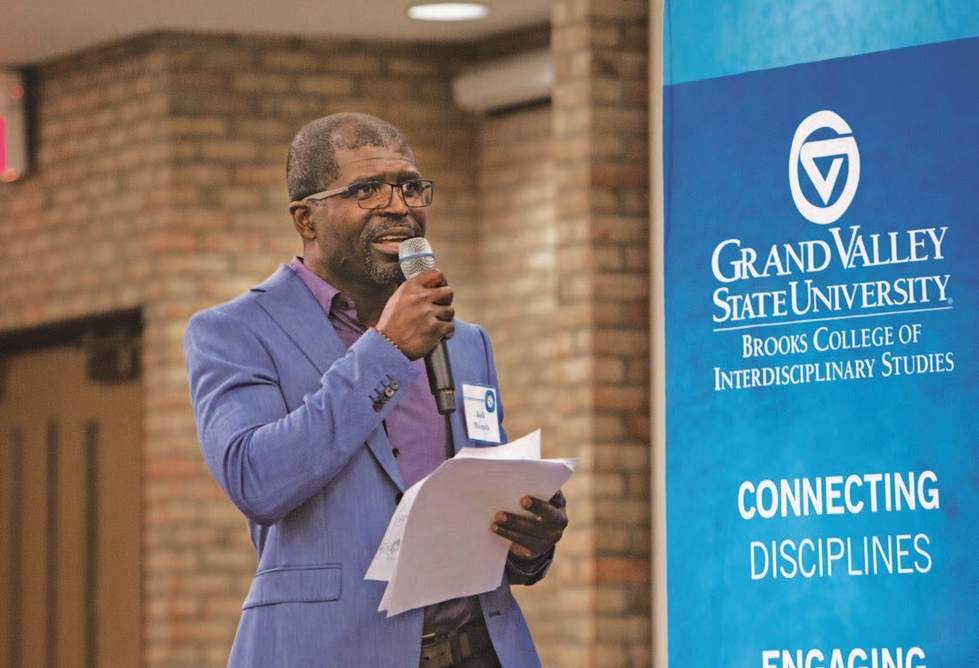
Jack Mangala, professor of civil discourse, introduces the third annual symposium.
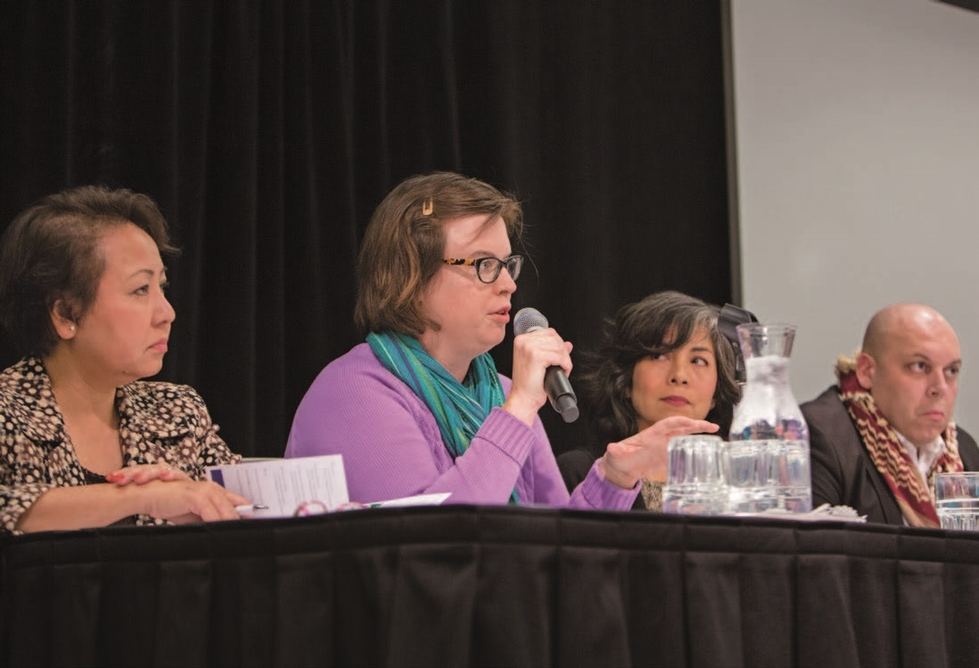
Panelist shares insights with the crowd.
Lecture Series Connects Students’ Educations to the World of Work
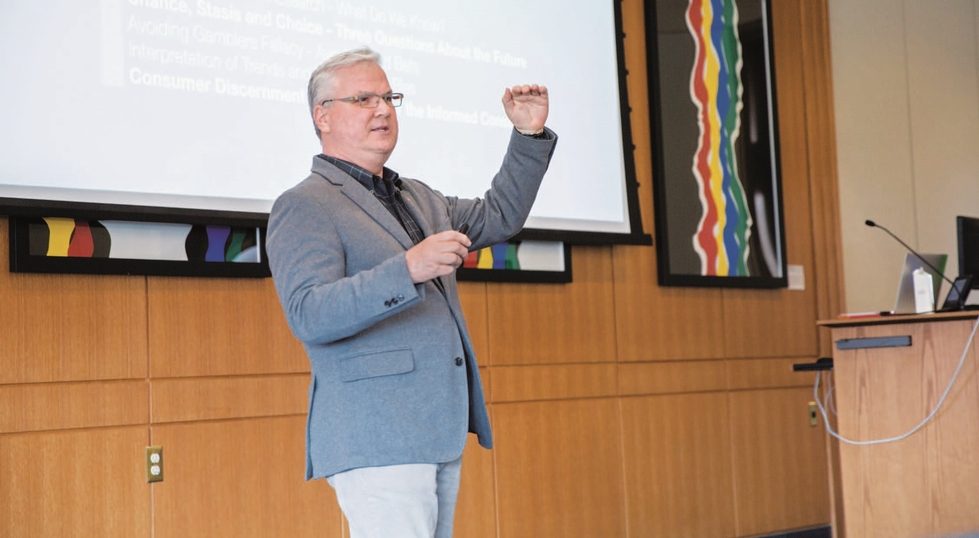
Nate Young speaks about design thinking and innovation.
Jeff Chamberlain, director of the Frederik Meijer Honors College, said presenters who visit campus for The Frederik Meijer Lecture Series help students translate the value of a liberal education to the workplace.
Each year, two professionals give presentations that demonstrate how entrepreneurship, innovation, and leadership can help solve issues students encounter in the workplace.
“The series helps us understand how the skills we learn from a wide variety of disciplines have tangible benefits in the workplace,” Chamberlain said.
In the fall semester, Brian Bordainick, head of Innovation Ventures at Hudson’s Bay Company, spoke to students about the challenges and opportunities of building a start-up. Chamberlain said Bordainick’s presentation highlighted the value of the lecture series, as students with interests in sustainability, entrepreneurship, and marketing could all relate to his stories.
“We want to have a holistic approach. Education enriches everything you do, but it is especially beneficial in the workplace if you can understand all the connections,” Chamberlain said.
The winter semester lecture featured Nate Young, vice president of global innovation at Newell Rubbermaid. He spoke to students about design and the future of design thinking and innovation. His knowledge highlighted the valuable connections of liberal education. Young said not all students who attended the lecture were designers, but all the students were able to understand how design thinking may influence their career.
Chamberlain said he believes that everyone is an entrepreneur. As a historian, he finds that he needs to reinvent himself, so he teaches a social product innovation course. The idea of a “company man,” someone who works at the same company for 30 years, is not going to be as common, Chamberlain said.
“People are moving around much more, they’re reinventing themselves much more, so they have to constantly change and develop and grow,” Chamberlain said. “A good basis in liberal education really helps you do that.”
“Members of the campus community make sustainable choices every day that affect our campuses,” Christopher said. “Those same people — students, faculty, staff members, and alumni — are also making a sustainable impact in their respective communities, which can be seen through our partnerships with the City of Grand Rapids, local industry, and many other organizations.”
— Norman Christopher
Grand Valley’s Sustainability Impact Totals $250 Million
The overall economic impact of Grand Valley’s sustainability initiatives in the region reached more than $250 million in 2015, the latest reporting year.
The Collective Sustainability Impact Report, compiled by the Office of Sustainability Practices in Brooks College, contained a breakdown of the resources associated with these efforts as well as the avoided costs at the university and in the region.
The report focuses on the initiatives outlined in Grand Valley’s Sustainability Guide and how they touch every area at the university, from community engagement, waste minimization, and energy conservation to courses, curriculum, and campus life. The report highlights 11 sections that describe practices used by Grand Valley students, faculty, and staff members to improve social, economic, and environmental impact.
Norman Christopher, executive director of the Office of Sustainability Practices, said the report reflects the importance Grand Valley places on sustainability as a core value, both on- and off-campus.
“Members of the campus community make sustainable choices every day that affect our campuses,” Christopher said. “Those same people — students, faculty, staff members, and alumni — are also making a sustainable impact in their respective communities, which can be seen through our partnerships with the City of Grand Rapids, local industry, and many other organizations.”
The university is a founding member of the Grand Rapids Community Sustainability Partnership, a group that now has more than 250 organization members. Grand Valley is also a member of the 2030 District committed to reduce energy use 50 percent by 2030 and reduce overall environmental impact in downtown Grand Rapids. Grand Valley is also supporting Grand Rapids Mayor Rosalynn Bliss’ Greening Initiative to have a tree canopy of 40 percent in the city.
Some highlights from the report include these accomplishments:
• Nearly 200 sustainability-related courses were offered at Grand Valley (economic, social, environmental).
• One million pounds of food were purchased by Campus Dining in 2015 from 23 local farms and 31 local suppliers.
• There were 20 completed LEED-certified building projects at Grand Valley by the end of 2015.
• Construction projects on campus in 2015 created 2,919 jobs.
• Over the last 15 years, Grand Valley has implemented more than 250 energy-saving projects totaling more than $2 million in annual cost avoidances and $1.5 million in annual, one-time savings.
The report was developed using data submitted through the university’s Association for the Advancement of Sustainability in Higher Education’s Sustainability Tracking, Assessment, and Rating System (AASHE STARS). The reporting system gauges the progress of colleges and universities toward sustainability in academics, engagement, operations, planning and administration, and innovation. Grand Valley is a gold-status university.
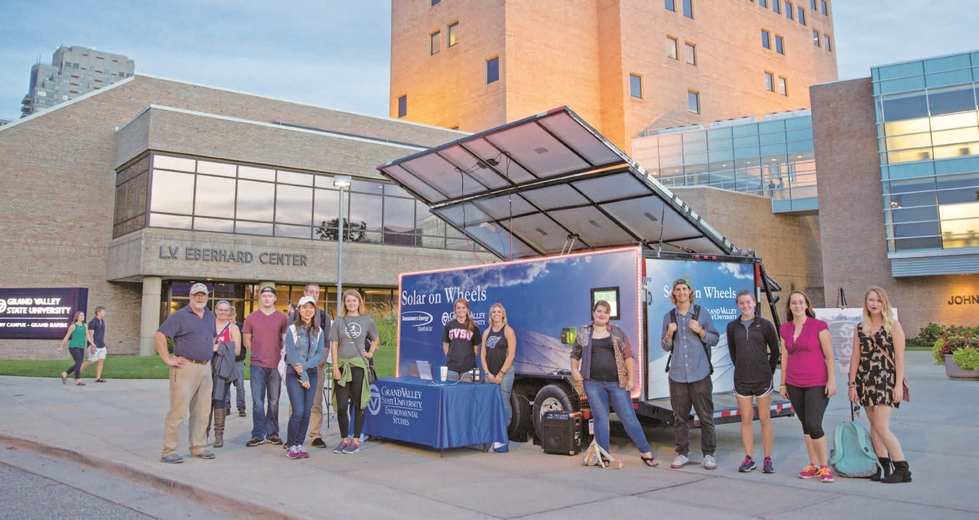
Professor Kelly Parker and students stand in front of the solar module during ArtPrize.
Students’ Solar Project on Display at ArtPrize 2016
An 18-foot, solar energy-producing module created by Grand Valley students was on display during ArtPrize® 2016. Students demonstrated the benefits of solar energy by powering LED lights, playing music, and providing a space for event goers to charge their phones.
Thanks to a $55,000 grant from Consumers Energy, students and faculty members spent the summer designing and building two transportable, solar energy-producing modules. The structures were designed and constructed by a team of students from the School of Engineering and a team from Grand Valley’s Muskegon Innovation Hub.
Eight solar panels and a collection of solar shingles make up the portable system. The unit, which took two months to build, has the capacity to emit 4 kilowatts of electricity. Music was played from the system that was performed by Grand Valley’s award-winning New Music Ensemble. Students in a sustainability course, led by Kelly Parker, professor and director of environmental studies, organized the display as part of a class project. The assignment was to think of a way to promote the benefits of solar energy.
“This solar garden was a project to take the learning outside of the classroom,” Parker said. Students from liberal studies, environmental studies, and engineering, along with independent researchers and internship students collaborated on this project, working through multiple semesters.
“We hope to give people a firsthand experience of the power of solar energy. We decided to time the display during ArtPrize so we could reach as many people as possible,” said Cara Maney, one of the five interns who worked at the demonstration, which reached thousands of people.
Consumers Energy’s solar power plant on the Allendale Campus will continue to serve as an extension of the classroom at Grand Valley. Consumers Energy will provide a $20,000 grant each year for the next six years for proposed interdisciplinary projects and curriculum.
Brooks College Mourns Loss of Kutsche Office Founder
Paul Kutsche, whose gift established Grand Valley’s Kutsche Office of Local History, died May 18 after several weeks in hospice care. He was 90.
Kutsche, a Grand Rapids native, retired as professor emeritus of anthropology from Colorado College. He returned to Michigan and, in 2008, worked with Grand Valley leaders to establish an office that would support local historians and cultural heritage organizations and give voice to diverse communities.
Director Kimberly McKee said Kutsche’s passion for preserving the voices of underrepresented communities was evident in his discussions with her.
“He inspired me and my commitment to creating community amongst those invested in local history and documenting histories of those who often find themselves on the margins,” McKee said. “His loss will be felt by the community as he was a vibrant and steadfast proponent of local history.”
Anne Hiskes, dean of the Brooks College of Interdisciplinary Studies, said housing the Kutsche Office of Local History within Brooks College has helped expand the college’s collaborative work with community partners while providing high-impact learning opportunities for students.
“The Kutsche Office is a fitting legacy for Paul, who was a cultural anthropologist, educator, local historian, and truly engaged citizen of West Michigan and the world,” Hiskes said. “The people of West Michigan and Grand Valley’s students, faculty, and staff will continue to benefit from the generosity of Paul and his family for generations to come.”
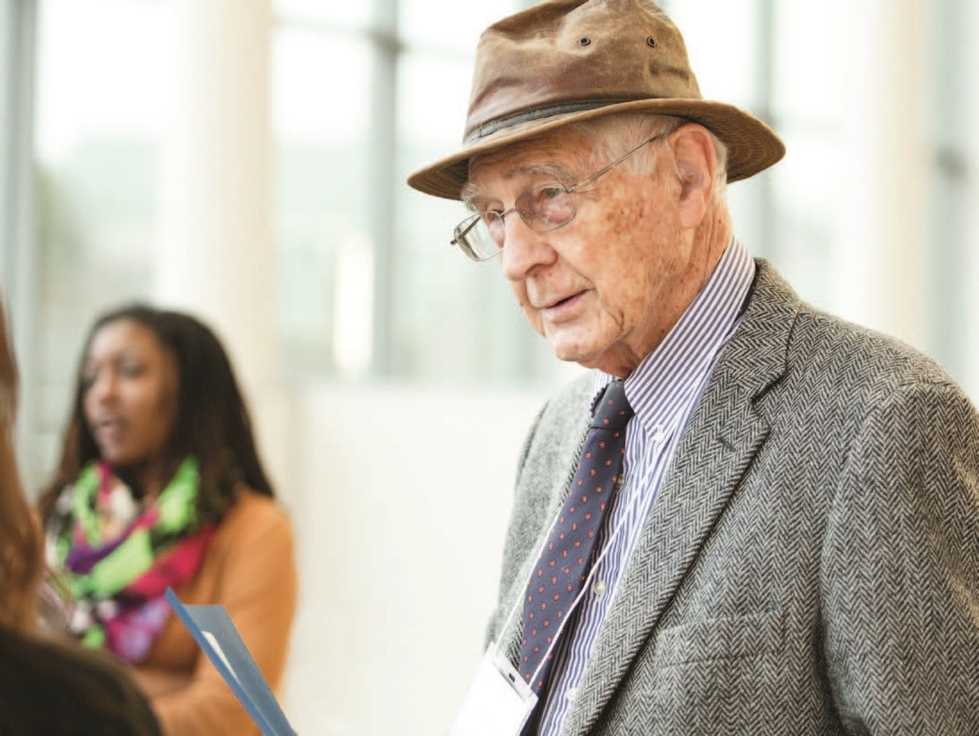
Paul Kutsche, founder of the Kutsche Office of Local History, died May 18.