


People, Principles, and Purpose: Recap of the AI Town Halls
Published April 16, 2026 by Bill Herbst Director, Academic Affairs Communications
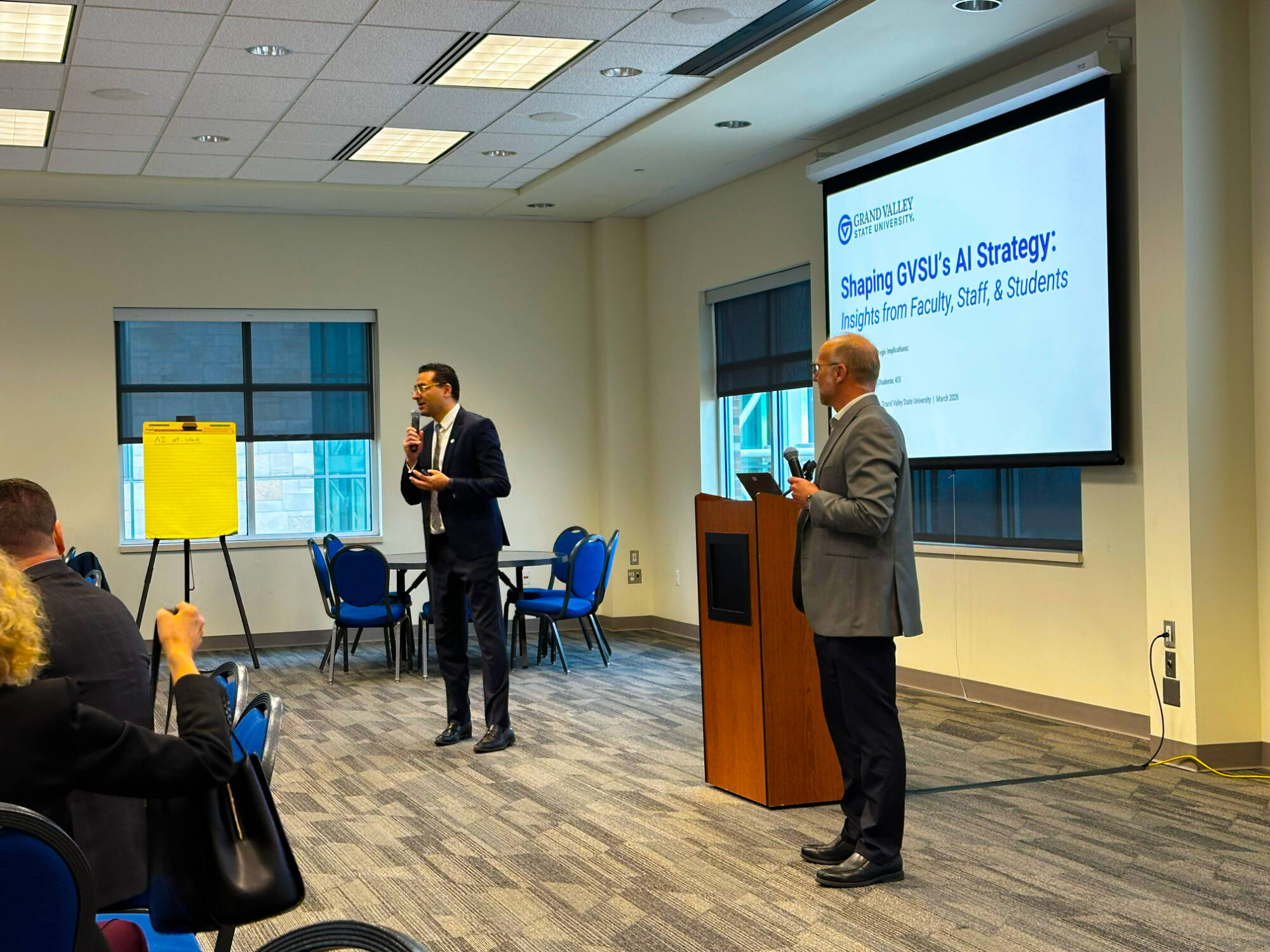
On March 16 and March 19, 2026, The AI Steering Team hosted two AI Town Halls. The events were led by Provost and Executive Vice President for Academic Affairs Jennifer Drake, Vice President for Information Technology and Chief Digital Officer Milos Topic, College of Computing Dean Marouane Kessentini and Senior Director of IT Innovation + Research Eric Kunnen. These gatherings were the next step in the AI Steering Team’s work to hone GVSU’s AI Strategy.
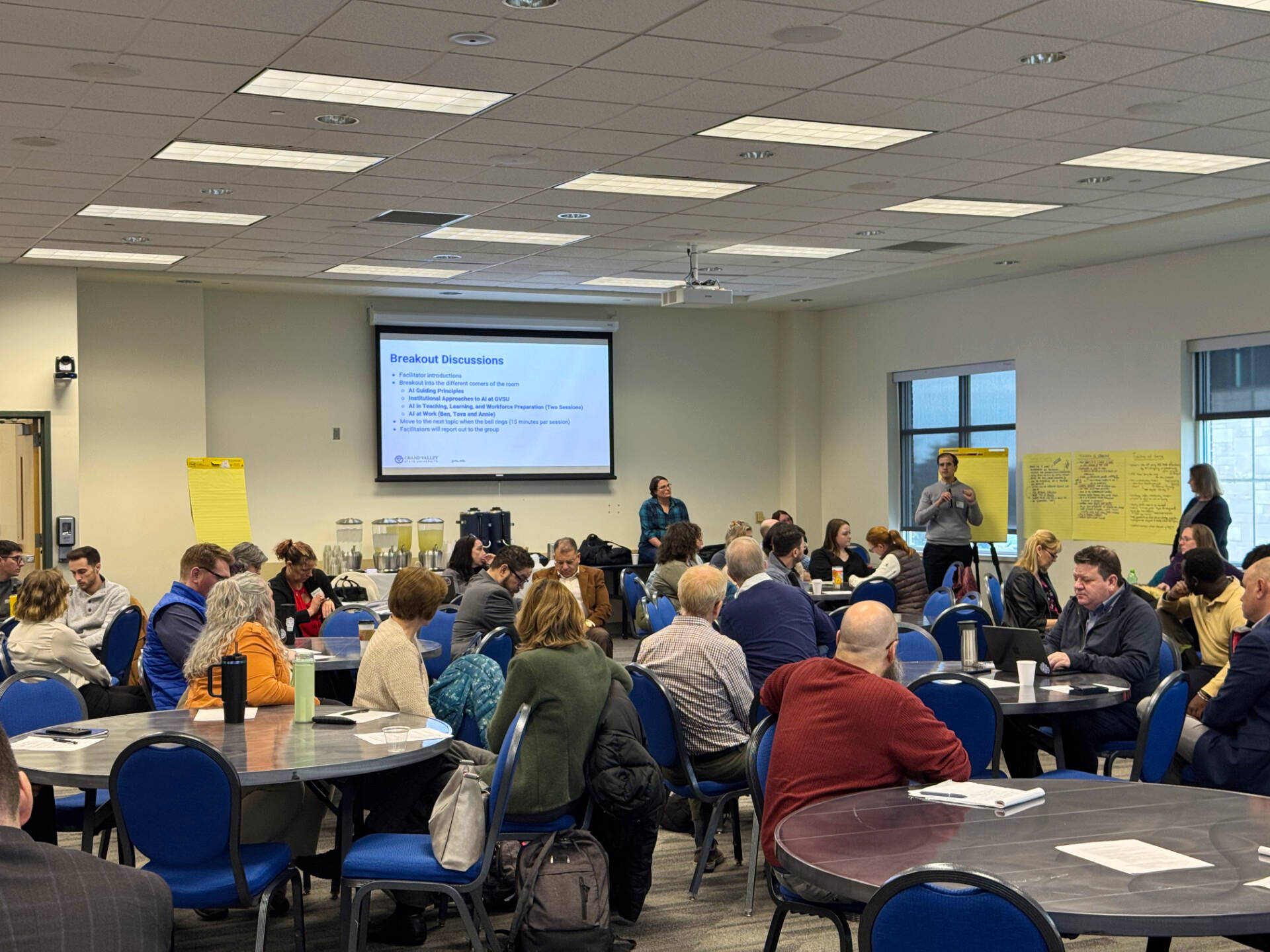
There was one event on each of the City and Valley campuses, and in total more than 150 faculty and staff participated. Participants took part in small group conversations that focused on four areas of AI. The discussions were open, honest, and thought-provoking. Those discussions suggest that GVSU’s opportunity is not simply to adopt AI, but to lead with a human-centered vision, leveraging faculty expertise, liberal education strengths, and community engagement to shape how AI advances student success, institutional effectiveness, and public trust.
Here is a more detailed summary of each of those discussion areas.
AI Guiding Principles
Across both town halls, participants emphasized the need for AI use at GVSU to be grounded in responsibility, trust, and human-centered values. Core themes included protecting student data and intellectual property through closed or “walled” systems, maintaining transparency about AI use, and ensuring humans remain accountable for outcomes rather than deferring decision-making to technology.
Participants highlighted tensions between efficiency and learning, warning against cognitive atrophy, loss of creativity, and overreliance on automated outputs. At the same time, AI literacy, workforce preparation, and institutional leadership were viewed as major opportunities.
These groups consistently called for adaptable guiding principles, rather than rigid methods, that evolve alongside rapidly changing technologies while balancing innovation, sustainability, ethical stewardship, and disciplinary differences.
Institutional Approaches to AI at GVSU
Discussion centered on moving from fragmented experimentation toward a coordinated institutional strategy. Participants acknowledged that GVSU already has numerous AI tools, pilots, and learning opportunities in place, but these efforts remain siloed and aren’t completely understood or clearly communicated across campus.
Key priorities included centralized governance, clear student and employee guidelines, expanded training programs, vetted tools and prompt libraries, and greater institutional support for enterprise-level platforms. Participants stressed the need for transparency around privacy, environmental impact, and cost-benefit decision-making, alongside a stronger “human-first” institutional philosophy.
A recurring theme was the desire for shared infrastructure, such as an AI help desk, curated tool ecosystem, and interdisciplinary collaboration, to align practice, policy, and culture while positioning the university as proactive rather than reactive in responding to AI advancement.
AI at Work
Conversations about operational use focused heavily on AI as a tool for efficiency, automation, and decision support across administrative and professional roles. Common uses included drafting and editing communications, summarizing meetings, analyzing contracts and reports, managing data, improving advising insights, automating outreach, and supporting scheduling or workflow management.
While the group agreed that AI expands institutional capacity, participants expressed concerns about data privacy, reliability, AI hallucinations, compliance with FERPA and FOIA, and uncertainty around approved tools. Employees requested clearer rubrics for responsible use, expanded access to enterprise solutions, and flexible, role-specific training. Some described AI as functioning like a junior staff member or assistant, reinforcing the need for human oversight, shared best practices, and improved internal communication to avoid duplication and fragmented adoption.
AI in Teaching, Learning, and Workforce Preparation
Group discussions reflected both optimism and caution about AI’s impact on learning. Participants agreed that universities must prepare students for AI-enabled workplaces while preserving critical thinking, creativity, authorship, and academic integrity. Key themes included defining baseline AI literacy expectations, embedding digital literacy across the curriculum, redesigning assignments to emphasize process over product, preserving academic integrity, and helping students critically evaluate AI outputs rather than simply generating answers. Differences across disciplines, student learning outcomes, and learning modalities were highlighted, along with equity and access concerns.
Participants emphasized that AI should function as a learning companion and is not a replacement for intellectual development, and called for scaffolded instruction, ethical guidance, and clear guardrails to help students develop judgment, responsible use habits, and durable human skills alongside technological fluency.