News from Grand Valley State University
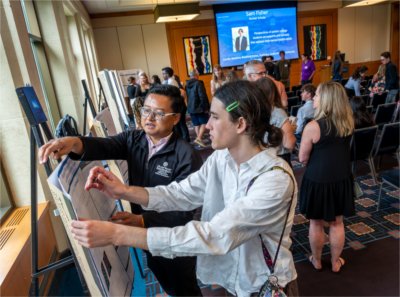
Students prepare their poster presentations before the start of the Summer Scholars Showcase.

Students unveil research projects at Summer Scholars Showcase

After a summer of discovery and learning, more than 50 undergraduate and graduate students displayed their research during the Summer Scholars Showcase on July 25 at the L. William Seidman Center on the Pew Grand Rapids Campus.

Over several weeks, the students collaborated closely with faculty mentors, engaging in academic exploration and data analysis. At the Showcase, they shared their findings with the GVSU community.

“These presentations represent the intersection of learning and doing and represent the hard work of asking big questions and pursuing thoughtful and often complex answers,” said Jennifer Drake, provost and executive vice president of Academic Affairs. “They also demonstrate the development of essential skills and habits of mind that will endure long after a project ends.

“Perhaps most importantly, engaging in research scholarship and creative activity helps students see themselves as creators of knowledge, not just consumers of it.”
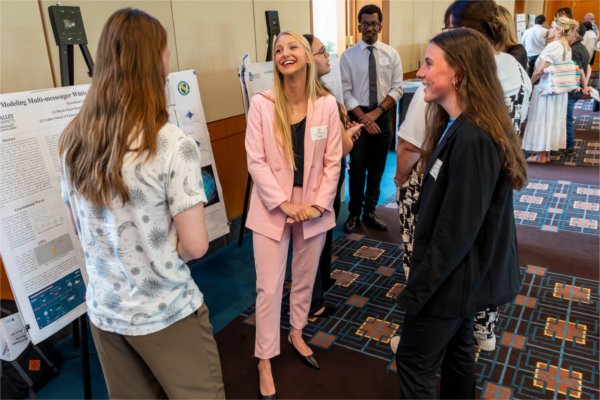
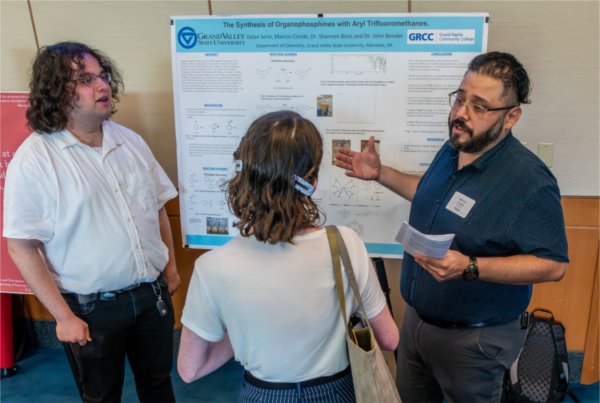
A student discusses her research with peers during the Summer Scholars Showcase.
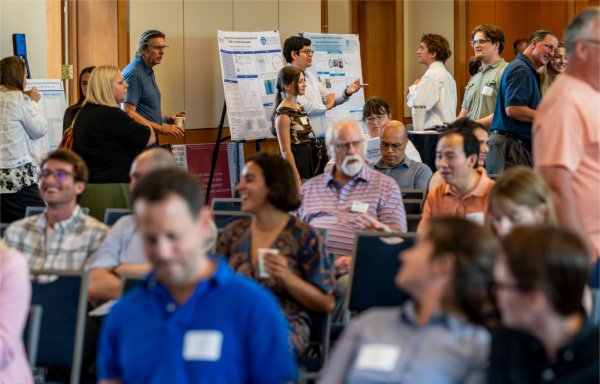
Guest settle into their seats while students discuss their research with visitors prior to the start of the Student Scholar Showcase.

The following profiles highlight students who participated in this year's Summer Scholars Showcase and shared insights from their research experiences.

Whether in the lab, the library or the community, these students represent a collective that embodies the curiosity, creativity and dedication that drive discovery and innovation.

"At Grand Valley, we believe that research scholarship and creative activity are not separate from a great education; they are essential to it," Drake said.

Ava Politi

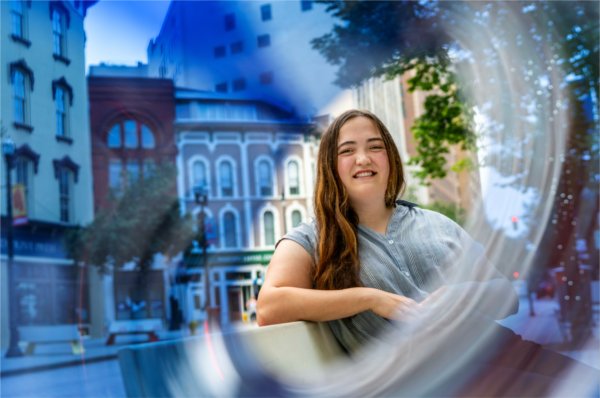
GVSU student Ava Politi poses for a photo in downtown Grand Rapids.
Image credit - Cory Morse

This summer, Ava Politi has been immersed in the history of Grand Rapids, specifically its retail history. 

Politi, a history major, has been working with her faculty mentor, Matthew Daley, to get a better understanding on how the city’s urban renewal projects of the 1960s led to the transformative 1970s and how those projects continue to affect downtown Grand Rapids and its nearby suburbs.

“I’ve previously taken courses before with professor Daley that focused on Grand Rapids, but never a full-out research project like this,” Politi said.

“I’ve loved history since I was in elementary school and for the longest time, only saw myself as going into teaching, until I was introduced to an internship in the summer of 2024 at the Grand Rapids City Archives that opened so many new doors for what I could do with my degree and love for history.”

Politi has been pouring over countless documents and spending hundreds of hours in archival research, examining the retail industry’s migration from downtown Grand Rapids to surrounding neighborhoods, particularly along the Wealthy Street area. 

“This project is very local, with it being all centered in Grand Rapids, which has given me a great opportunity to explore these spaces and go to the exact source of the information I am seeking,” Politi said. 

Ale Brenes and Sawyer Crum

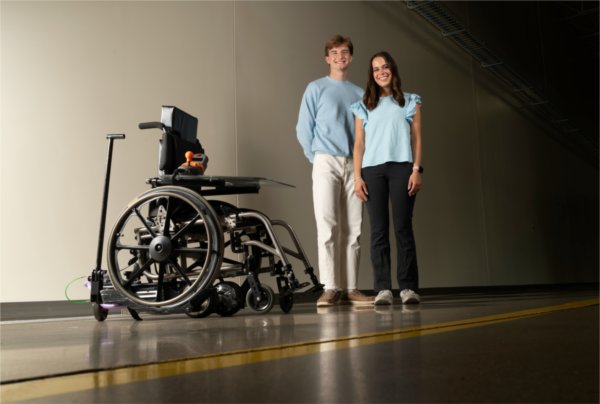
Sawyer Crum, left, and Ale Brenes have partnered on a clinical trial working with children in wheelchairs.
Image credit - Cory Morse

Despite their different majors, juniors Brenes and Crum have united on a project, thanks to the research of their faculty mentor, Lisa Kenyon. 

Brenes, an allied health sciences major, and Crum, a clinical exercise science major, are collaborating on a clinical trial aimed at helping children with cerebral palsy become comfortable using powered wheelchairs. The study is funded by the National Institutes of Health.

Brenes and Crum worked with five of the 16 children participating in the study whose ages ranged from 5 to 17 years old. The pair met with each child, twice a week for hour-long sessions.  

“We educate them on how to use powered wheelchairs through structured intervention and retesting sessions,” Brenes said. 

An adapter called the “IndieTrainer,” is attached at the base of the child’s manual wheelchair, converting it into a powered one. The child can then maneuver the wheelchair via a joystick.

Headquartered in Kenyon’s lab in GVSU’s Innovation Design Center on the City Campus, Brenes and Crum assist Kenyon in utilizing games and personalized tasks to help each child build familiarity and increase their mobility skills with the powered chair’s capabilities. 

“We’ll play games with them and ask, ‘Oh, what’s that over there,’ so that they learn that they are moving themselves to see what they can do with the chair,” Brenes said. 

“It’s trying to empower and show them that they have autonomy to do what they want when they’re in this power wheelchair. We don’t want them to be dependent on us.”

The ultimate goal is for the child to build enough independence so that they qualify to receive their own powered wheelchair. The pair have already seen gains in their work, Crum said.

“Hearing from Dr. Kenyon, there's definitely been a lot of success with it,” Crum said. “At the very least, they are seeing statistically significant changes in the child's ability to drive.”

Marcos Conde and Dylan Serie

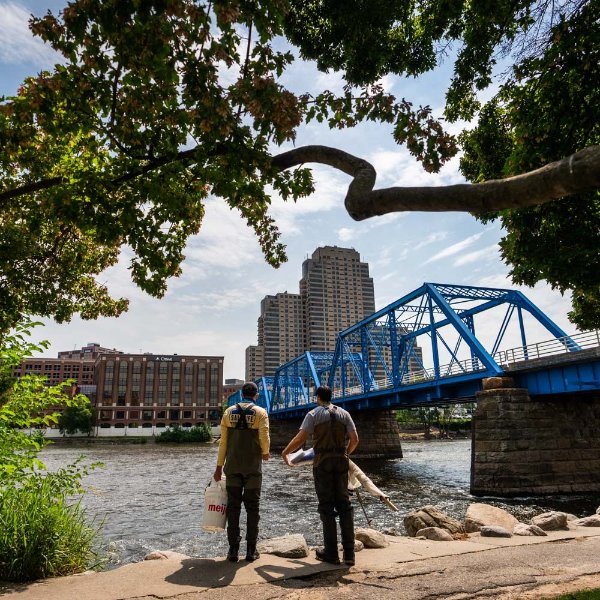
Marcos Conde, right, and Dylan Serie's research focused on the purification and recycling of rare metals.
Image credit - Cory Morse

A bridge program between GVSU and Grand Rapids Community College is providing valuable experience for two GRCC students under the mentorship of a GVSU faculty member.

Serie, a chemistry major, and Conde, a biochemistry major, are working with chemistry professor John Bender and studying rare metals in his lab. Serie and Conde said they employ chemical compounds called phosphine oxides to extract, separate and purify these metals. 

The pair explained that these rare metals play a crucial role in the production of electronics such as cell phones. With global demand and competition on the rise, they emphasized the importance of developing domestic sources rather than relying on foreign imports.

“All of these metals that we're working with have applications in quantum computing, electronics,” Serie said. “So it's better to have as much of the material as we can, instead of having to try and send people out to get it.”

Their work also touches on broader sustainability issues, especially as the global proliferation of electronics leads to increased waste.

“It’s very exciting,” Conde said. “In today's scientific climate, we are starting to minimize a lot of purchasing of certain things from outside of the country. To develop within the country is a big deal right now, especially for chemistry.”

For Conde, the research experience has been life-altering for him and his educational journey. In his mid-40s, Conde enrolled at GRCC after 18 years in Grand Rapids’ restaurant industry. 

Conde, who said he’ll be transferring to Grand Valley to pursue his bachelor’s degree, said his research has sparked a new passion and purpose. 

“One of the biggest rewarding things is that I can tell my friends and family, or anyone that's interested in chemistry, that it isn’t about age anymore,” he said. “Colleges want people to go in and get your education. You never have to throw in the towel.” 

Subscribe

Sign up and receive the latest Grand Valley headlines delivered to your email inbox each morning.