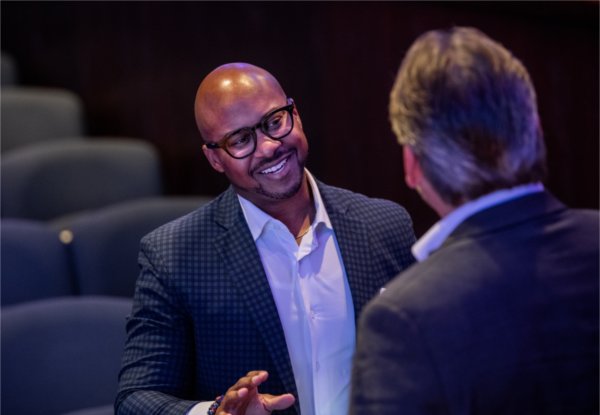
Rodney Robinson with Dell Technologies explained how
Dell’s AI and digital assistants are improving learning outcomes in
higher education and assisting faculty in building engaging curriculum.
Robinson said higher education needs to adapt to the
variety of students attending classes, and AI can help faculty and
administrators. AI can provide personalized virtual tutoring,
automated grading and feedback, predictive analysis for success and
AI chatbots for administration, Robinson said.
“Gen AI isn't just a set of tools,” Robinson said.
“It's a force multiplier for student success, administrative
efficiency and innovative research. As AI becomes central to higher
education, those who embrace its potential will lead the next
generation of academic excellence.”
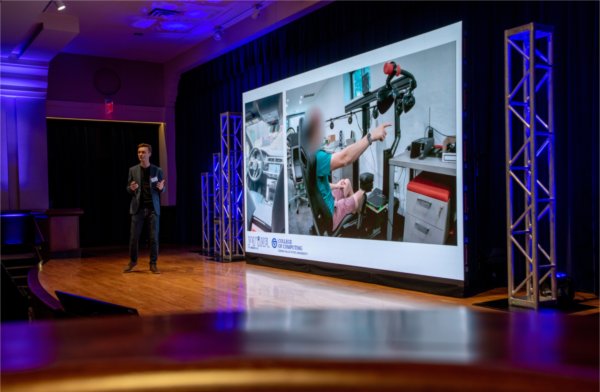
Paul Fink, assistant professor in the College of
Computing, closed the event by showcasing his projects and how AI
can be utilizied for people with disabilities.
Fink said autonomous vehicles can provide independence,
freedom and autonomy for people with disabilities.
He’s currently researching methods to
increase engagement for blind or low-vision people
.
“One of the projects that I've been working on in the
last few years has been how to enable more salient audio information
throughout the trip with autonomous vehicles,” Fink said.
Fink’s research would enable a passenger in an
autonomous vehicle to gesture through hand or arm signals and elicit
audio-based information from the vehicle, such as alternative routes
or nearby points of interest.
“Designing technology for people with disabilities is
not just something that's going to benefit them, it's the kind of
technology that's gonna be beneficial to all of us,” Fink said.
“If we continue to think about those new sensory
pathways, we're going to be able to revolutionize and drive
innovation for all of the technology that we use.”