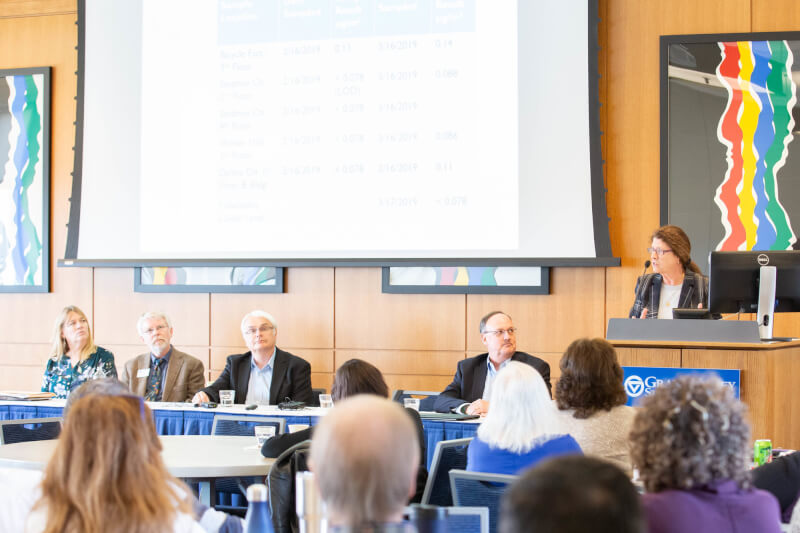
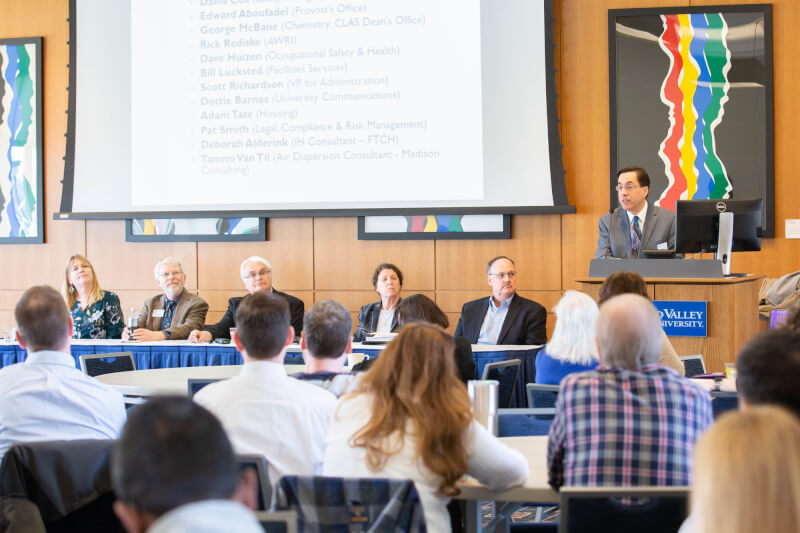
Grand Valley experts told the audience at a March 29 meeting that
results from indoor air quality tests at select buildings on the Pew
Grand Rapids Campus were found to be safe.
The meeting was held in the L. William Seidman Center to share the
test results and information regarding an MDEQ study of emissions of
ethylene oxide from Viant Medical, Inc. in Grand Rapids.
Grand Valley hired an independent company, Fishbeck, Thompson, Carr
& Huber, Inc., to test the indoor air quality in the L. William
Seidman Center, The Bicycle Factory, the DeVos Center, and Winter
Hall, which are all located near the Viant facility.
Officials said measured results from testing on February 16 were low
and considered to be in the safe range. Grand Valley scheduled
additional testing March 16 which verified the initial results.
See
additional information here.
Panelists at the meeting included Grand Valley experts Dave Huizen,
occupational health and safety program director; George McBane,
professor of chemistry; and Rick Rediske, professor and researcher at
the Annis Water Resources Institute.
They said the results were "very low, either below or just
above the detection limit."
They said based on all of the sampling information, as well as the
results of two sets of modeling, all the risk levels for Grand Valley
employees and students using the most conservative model
for estimating total cancer risk are less than the risk threshold for
public health intervention.
Grand Valley experts said they agree with the MDEQ that the measured
and modeled concentrations do not pose a short-term health concern to
faculty and students at the Pew Grand Rapids Campus, and the
additional lifetime cancer risk, while not zero, is too small to
warrant concern.
They said it is highly unlikely that even one GVSU person will
contract cancer because of ethylene oxide from Viant.
Other panelists included Deb Alderink, occupational safety and health
manager with Fishbeck, Thompson, Carr & Huber, Inc., and Tammi
VanTil, air dispersion consultant and president of Madison
Consulting. Ed Aboufadel, assistant vice president for Academic
Affairs at Grand Valley, served as moderator.