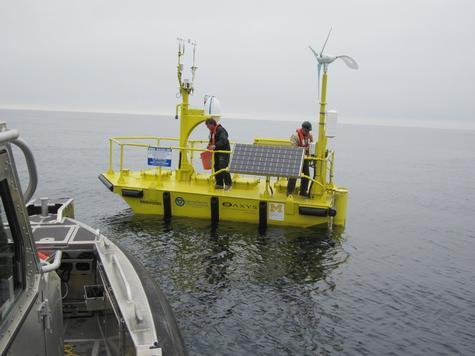
Grand Valley wind research buoy ready for mid-lake challenge
May 7, 2012


The research buoy that is collecting data for Grand Valley State
University’s offshore wind assessment was placed 35 miles offshore of
Lake Michigan May 7, where it remain until December. The buoy will
continuously collect data about offshore wind characteristics, along
with meteorological, marine and avian data, to help assess the
viability of commercial-scale wind energy generation in the Great
Lakes.
The buoy can now collect wind measurements up to 175 meters
high, which is the same height as next-generation wind turbines
currently being marketed, said Arn Boezaart, director of Grand
Valley’s Michigan Alternative and Renewable Energy Center. “The data
collected with have considerable ‘shelf life’ value for research
purposes,” he said. “Using a floating research platform to collect
wind measurements that high up has never been done before on the Great
Lakes or in North America. This is also the first time a research buoy
of this type will operate this far offshore. Project supporters across
North America are eagerly waiting for the research results.”
Researchers have not had this kind of real-time field data
before, said Jim Edmonson, project manager of the study. He said the
measurements will be especially interesting because the mid-lake
plateau, where the buoy was placed, is expected to have very high wind
energy potential. “It will continue to give manufacturers of the buoy
the opportunity to push the limits of the technology for our benefit,
to obtain even more valuable data,” he said.
Boezaart said data retrieval from the buoy will take place
mainly by satellite due to its remote location. “We’ll physically
visit the buoy site every 30-45 days to collect data from the computer
data cards, which will be processed by Grand Valley researchers in our
School of Engineering and passed on to researchers in other areas,” he
said.
As part of the six-hour trip to its stationary location on the
lake, a lake bottom survey was completed to inspect the location where
the five-ton anchor was dropped and to comply with regulatory requirements.
About the wind assessment project
The primary objective of the Lake Michigan offshore wind
assessment project is to gain a better understanding of offshore wind
characteristics and dynamics, as well as potential wind energy. Other
related physical, biological and environmental characteristics related
to Great Lakes wind will be evaluated, including water quality
characteristics, the water and air boundary layer, and bird and bat
activity. Data collected will be used by NOAA’s National Weather
Service in preparation of its marine forecasts.
About the WindSentinel research buoy
The research buoy, one of two such research platforms in the
world, is an six-ton, 20-by-10 foot boat-shaped structure that can
measure wind characteristics up to 175 meters above the water using
advanced laser pulse and Doppler wind sensing technology in remote
locations. It was constructed by AXYS Technologies of British
Columbia, and is equipped with a Vindicator laser wind sensor
manufactured by Catch the Wind Inc. of Virginia.
Learn more about the Lake Michigan offshore wind assessment at
www.gvsu.edu/marec and
follow its progress on MAREC’s Facebook
page and Twitter account.
AUDIO:
Arn Boezaart said this is the first time real-time results of this type will be collected (audio)
Boezaart said computers on the buoy are collecting data in one-second increments (audio)
Boezaart said scientists will take a look at the fish species in
the area near the buoy (audio)
Subscribe
Sign up and receive the latest Grand Valley headlines delivered to your email inbox each morning.