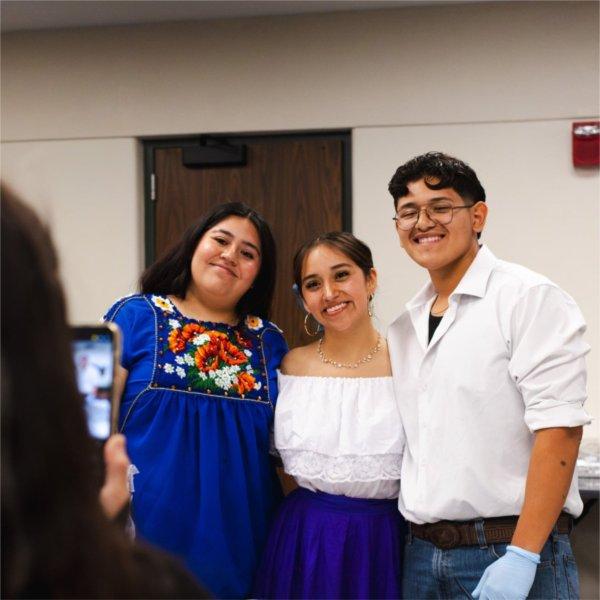
Students in an innovative philosophy class develop their own
courses in the humanities, and then teach them at a prison, a
job-training agency for disadvantaged youth, and a rehab center. They
learn much more than they teach, the students say. Most significantly,
they learn lifelong lessons about democracy, says their professor.
The course at Grand Valley State University has recently
garnered national attention. Community Working Classics, offered
through the GVSU Philosophy Department, was awarded the 2002 prize for
Excellence and Innovation in Philosophy Programs by the American
Philosophical Association and the Philosophy Documentation Center. The
program is now considered a model for universities and organizations
nationwide. (See www.apa.udel.edu/apa, under prizes and awards.)
GVSU Philosophy Professor Michael DeWilde began the Community
Working Classics (CWC) class in 1998 inspired in part by the work of
educator Earl Shorris, who documented his experiences teaching the
humanities to the Manhattan poor in his 1997 book, New American
Blues. The basic idea was to take philosophy and other humanities
subjects ¿ literature, ethics, art, and history, to name a few ¿ out
of the classroom and into the harsh light of the real world. How would
grand but abstract concepts ¿ justice, opportunity, equality ¿ stand
up when discussed with prison inmates ¿ or recovering addicts ¿ or
street people?
In the last four years, Grand Valley's CWC students have offered
humanities classes to more than 200 people in the community. This year
DeWilde and his students are teaching classes at Muskegon Correctional
Facility, Grand Rapids Job Corps, a residential job-training facility
for disadvantaged youth, and Project Rehab, a substance-abuse
treatment facility in Grand Rapids, Mich.
'We try to offer the humanities to people in places who would
not otherwise receive them,' said Ieisha Caddle, 22, a sociology
senior who taught a philosophy of law class to prison inmates. 'We
have this idea that when people are taught the humanities, they become
more humane, and the world we live in can become better.'
DeWilde describes CWC as a kind of 'trial by fire' that
persuades students to stretch themselves, test what they're learning,
and become active participants in their education and community. 'They
are responsible for not only the content, but the dynamics of the
class, and they rise to the challenge and find resources they didn't
know they had,' DeWilde said.
At the heart of the program is the value of a liberal arts
education that prepares students to be educated and active citizens ¿
a concept that gets lost in today's emphasis on career-building,
DeWilde said. He describes the CWC experience, which compels students
to develop community organizing skills, as 'education for democracy'
that they will always have with them.
'It's messy, but I think students get a larger sense of their
own place, and perhaps their own power,' he said. 'The highest goal is
to have both Grand Valley students and the community students and
inmates be better, more informed citizens and act as full participants
in their community.'
DeWilde said that he has heard from Grand Valley students and
community students that their experience with Community Working
Classics has been life changing. One woman, a former prostitute who
participated in a class taught at an inner-city agency, reported
afterwards that she had enrolled in college. Another, an inmate at
Muskegon Correctional Facility, said that he cannot stop reading and
thinking about the classes he has taken.
Caddle, of Holland, Mich., said that she wishes every college
student could sit in her prison class and experience the dynamic
exchange of ideas. 'I think I learned more from them than they learned
from me, hands down,' Caddle said of the inmates.
Grand Valley students are teaching classes in the community now
through March 2003. Call one of the contact numbers listed for more
information or to arrange a site visit.
DeWilde will accept the American Philosophical Association award
in March 2003. Previous winners include Montclair State University
(N.J.), University of Nevada-Las Vegas, and Trinity College (Hartford, Conn.).
Philosophy program recognized nationally
Feb 19, 2011


Subscribe
Sign up and receive the latest Grand Valley headlines delivered to your email inbox each morning.