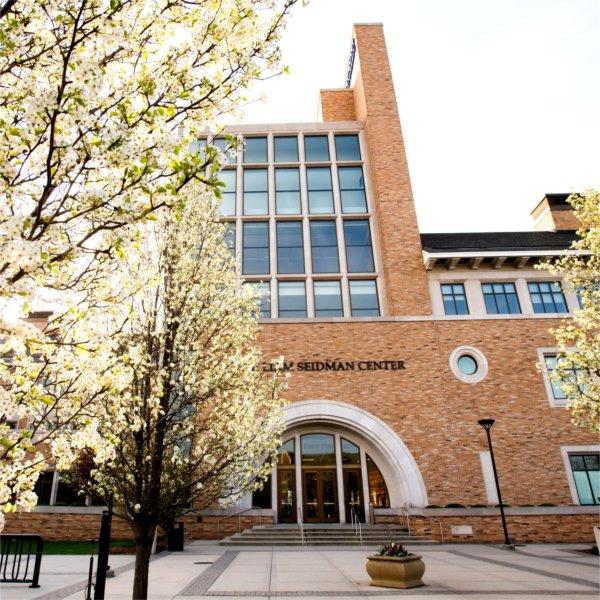
Grand Valley State University's Niemeyer Learning and Living Center has
been awarded LEED Silver certification from the U.S. Green Building Council.
The announcement comes quickly on the heels of the announcement that
Grand Valley's Indoor Turf Building earned LEED Gold certification from
the USGBC.
LEED — which stands for Leadership in Energy and Environmental Design —
is an internationally recognized certification system that certifies
environmentally sustainable construction projects. The process considers
factors like building location, water and energy use, indoor air quality
and building design.
The turf building is the second Grand Valley building to be awarded the
coveted LEED Gold certification. The first was the Michigan Alternative
and Renewable Energy Center in Muskegon, it was considered a
cutting-edge view toward a greener future. It was Grand Valley's first
building to receive the coveted LEED certification from the USGBC.
The Glenn A. Niemeyer Learning and Living Center is home to the Frederik
Meijer Honors College and features 187,000 square feet of residential
space and 41,000 square feet of academic space. It is a state-of-the-art
facility that helps the college’s mission of providing a challenging
interdisciplinary liberal education and living/learning environment that
prepares students to be intellectually curious, life-long learners and
leaders in their communities. The new center has living space for some
450 students, a 70-seat case room, multi-purpose room, science
demonstration lab, listening room, library/reading room and two LearnLab
classrooms. There are also 16 faculty, staff and clerical offices.
The center is designed to meet the U.S. Green Building Council’s LEED
standards, which call for high performance and sustainability by
maintaining standards for water and energy conservation, material
selection and indoor environmental quality. James Moyer, Grand Valley’s
assistant vice president for Facilities Planning, said the building goes
a long way in improving Grand Valley’s commitment to sustainability with
the use of eight rain gardens, green roofs and an infiltration system.
The site consumes 60 percent of stormwater runoff, and the lighting
system includes occupancy sensors, daylight harvest sensors, scheduled
light controls and multi-level switching. The apartments have Energy
Star appliances and the laundry rooms have high-efficiency washers and dryers.
The facility also has low-flow faucets and showerheads, dual flush
toilets and waterless urinals, which reduce water consumption by 37
percent — 1.4 million gallons per year.
The construction of the facility was also eco-friendly. Wherever
possible, the materials used in the building’s construction were locally
manufactured and made of recycled materials. Much of the construction
waste was recycled.
Now, the university has 15 structures that either have been LEED
certified or are in various stages of the process of being certified —
visible signs of Grand Valley's commitment to making its operations
greener and more sustainable. In addition, an application has been filed
to have the entire Allendale Campus LEED certified.
The proliferation of LEED buildings at Grand Valley is part of a
university-wide commitment to environmental, economic and social
sustainability — a trio of factors commonly referred to as the
"triple bottom line." Thus, achieving LEED certification isn't
the end of the work, it's the beginning, said Moyer. The university is
looking at amount of use rather than simply cost of utilities and other
resources.
"You can't control the unit cost of what you buy, but you can
control how much you buy, and we're always looking at ways to buy
less," he said.
Moyer added that each year, as more energy-saving projects come on-line,
related utility budgets are reduced to reflect those savings. "This
recovery of funding helps maintain a focus on the consumption
factor," he added.
The university's Michigan Alternative and Renewable Energy Center in
Muskegon and Laker Turf Building in Allendale are certified LEED Gold;
Allendale's Lake Ontario Hall is also LEED Silver. Grand Rapids' John C.
Kennedy Hall of Engineering is LEED certified, as is a renovation of the
lower floor of Allendale's Mackinac Hall and addition to the Kirkhof
Center. Also certified LEED Silver is the Green House on Watson, a
single-family home that was built as a demonstration project in
partnership with the Padnos College of Engineering and Computing.
An applications have been filed and certification is pending for and
expansion to Mackinac Hall. Applications will be filed for the recently
completed Bicycle Factory, the soon-to-be-built Housing 2010 and
Learning/Dining 2010 projects and planned new library, named the Mary
Idema Pew Learning and Information Commons.
Grand Valley has been recognized nationally for its sustainability
efforts and was the only Michigan school cited in Kaplan College Guide
2009's list of "cutting-edge green" colleges and universities.
The university was the recipient of the USGBC’s 2008 Recognition Award
and the Sustainable Endowments Institute’s 2008 National Sustainability
Innovator Award. Grand Valley’s Mark A. Murray Living Center was given
an Energy Star designation from the U.S. Environmental Protection Agency
— the first university student housing unit in Michigan to receive such
a designation.
Construction of the Niemeyer Living Center and Honors Hall was managed
and completed by Pioneer Construction, a West Michigan-based
construction company that has partnered with Grand Valley on several
high-visibility and LEED certified University properties, including Lake
Ontario Hall and the John C. Kennedy Hall of Engineering, among other buildings.
Grand Valley Honors College building LEED certified
Jul 22, 2009


Subscribe
Sign up and receive the latest Grand Valley headlines delivered to your email inbox each morning.