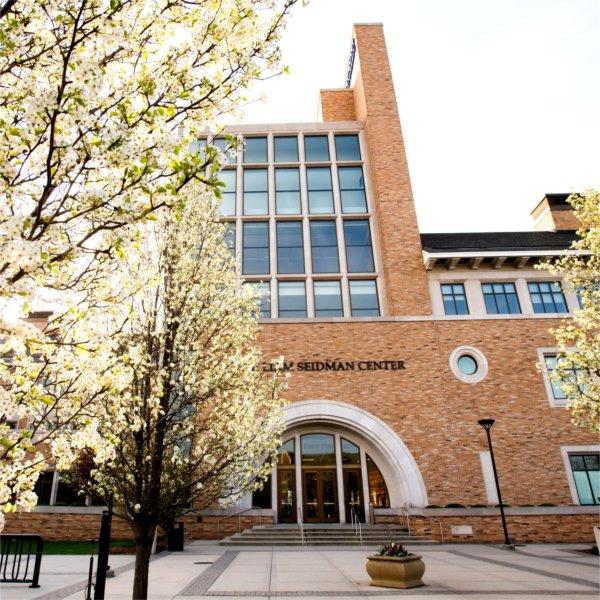
Welcome to Grand Valley’s Cook-DeVos Center for Health Sciences. We are honored to have you with us today, and pleased for the chance to exchange views with you about the state’s support for higher education.
CHS was planned in a way that allows us to put all of our health programs — nursing, physical therapy, occupational therapy, physician’s assistant, and biomedical sciences — under one roof. What makes CHS unique is that this building was built on Medical Mile, near Spectrum Health and the Van Andel Research Institute, organizations with which we have important collaborative relationships. MSU’s College of Human Medicine will join the neighborhood soon, complementing St. Mary’s, Metro Health, and Mary Free Bed hospitals. Together, our organizations cement Grand Rapids as a destination city for high quality medical education and superior medical care.
This is also a great building for our students, who complete their studies on a hospital and research campus. This makes them highly prized by employers. This year more than 5,000 of our 23,500 students are enrolled in one of the health sciences, making Grand Valley Michigan’s #1 provider of health care professionals. The collaboration that produced this building — with the state, the university, and our donors as partners — shows the Capital Outlay process at its best.
Just a few blocks from here is Grand Valley’s Pew Grand Rapids Campus, home to the John Kennedy Hall of Engineering. This new lab and classroom building is allowing us to double enrollment in our engineering and computer science programs.
Why am I starting my testimony with comments about facilities? It’s a one-word answer: jobs. And these jobs require a college education. Grand Valley prepares its graduates for high paying jobs in professions that are hiring, right here in Michigan. Yes, Michigan. Don’t believe everything you hear about the economy. The statistics for our most recent graduating class are compelling: 97% are working or in graduate school. Of those working, 88% are pursuing their careers in Michigan – careers in high skilled, high paid occupations. And, remember that 95% of our students are Michigan residents. More than a third come from east Michigan, with large percentages from Wayne, Oakland and Macomb counties. Grand Valley is no longer a regional school. Our impact is statewide.
At times like this, I am tempted to brag about Grand Valley’s academic quality, and its value, especially for students struggling to pay tuition. Our tuition is 3rd lowest in Michigan. And our student profile is among the state’s best. I am very proud of the quality we deliver for the price we charge.
Because 82% of all university revenue comes from students and their families, and I think we provide them a great return on their investment. This morning I gave each of you a copy of our Accountability Report, which measures Grand Valley’s performance in 35 separate categories, and compares our results to those of other Michigan schools, as well as to national averages. Measuring outcomes, as we have done, provides the right backdrop for discussing the state’s role in supporting public higher education.
Yet because state funding does not follow outcomes, Grand Valley continues to be penalized by agreeing with the Cherry Commission’s plea to admit additional students knowing — as do we all — that Michigan will grow only with a better educated work force.
Unfortunately, other states are racing past Michigan in this regard. To compete in the 21st century economy, we must meet or beat them. Yet, Michigan is last among the 50 states when measuring recent state investment in higher education. I believe that a college degree is a public good, a public good that requires maintenance of effort by the state. Maintenance of effort means lower tuition. A continued slide in support means higher tuition.
This year, I want to commend the Governor for proposing a 3% increase in higher education funding. She has also proposed a formula and a policy direction that holds out the promise of consistency. Remember, it takes 4 years to make nurses, engineers, and math teachers. So, if state government is going to incent for result, the incentives need to stay in place for at least that long.
Whatever you do, be it an across the board inflationary increase or a formula, make your plan as predictable, dependable, and sustainable as you can. And it must be rational. Floor funding and counting changes in enrollment must be part of any recurring formula. Should you adopt a formula that doesn’t count enrollment, Grand Valley will have less funding per student next year. Just like this year. And just like last year. For a state government that encourages more high school students to go to college, this is an unwelcome development.
As I finish my comments I would like to start the discussion by posing a question of my own: please tell us what you expect of Grand Valley. I hope it’s what we’ve been doing: accessible and affordable for new students, delivering high quality and relevant academic programs, graduating students who stay in Michigan, contributing to the economic development of our state and running efficient operations. But if it’s not, this morning would be a great time to start that discussion so that together we can prioritize and invest in the future of Michigan.
Thank you.